Russia rejects compensation to Georgia over 2008 war

Russia rejects compensation to Georgia over 2008 war
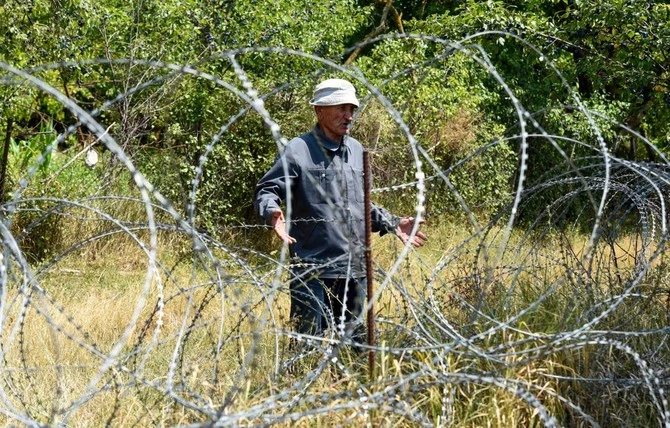
Russia will not comply with a European court ruling ordering it to pay Georgia almost $300 million for violations it has allegedly committed since their 2008 war, the Kremlin said Wednesday. (AFP/File)
Short Url
Updated 15 October 2025
Follow

Russia rejects compensation to Georgia over 2008 war

Russia rejects compensation to Georgia over 2008 war
  • ECHR upheld Georgia’s complaints, ordering Moscow to pay just over $292m in compensation
  • “We will not comply with the ruling,” Kremlin spokesman Dmitry Peskov said

MOSCOW: Russia will not comply with a European court ruling ordering it to pay Georgia almost $300 million for violations it has allegedly committed since their 2008 war, the Kremlin said Wednesday.
Russia invaded Georgia in 2008 after Tbilisi launched a surprise offensive against pro-Moscow separatist forces that it said were shelling Georgian villages.
Since then, it has occupied areas of northern and western Georgia comprising almost one-fifth of the country and installed puppet governments that have prevented the return of ethnic Georgian citizens, according to Tbilisi.
It has also blocked the teaching of Georgian in schools, Georgia says.
On Tuesday, the European Court of Human Rights (ECHR) upheld Georgia’s complaints, ordering Moscow to pay just over 253 million euros ($292 million) in compensation.
“We will not comply with the ruling,” Kremlin spokesman Dmitry Peskov said.
Moscow quit the Council of Europe, of which the ECHR is part, following its 2022 offensive on Ukraine but the court says it remains liable for violations committed before then.
Moscow has repeatedly ignored ECHR rulings, including while it was still a member of the Council of Europe.
Georgia formally cut diplomatic relations with Russia in the wake of their 2008 war, but has taken informal steps to improve ties in recent years — a process that Georgia’s opposition has heavily criticized.
When asked on Wednesday whether the non-payment of the fine would affect the diplomatic thaw, Peskov said it was a “separate matter.”
Moscow recognizes the breakaway Georgian regions of Abkhazia and South Ossetia as independent, while most of the world recognizes them as Georgian territory.


Dutch court dismisses appeal seeking to halt weapons exports to Israel

Dutch court dismisses appeal seeking to halt weapons exports to Israel
Updated 53 min 53 sec ago
Follow

Dutch court dismisses appeal seeking to halt weapons exports to Israel

Dutch court dismisses appeal seeking to halt weapons exports to Israel
  • The group of 10 NGOs were hoping the lawsuit would force the Dutch to stop sending weapons and trained police dogs to Israel
  • The Dutch government denied it is in violation of the 1948 Genocide Convention

THE HAGUE: A Dutch appeals court on Thursday dismissed an appeal by a group of human rights organizations that filed a lawsuit arguing the Netherlands was violating international law by continuing to sell weapons to Israel.
The Hague Court of Appeal found that although “there is a serious risk that Israel will commit genocide against the Palestinian population in Gaza,” the Dutch government has “considerable discretion” to determine foreign policy and issues of national security.
The group of 10 NGOs were hoping the lawsuit would force the Dutch to stop sending weapons and trained police dogs to Israel and cut economic ties with businesses operating in occupied Palestinian territory.
The activist groups pointed to several emergency orders from another court, the International Court of Justice, that they say confirmed the obligation to stop weapons sales. In January, the top UN court said it was plausible Palestinians were being deprived of some rights protected under the Genocide Convention.
A lower court ruled last year that there were sufficient checks already in place to comply with international law. In Thursday’s decision, the court noted that the government had already taken a number of measures, including stopping the exports of some products.
The Dutch government denied it is in violation of the 1948 Genocide Convention, drawn up following World War II. “Every cooperation is cautiously weighed,” government lawyer Reimer Veldhuis said during a hearing last year.
That hearing was held the day after another judicial institution in The Hague, the International Criminal Court, issued arrest warrants for Israeli Prime Minister Benjamin Netanyahu and his former defense chief for alleged war crimes in Gaza.
Netanyahu strongly denies the accusation.
Judges had postponed Thursday’s decision until after the Dutch Supreme Court ruled in a separate case on the export of fighter jet parts to Israel.
Human rights groups filed suit in 2023 to halt the export of F-35 fighter jet parts to Israel, citing a clear risk of violations of international law if they are used in strikes on Gaza.
Last month the Supreme Court ordered the Dutch government to reevaluate its currently suspended license. Foreign Minister David van Weel said at the time that it was unlikely that exports would resume “given the current situation” in Gaza.
A fragile US-brokered ceasefire aims to wind down the war that was triggered by the Hamas-led attack on southern Israel that killed about 1,200 people and saw 251 taken hostage on Oct. 7, 2023.
Israel responded with a sweeping military offensive that has killed more than 68,800 Palestinians in Gaza, according to Gaza’s Health Ministry. The ministry, part of the Hamas-run government and staffed by medical professionals, maintains detailed records viewed as generally reliable by independent experts.