
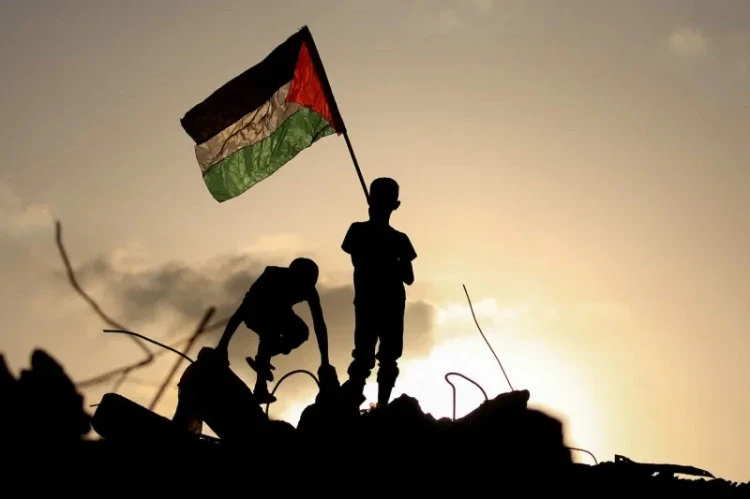

More than 1,000 days after Israel launched a genocidal war against the people of Gaza in retaliation for the Oct. 7, 2023, Hamas attacks, the Palestinian people find themselves engulfed in the most consequential onslaught yet against their existence as a nation seeking to end decades of oppressive occupation.
Today, millions face death by starvation, disease and wanton bombings in war-torn Gaza, while their brethren in the West Bank face a systematic, government-sanctioned offensive aimed at uprooting them from their lands, amid waves of settler terror, mass confiscation of land, economic strangulation, torture in detention centers and the specter of displacement and annexation.
The Oct. 7 attacks have become a dismal watershed for millions of Palestinians, unleashing an unprecedented attempt by a fanatical Israeli government to bury the Palestinian aspiration for liberation and statehood for good. What is shocking for many, though, is that, despite the ongoing slaughter in Gaza, the daily encroachment on West Bank lands and the ethnic cleansing under way in East Jerusalem, the Palestinian leadership remains shackled by internal squabbling, rampant corruption and political paralysis.
More astounding still is that, as the Palestinian national liberation movement faces its biggest challenge yet — bigger than the one it faced in the 1948 Nakba or the 1967 June war — almost nothing is being done to salvage the movement, repair its shortcomings or correct its trajectory. Israel bears responsibility for many of these self-destructive dynamics but the Palestinians are facing a slow death and their cause, despite resurgent international support, is being systematically dismantled.
Oct. 7 may have become a linchpin in the Palestinian struggle for survival but the demise of the national liberation movement has been unfolding for years. The Oslo process was long ago abandoned by right-wing Israeli governments led by Benjamin Netanyahu and peace negotiations have been dormant for more than a decade. Netanyahu’s current far-right government, the most radical in Israeli history, launched its program to liquidate the Palestinian issue well before the events of October 2023.
But the slow unraveling of the Palestinian national movement began many years earlier, first under Yasser Arafat and later under his successor, Mahmoud Abbas. The Hamas-Fatah split, which began in 2005, was never going to be resolved through talks. Gaza, under Hamas and with the tacit backing of Netanyahu, enjoyed a form of autonomy from the Palestinian Authority. The gulf between the two biggest political movements widened over the years and reconciliation efforts were never taken seriously by either side — a self-inflicted injury that would later come back to haunt both.
Netanyahu used the Oct. 7 attacks to launch his most ambitious plan yet: to dilute the Palestinian issue and push toward a “Greater Israel” in a new Middle East with Israel at its center. For that plan to succeed, the Palestinians must disappear from the geopolitical scene — through genocide, intimidation and transfer.
The Palestinian leadership never grasped the core conviction behind Netanyahu’s plan. It continues to cling to the false hope of negotiations under the defunct Oslo process, failing to appreciate that the PA, like the Palestine Liberation Organization before it, has become irrelevant.
That erosion of legitimacy now shows up in the polling. According to a 2026 survey by the Palestinian Center for Policy and Survey Research, neither Fatah nor Hamas commands real public backing: Hamas edges out Fatah, 35 percent to 24 percent, but a third of Palestinians back neither. And trust in Hamas within the West Bank has collapsed to just 8.5 percent, with more than two-thirds of respondents trusting no faction at all.
The Palestinian leadership remains shackled by internal squabbling and political paralysis.
Osama Al-Sharif
Fatah, once a broad liberation movement, has hardened since Oslo into a closed structure defending its own survival — reflected in Mahmoud Abbas’ dismal 34.4 percent approval rating and the 55.8 percent disapproval of the PA’s performance. Hamas, meanwhile, has never resolved the contradiction between armed resistance and governance, a tension catastrophically exposed after Oct. 7. Support for that decision has fallen from 71 percent to 53 percent as war fatigue deepens and the appetite for negotiation grows.
Compounding this is the collapse of the PLO itself. Once the vehicle that unified Palestinians nationally, it is now a marginalized body excluded from decisions about Palestinians’ own future — a marginalization deepened by the 2025 Trump peace plan, which sidelined the PA from any role in postwar Gaza and left the PLO with no seat at the table.
Meanwhile, the genocide in Gaza and the tightening of a de facto annexation system in the West Bank under a fanatical Israeli coalition underscore the paralysis gripping the Palestinian national movement today.
Abbas and the PA are under pressure to reform but the question is whether that pressure has come too late. Long-delayed legislative elections are due this November, to be followed by a presidential election next year. It all risks feeling hollow when Israel now controls more than 70 percent of Gaza and the whole of the West Bank and is pushing hard toward annexation and the liquidation of the Palestinian cause.
There is, at least, one piece of good news: 159 of the UN’s 193 member states now recognize Palestine as a state, a trend that has accelerated in the wake of Israeli atrocities in Gaza. But that momentum owes far more to Israel’s own conduct — and to the more than 70,000 Gazans killed, with the toll still rising — than to any diplomatic achievement of the Palestinian leadership. Nor does it change the facts on the ground: land continues to be annexed and people continue to be displaced.
The recognition, however welcome, remains largely symbolic.
What Palestinians need now is a new approach: a new leadership built on a new political structure. Oslo is dead and the PA is on the verge of collapse. Israel has no interest in negotiating or recognizing a Palestinian state and the PLO is absent from the scene. The only plausible alternative may be an all-Palestinian conference — convened, perhaps, under the Palestinian National Council — bringing together Palestinians from every community and diaspora to elect a leadership capable of reviving the national movement.
Such a conference would create a legitimacy neither Fatah nor Hamas can currently claim, precisely because it would draw its mandate from Palestinians everywhere rather than from any single faction or territory. The obstacles to convening one — political rivalry, geographic fragmentation and Israeli and international resistance — are real, but so is the vacuum it would fill.
This is no longer simply factional rivalry — it is a crisis of representation that threatens the movement’s very survival. Palestinians today face a stark choice if they are to endure as a national movement: renewal through a new political order or disintegration.
• Osama Al-Sharif is a journalist and political commentator based in Amman.
X: @plato010


