
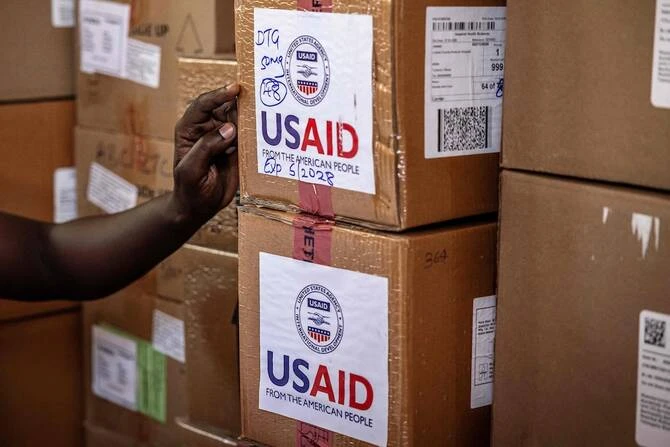

Development finance rarely disappears overnight. Budget allocations usually rise and fall gradually, giving governments enough time to adjust spending plans or seek alternative funding. Recent developments across sub-Saharan Africa have, however, broken that pattern.
Official development assistance has fallen by roughly 26 percent within a single year, marking one of the sharpest contractions in modern development finance. Such a sudden withdrawal resembles the “sudden stop” crises more commonly associated with private finance, except the missing capital funds hospitals, vaccination campaigns, food assistance, schools, and basic state functions rather than factories or financial institutions.
Several forces are responsible for this.
Higher interest rates, rising public debt, aging populations, and persistent fiscal pressures have pushed donor governments to tighten budgets. Military spending has climbed across much of Europe, while domestic priorities increasingly outweigh overseas commitments. Multi-year aid appropriations approved years ago are quietly expiring without equivalent renewals, creating funding cliffs that recipient governments often discover only after drafting their own budgets.
Timing makes the shock particularly damaging. Africa enters this period after six consecutive years of overlapping crises, including the pandemic, food and energy price spikes, climate disasters, armed conflict, and aggressive global monetary tightening. Fiscal buffers have steadily eroded, foreign exchange reserves have weakened, inflation remains elevated across many economies, and international capital markets have become increasingly inaccessible.
Average aid flows equal roughly 3 percent of gross domestic product across sub-Saharan Africa, but regional averages conceal much deeper vulnerabilities. External assistance exceeds 6 percent of GDP in several low-income and fragile states, while donor financing supports more than half of public health spending in countries such as Somalia and South Sudan. Nearly everything from HIV treatment to childhood immunization, nutrition programs, maternal healthcare, and humanitarian relief is heavily dependent on external funding.
Aid has historically functioned as Africa’s countercyclical capital, expanding during wars, droughts, epidemics, and economic downturns precisely when private investors retreat. Current reductions remove one of the few external financing sources designed to increase during crises, amplifying every other macroeconomic pressure already confronting governments.
Today, however, African governments face a series of deeply uncomfortable trade-offs.
Allowing donor-funded programs to expire protects public finances but carries immediate human costs. Health systems across several countries have already begun scaling back services as funding gaps widen. Global health initiatives have experienced reductions approaching two-thirds in some operational areas. Vaccination campaigns have slowed, HIV treatment programs face growing uncertainty, and food assistance has been curtailed despite rising displacement and food insecurity.
What is more, governments attempting to preserve social services frequently sacrifice public investment instead. Roads, electricity networks, irrigation systems, ports, digital infrastructure, and schools are postponed because immediate spending pressures leave little room for long-term projects. Every canceled infrastructure project raises future business costs, while lowering potential economic growth.
Private investors rarely fill these gaps — if at all. Manufacturing firms evaluating investment opportunities consider electricity reliability, transport efficiency, digital connectivity, and regulatory stability before committing capital. Aid reductions therefore produce a second-order investment shock by weakening the very infrastructure that attracts private enterprise. Emergency tax increases introduced to offset lost grants further complicate investment decisions by reducing expected returns and increasing operating costs.
On the other hand, debt financing offers only limited relief. More than half of low-income countries in sub-Saharan Africa are already assessed as being in debt distress or facing a high risk of it. Several governments now spend more servicing debt than funding public healthcare or other critical services.
Moreover, international debt markets have become equally unforgiving. Higher US and European interest rates have redirected global investors toward lower-risk assets, sharply increasing borrowing costs for frontier markets. African sovereign bond spreads have widened considerably, while several governments have effectively been priced out of Eurobond markets altogether. Refinancing existing debt has consequently become far more expensive than issuing it only a few years ago.
Global development finance is undergoing a reset.
Hafed Al-Ghwell
Domestic borrowing creates another set of problems. Commercial banks purchasing government securities have fewer resources available for businesses seeking loans. Small and medium-sized enterprises consequently face higher borrowing costs, weaker credit availability, and slower expansion. Everywhere on the continent, financial systems increasingly finance governments rather than productive investment.
Taxation has become the remaining policy lever available to many finance ministries. Governments have expanded VAT collections, broadened corporate tax bases, introduced new digital taxes, reduced fuel subsidies, and strengthened tax administration. Stronger domestic revenue ultimately improves fiscal resilience, but emergency tax measures introduced during periods of high inflation often result in unintended consequences.
Higher VAT immediately reduces household purchasing power. Expanded business taxation compresses profit margins already strained by elevated financing costs, unreliable electricity, and expensive imports. Smaller firms frequently postpone hiring, delay investment, or shift further into the informal economy, reducing the very tax base governments seek to expand. Fiscal necessity therefore collides with private sector competitiveness at precisely the wrong moment.
Political incentives further complicate reform.
Raising taxes generates immediate public resistance, while reducing long-term investment produces less visible political costs. Social services often absorb disproportionate reductions because comprehensive fiscal reforms require years of administrative modernization rather than a single budget cycle. Evidence increasingly suggests aid cuts alone rarely trigger the structural revenue reforms many donors anticipate.
Broader structural questions also emerge.
Development models built around predictable grant financing become increasingly fragile when donor priorities shift according to domestic elections, fiscal consolidation, or geopolitical competition. International financial institutions have struggled to compensate. Debt restructuring remains slow, concessional financing remains insufficient, climate finance remains fragmented, and humanitarian funding continues to operate separately from broader development financing despite increasingly overlapping crises.
At the same time, governments are expanding engagement with Gulf states, China, India, Turkiye, regional development banks, and other emerging partners in search of investment and alternative financing. Greater diversification offers new opportunities but also reflects diminishing confidence that traditional development finance alone can meet Africa’s long-term needs.
Aid contraction therefore represents far more than a temporary budget adjustment. Global development finance is undergoing a structural reset with lasting implications for fiscal stability, investment, and human development. African governments will need stronger tax administration, wider digital economies, more transparent public financial management, and faster economic formalization in order to strengthen domestic resilience.
International partners, meanwhile, face an equally urgent responsibility to modernize debt restructuring frameworks, expand concessional finance, and replace increasingly fragile aid models with deeper trade, investment, and productive partnerships.
Economic development has always depended on predictable capital. However, predictability is becoming increasingly scarce. Africa’s greatest challenge now lies in adapting before temporary funding shocks become permanent constraints on growth, productivity, and opportunity.
- Hafed Al-Ghwell is senior fellow and program director at the Stimson Center in Washington and senior fellow at the Center for Conflict and Humanitarian Studies. X: @HafedAlGhwell


