
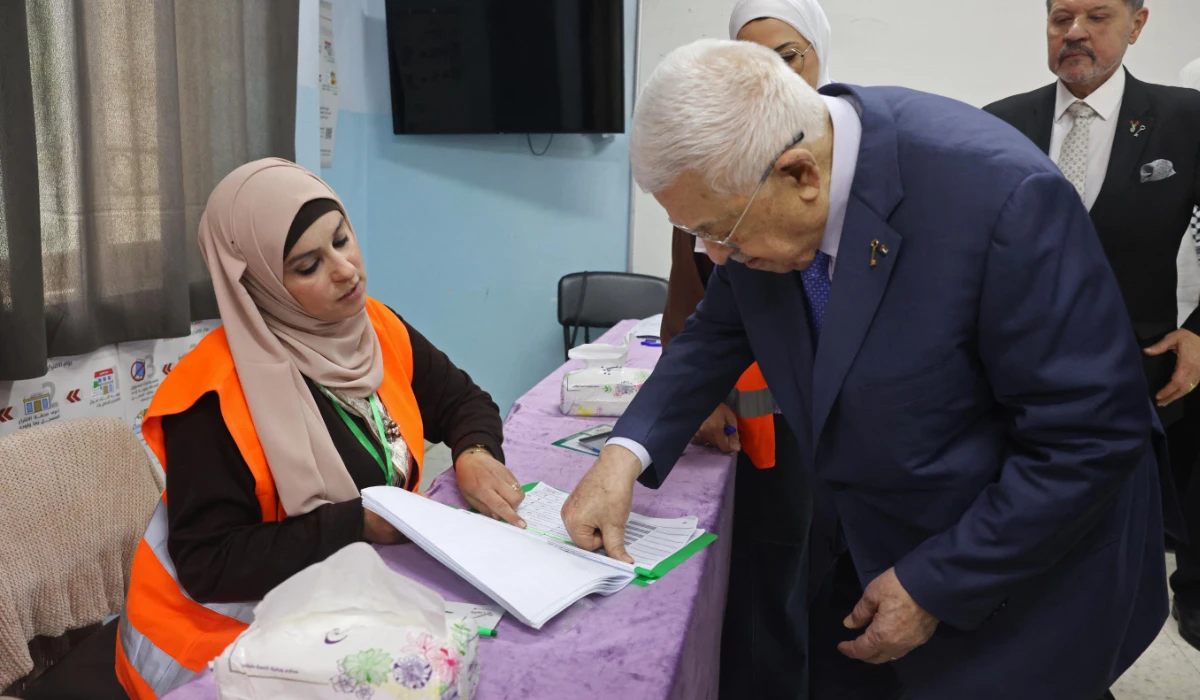

For many observers of the current Palestinian political status, the question is whether we will witness legislative elections in the Occupied Territories as announced on Nov. 28. While I am hesitant and can see plenty of reasons why the elections might be canceled or delayed again, I still think we will see them take place.
One can make a strong argument that the idea of true elections in occupied areas is an oxymoron. How can elections be free and fair, many argue, while Israel’s occupation is at its nastiest phase and while Israel can easily arrest nominees it does not like, stop the movement of ballot boxes and disrupt the election process in many other ways, including turning off electricity and even the internet?
All the above is true and I would be extremely skeptical that the Palestinian elections would survive if they were planned before the Oct. 27 Israeli poll. If that had been the case, then Israeli officials would have tripped over each other to slow down, frustrate or stop the elections from taking place. Competition as to who can be nastier to Palestinians is already on display in Gaza, Jerusalem and the rest of the West Bank.
A gap of one month after the Israeli elections is also rather short if there is no clear winning coalition. Coalition talks may stall and, if no bloc could muster 61 members of the Knesset in support, we might be in a bind as the current government would remain in caretaker control.
Aside from the Israeli elections, there are plenty of other challenges. Gaza and Jerusalem are among the toughest. It is true that municipal elections were held in Deir Al-Balah last September but holding Gaza-wide legislative elections will be a huge challenge.
A similar challenge will be East Jerusalem. The last scheduled elections in 2021 were postponed due to Israel’s refusal to allow East Jerusalemites to cast absentee votes in six post offices in Jerusalem. If this obstacle is not overcome, will the Palestinian election commission switch to online rather than physical absentee voting at post offices?
But perhaps the final decision to hold, postpone or cancel the Palestinian legislative elections might be in the hands of Hamas. A senior spokesperson for the group has said that the Islamist movement is considering joining the widest possible coalition and that it will participate in the elections. While any participation by Hamas would give the new council more legitimacy, it is not clear whether Hamas would agree to the conditions of the elections — namely accepting all international agreements signed by the Palestine Liberation Organization, including the recognition of Israel. Or whether it would attempt to gain a majority of seats or just participate in a secular/nationalist coalition, meaning that, even if that coalition were to win, it would not be in the majority of the overall Palestinian Legislative Council. Also, much would depend on the individuals Hamas nominates to the council, whether they are military or political.
Competition as to who can be nastier to Palestinians is already on display in Gaza, Jerusalem and the West Bank.
Daoud Kuttab
While the legislative council will be empowered to legislate and hold the government accountable, the current Palestinian political system is presidential. In other words, the Palestinian president and his existing security, intelligence and media institutions will not change regardless of the outcome of the November poll. Presidential elections are set for the first quarter of 2027 but, since no specific date has been announced, they may not take place next year if the results of the legislative poll are deeply unappealing to the current power in charge of the Mukataa (the presidential headquarters in Ramallah).
Despite all the above challenges, my prediction is that the elections for the Palestinian Legislative Council will take place for a totally different reason. Palestinian President Mahmoud Abbas pledged in New York last September (via video call because the pro-Israel Trump administration refused to grant him and his team visas) a multistep reform. Palestinians have addressed the issue of unreserved funding to families of prisoners and martyrs, the curriculum book issue and have begun electoral reform by successfully holding municipal elections.
The international community, including Washington, has bought into the Israeli excuses for dealing with Ramallah by forcing it to carry out serious reforms. Although most historians would laugh at the idea of a people under occupation being forced to reform and practice liberal democracy to be considered worthy of talks, that is the marker that has been set and the Palestinians have accepted the challenge.
The Palestinian PLO leaders who agreed in 1993 to exchange letters of recognition with Israel are being forced to meet further requirements to gain the right to speak with American officials and be granted visas to New York. It is for this specific goal that the PLO leadership in Ramallah will do everything humanly possible to hold the elections on time. If the Israelis are the ones who stop it, then the failure would not be due to any Palestinian refusal to carry out the reforms it has committed to — in particular to France and Saudi Arabia as a condition for the international push for recognition of the state of Palestine.
• Daoud Kuttab is an award-winning Palestinian journalist and former Ferris Professor of Journalism at Princeton University. He is the author of “State of Palestine Now: Practical and Logical Arguments for the Best Way to Bring Peace to the Middle East.”
X: @daoudkuttab


