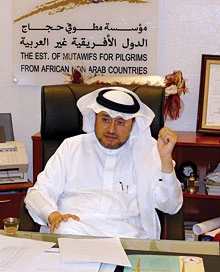
MAKKAH, 18 December 2007 — Maghrib prayer called, Abdulwahid Saifaddin asked the board members if they were ready to pray. In minutes, his voice filled the room as he led board members and employees, as well as members of the Arab News team that is covering this year’s Haj, in prayer.
With the conclusion of the supplication, Saifaddin, chairman of the Establishment of Mutawifs for Pilgrims from African Non-Arab Countries, returned to his seat behind the desk to resume an interview with Arab News on the role and tradition of the mutawifs.
“Being a mutawif is a vocation and a tradition that has been carried from generation to generation,” said Saifaddin. “It’s a calling that stems from a profound sense of belonging within the culture of mutawifs.”
Mutawifs are local representatives who handle groups of pilgrims. Part guide, part facilitator and part problem solver, the mutawif is essentially the sponsor and advocate for groups of pilgrims.
Mutawifs arrange transportation between ports of entry and the holy sites for the pilgrims; they arrange accommodations. With the job comes considerable responsibility. For example, the mutawif hold the passports and other important documents of inbound pilgrims and is supposed to ensure not only safe and reliable passage but also the exit of these pilgrims.
Mutawifs are organized under establishments, such as the one Saifaddin represents. The Establishment of Mutawifs for Pilgrims from African Non-Arab Countries was founded in 1983 when all the Makkah mutawifs serving these countries united. It is one among six mutawifs establishments of Haj and pilgrims affairs in Makkah each serving different countries. In 2005 Senegal President Abdoulaye Wade awarded Saifaddin the Knight of the Order of Lions (Wisam Al-Asad), the country’s highest civilian honor, for his efforts in serving pilgrims.
The tradition of the mutawif can be traced back to pre-Ottoman times albeit these positions weren’t as documented or organized as they are today. The most important qualification for a mutawif is being able to empathize with pilgrims, many of whom may have never traveled before and may be overwhelmed by the whole experience — especially during Haj.
In its first edition on Dec. 12, 1924, Um Al-Qura, a Makkah newspaper, King Abdul Aziz recognized the mutawifs’ rightful role in serving the pilgrims and made assurances that the tradition would be preserved and formalized. In his footsteps, King Abdullah’s official confirmation of the mutawifs establishments has stabilized the sector further. Consequently, a committee of members from Haj-related administrative departments was formed to overlook mutawifs’ affairs, challenges and processes.
“The committee went to all Haj mutawif organizations to hear from us about the obstacles and challenges involved in serving Haj pilgrims,” said Saifaddin. “The committee then submitted the report to the Ministry of Haj.”
The fruit of this effort is what led to the collaboration of different sectors such as: transportation, health and security to join forces with Haj mutawifs.
When asked about the obstacles mutawifs organizations face, Saifaddin said that they are mostly related to information issues. Information that needs to be given to prospective pilgrims prior to their arrival and information to be given to the mutawifs about pilgrims also prior to their arrival.
“It’s important that pilgrims be informed of the basics at least. Such as how to perform Haj and what to avoid while performing Haj rituals,” said Saifaddin. “It’s also important for us to know those who have children coming with them or have special needs such as those who are using wheelchairs. The more we know, the better we can accommodate them.”
This year, the Establishment of Mutawifs for Pilgrims from African Non-Arab Countries has 29 Haj groups. Each of these groups has a director and a deputy director that leads a team to attend to the different aspects of the pilgrimage process. From the moment the pilgrim lands to the moment he leaves he is their responsibility. This is why, Saifaddin says, it’s crucial for mutawifs organizations to be fully informed about the travel details of the pilgrims.
Saifaddin emphasized that the basis of the mutawif’s role is experience.
“My father, though orphaned at an early age, grew up to continue the tradition of mutawifs in our family because of my grandmother. She kept it alive and I am the son of that,” said Saifaddin.
Mutawifs may also play the role of a basic tour guide, taking pilgrims before or after their religious rites to see the Two Grand Mosques Museum, the factory where the Kaaba’s Kiswa (the ornate silk material that drapes the cube-shaped structure in the center of the Grand Mosque) is made, as well as trips to nearby cities such as Jeddah and Taif.
The mission of the establishments is to maintain the honor, integrity and responsibility of the profession of mutawifs by working together with the spirit of one team to offer the best services required for the guests of God.
“We’re honored to be able to play this role,” said Saifaddin. “It’s a blessing from God to serve His guests.”