

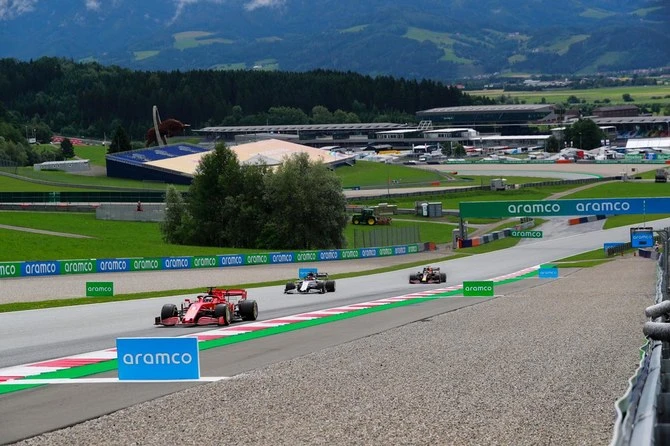

This summer, a competition was held at Silverstone in the UK, with teams from 54 countries racing cleverly engineered cars to win a world championship.
This competition was not the British Grand Prix, which took place at the beginning of July; it was a global challenge designed to nurture the next generation of inventors and engineers for the Aramco F1 in Schools World Finals to be held a couple of weeks later.
This year students from Saudi Arabia, hand-picked by the Ministry of Education, trained by the King Abdulaziz Center for World Culture, also known as Ithra, and supported by Aramco, will compete in the competition.
Aramco F1 in Schools challenges 9- to 19-year-old students to design, build and race miniature, compressed-air-powered Formula One cars.
They develop practical skills by learning about physics, aerodynamics, manufacturing and financial planning but also stretch their imaginations through more creative disciplines, including design, branding, graphics, marketing and media.
The initiative aims to raise awareness of STEM subjects — science, technology, engineering and mathematics. But since the teams are tasked with creating a miniature car that combines engineering and aesthetics, at Ithra, we call them STEAM subjects, where A in the acronym stands for art.
Teams from over 26,000 schools around the world apply to participate in the competition. A series of regional races culminate in the Aramco F1 in Schools World Finals. Key performance indicators are set, and points are awarded through scorecards that cover design and engineering, brand identity, verbal presentation and enterprise, which includes project management, marketing, sponsorship and digital media.
Teamwork and talent
As this is the first year that the Kingdom is participating at a national level, we have focused on selecting students from a wide range of schools in the Kingdom. We were impressed by the talent and ambition of a truly exceptional group of girls and boys and had the difficult job of choosing just 25 participants.
We then created four teams of six and provided two mentors to support them: a teacher from the Ministry of Education and a lecturer from the King Fahd University of Petroleum and Minerals, specializing in engineering and technology.
They met after school for eight weeks at the university’s training hub. They were taught to design and build a miniature F1 car using hi-tech equipment ranging from computers with the latest modeling and design software to 3D printers.
Although the models are miniature versions of a real racing car, the principles the students had to understand and apply were the same as those faced by an F1 team – resistance, drag, velocity and deceleration.
But the program is not just about design and speed. It is also about developing broader skills that will benefit the students in the future, including how to create and implement a financial strategy, promotion, branding, teamwork and leadership.
The atmosphere in the hub was energetic, positive and inspirational. The students, who came from very different backgrounds, loved the challenge and often talked about their favorite drivers and cars, including specific models from past years.
As all four teams produced impressive work and picking the three winning teams was hard, we decided to take the fourth team along to observe and audit the competition without actually taking part.
Inspiring change
The Aramco F1 in Schools program is inspiring and empowering in many ways. It also enables us to assess how students are performing compared to their peers around the world and can nurture their creativity and ambition.
Additionally, the international aspect of the competition is hugely valuable. These talented young people, who are proud to represent their country, are already beginning to feel they are part of a global community.
We have put forward solid teams for the first Saudi participation in Aramco F1 in Schools World Finals competition, and it will be fascinating to chart the careers of these talented young people a decade from now.
Ithra plans to continue competing in the years ahead, with more schools taking part, inspiring the next generation of Saudi students to choose a career in STEAM.
An additional benefit of the program is that it offers an opportunity to showcase more female talent in these historically male-dominated fields.
Ithra and Aramco are delighted to see female students taking such an active role in every project step. In the future, we hope to see them take engineering jobs or even leadership roles in actual F1 teams.
• Talal Al-Marri is public affairs general manager at Saudi Aramco.


