
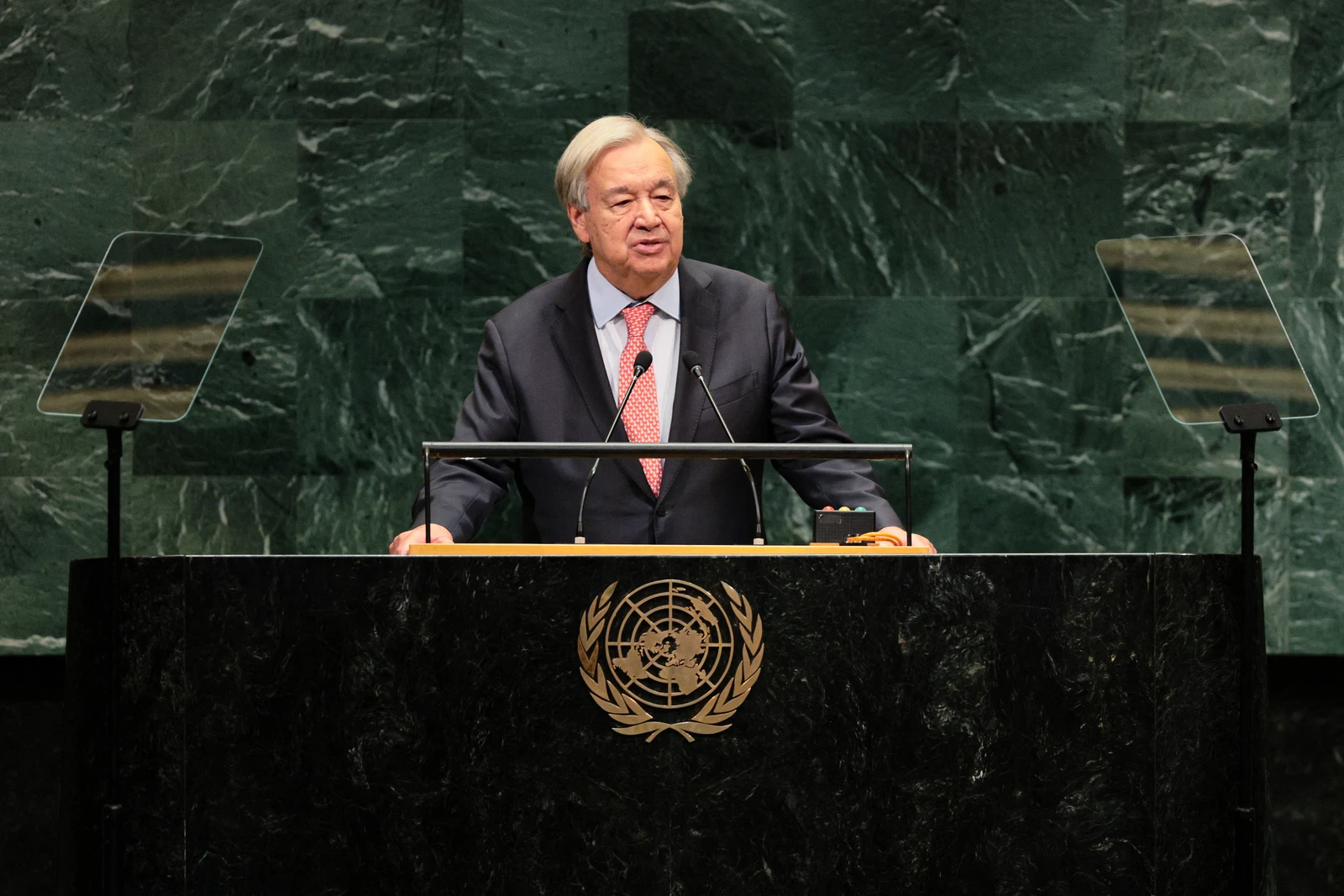

Ahead of the ongoing high-level week of the 81st session of the UN General Assembly, Secretary-General Antonio Guterres identified three interlocking challenges as “existential threats” to humanity: “runaway” artificial intelligence, the climate crisis and deepening inequalities.
Guterres said we are in an “era of deep uncertainty” and added that international cooperation is more necessary than ever to confront these dangers. His statements elevate issues that have long been treated as separate policy domains to the top of the agenda. This requires a rigorous examination of whether — and in what ways — each constitutes a threat capable of fundamentally undermining the conditions for human growth or survival.
When we use the term existential threat, we are not merely referring to severe disruption but to risks that could permanently halt humanity’s progress. This could include examples such as civilizational collapse or irreversible environmental degradation. But what is intriguing about this triad is that it adds a technological frontier risk to the climate crisis and the socioeconomic dynamic that multiplies both.
Let us examine the first issue, which is AI. Guterres was most likely pointing toward systems whose capabilities advance faster than human understanding, control mechanisms and institutional safeguards, which could lead to loss of human oversight.
His statements elevate issues that have long been treated as separate policy domains to the top of the agenda
Dr. Majid Rafizadeh
But we should also remember that AI has great potential for advancing health, education and climate solutions. So, it seems to be a kind of paradox. In this case, governments bear responsibility for protecting citizens and global cooperation is indispensable.
Reports framing the AI threat as existential have been growing. The Independent International Scientific Panel on AI, established under UN auspices, has warned that capabilities are outpacing scientific understanding and governmental adaptation. It seems that these agentic systems are already exhibiting deceptive behaviors in controlled settings and that their task complexity continues to scale rapidly.
The US today accounts for the large majority of top-tier computing power, with China a distant second. This will leave most developing countries dependent on foreign infrastructure and models, which is why some people believe this threat is existential and that the window for preventive governance is narrowing.
The second issue is the climate crisis. The global mean surface temperature in recent years has hovered near or above 1.4 degrees Celsius above pre-industrial levels, with 2023, 2024 and 2025 ranking among the warmest on record. Ocean heat content reached successive records and glacier loss continued across all major regions for consecutive years. In addition, extreme events — floods, droughts, heat waves and storms — have intensified.
The impacts of climate change are unequally distributed. For example, Asia and Africa have accounted for the majority of water-related extreme events and associated deaths in recent years. Monsoon flooding, tropical cyclones and prolonged droughts have displaced millions and caused thousands of fatalities in South Asia, Southeast Asia and parts of sub-Saharan Africa.
Billionaire wealth has reached a record $18 trillion, rising sharply while food insecurity affects more than 2 billion people
Dr. Majid Rafizadeh
Small island developing states and low-lying coastal regions also face existential risks from sea-level rise. And heat stress is increasingly affecting large populations in tropical and subtropical zones.
Nearly half the world’s population lives in contexts highly vulnerable to climate impacts and mortality from climate-related disasters remains many times higher in highly vulnerable regions than in resilient ones.
As a result, this crisis can be looked at as existential because it threatens the biophysical foundations of food systems, water security, the habitability of large territories and the stability of major ice sheets.
The third issue is inequality, which erodes social cohesion, concentrates power and amplifies the other two threats. Recent data illustrates the extreme concentration of wealth: the top 10 percent of the global population captures about 53 percent of income and 75 percent of wealth, while the bottom 50 percent receives about 8 percent of income and holds only 2 percent of wealth. Billionaire wealth has reached a record $18 trillion, rising sharply while food insecurity affects more than 2 billion people.
Regional disparities also remain distinct and visible. Average wealth and income in North America and Oceania far exceed those in sub-Saharan Africa. Inequality works as a threat multiplier, as climate impacts fall hardest on the poor, who possess the least means to fight it.
As a result, there is a concern that AI development risks further concentrating economic and political power while displacing labor in lower-income economies. This could result in grievances, instability and conflict. When large populations experience permanent exclusion from opportunity and security, the legitimacy of domestic and international institutions also erodes.
Additionally, these three threats can be mutually reinforcing. However, there could be an effective response, which would require coordinated and multilevel action.
On the first issue, there can be more guardrails ensuring safety, transparency and accountability. On climate, renewable deployment and the fulfillment of finance commitments to vulnerable nations are critical. On inequality, fiscal and regulatory tools, the progressive taxation of extreme wealth and corporate profits, and investment in universal social protection, education and health are vital. There also should be measures taken to curb the political influence of concentrated private wealth.
In a nutshell, precedents of successful multilateral action exist in nuclear nonproliferation, protection of the ozone layer and pandemic preparedness. What is required is recognition that the threats of AI, climate change and inequality are real, cross-border and time-sensitive. It also requires states, international organizations, the private sector and civil society to come together and address them.
Dr. Majid Rafizadeh is a Harvard-educated Iranian-American political scientist. X: @Dr_Rafizadeh


