
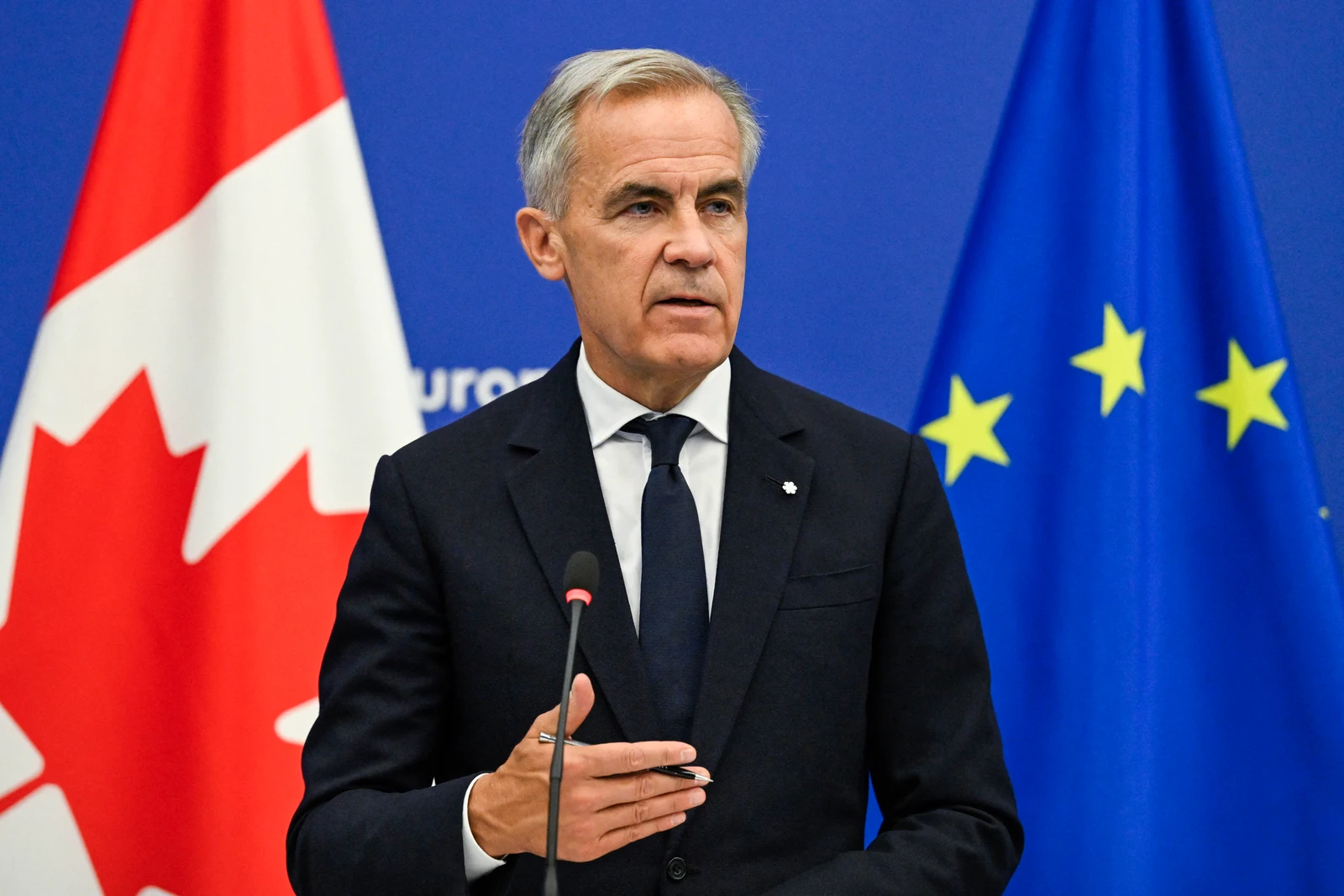

The EU is potentially entering a transformative period in its development. European Commission President Ursula von der Leyen last week opened the door for Canada to become the bloc’s first associate member. How significant a moment is this in the history of the EU? And why Canada and why now?
The EU was established in 1993 under the Maastricht Treaty. It was the result of the gradual integration of certain European states since 1945. As a result of the Second World War, Europe was divided between different blocks: the communist East, which was dominated by the Soviets, and the liberal West. As fears of a repeat of Germany’s position in the war caused great concern, thoughts of a federal Europe occurred, with the aim of binding Germany into democratic European institutions, thus reducing the chances of a return to war.
There are parallels between historical events and the current events in Europe. Germany is again in the spotlight over its choices for the future. The Left Party has been acknowledged as the winner of Sunday’s Berlin state election with about 25 percent of the vote. The Christian Democratic Union of Chancellor Friedrich Merz received 18 percent and the far-right Alternative for Germany 16 percent. In Mecklenburg-Vorpommern, Alternative for Germany came out on top with 37 percent of votes. Merz described the CDU’s performance in the northeastern state as a “disaster.” The party failed to meet the 5 percent threshold to sit in parliament — its worst state outcome since the Second World War.
It is time to make a decision on whether to U-turn toward the historical pattern of European-Russian unity
Dr. Diana Galeeva
Meanwhile, the successor of the communist past — Russia — held national parliamentary elections at the weekend. Those who understand the core of the Russian electoral selection process might be surprised by the statement made by Russian President Vladimir Putin on the first day of the State Duma elections. At a meeting of the Military-Industrial Commission on Friday, Putin called on Europe to “live in friendship” or face consequences, while referring to military exercises in the Baltic Sea by NATO states. The Russian president confirmed he has no intention or grounds to attack Europe, as Moscow is “ready to cooperate and restore relations with our European neighbors.”
This signifies that today is another significant moment in the EU’s future. It is time to make a decision on whether to keep Russia in the camp of the Global South’s power centers or remember the past and U-turn toward the historical pattern of European-Russian unity — such as during the time of the Russian Empire, the Spanish Empire, the Byzantine Empire, the Holy Roman Empire and the British Empire. Therefore, the timing of such a proposed transformation is unique in European history. Binding Canada as an associate member also makes it attractive for the bloc to evaluate the Kremlin’s relations with the EU, which have been at rock-bottom since the outbreak of war in Ukraine in 2022.
Analysts have raised concerns about the potential mechanisms of a new EU model of integrating associate members. The bloc has previously experienced a similar unprecedented moment, but it was in reverse with the UK’s Brexit referendum of 2016. Now, we might witness a moment of togetherness as a result of Canada joining the 27-nation bloc as an associate member.
Von der Leyen proposed bringing Brussels’ relations with Canada “to the highest level possible.” She suggested developing relations on issues including climate change, artificial intelligence, geopolitics and Arctic security. Canadian Prime Minister Mark Carney supported the idea of building “a unique security and economic alliance” with Europe, but not full membership.
Analysts have raised concerns about the potential mechanisms of a new EU model of integrating associate members
Dr. Diana Galeeva
Canada and the EU already have a free trade agreement, which eliminates duties on 99 percent of all tariff lines. The EU-Canada Comprehensive Economic and Trade Agreement came into force in 2017.
Most analysts connected the move with Canada’s deteriorating relations with the US, due largely to the tariffs introduced by the Trump administration — in July, the White House imposed 50 percent tariffs on some Canadian goods. However, it seems that instead the move aims to challenge the current global order and its key heavyweights, in which the Global South plays an essential role.
According to Berenberg Bank’s chief economist Holger Schmieding: “It is not necessarily against the US, but it is clearly in favor of making (Europe) less dependent on the US and less dependent on China, and that deeper partnership with other countries, like-minded democracies, is actually something we see in the economic rearm.”
The proposal has already been supported by many European leaders, with Finnish President Alexander Stubb commenting that the EU must “think big” in terms of its enlargement. Stubb said the bloc should push to increase its membership to 40 states, mentioning the likes of Canada, Norway, the UK, Iceland and others as potential members. Merz has previously suggested that Ukraine be allowed to join the EU as an associate member.
The Kremlin’s suggestion to “live in friendship” can also be the foundation for peaceful initiatives, with the possibility of Moscow returning to its historical heritage in the range of the European empires. It is clear that Europe has been through a truly impressive transformation since 1945 and it is worth watching how the Ukraine war might become a lesson that is taught in European capitals to live in friendship and prioritize common interests. In a surprise to many, this moment might see the ashes of war turned toward prosperity and strength.
Dr. Diana Galeeva is an academic visitor to the Center of Islamic Studies at the University of Cambridge.


