
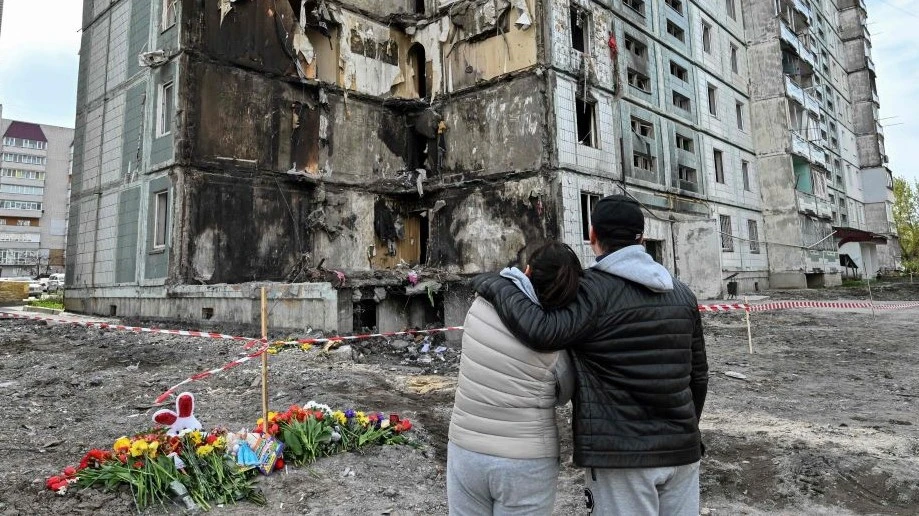

On the day Vladimir Putin issued an order to build museums across Russia to commemorate his country’s war in Ukraine, another very different kind of monument to the conflict’s cruel brutality was created by his forces in the city of Uman, 210 km south of Kyiv.
In the early hours of Friday, as civilians slept, a Russian Kh-101 cruise missile soared above the Ukrainian countryside. Far below, in a complex of some 46 apartments, a resident heard the missile’s distinctive “whooshing” sound as it headed toward her building. Grabbing her children, she threw them into a bathtub and covered them with pillows and a blanket. Then, she told us, she just waited and hoped they would see the morning.
In the event, she and her family were among the lucky ones. When the missile slammed into the complex, its ferocious blast tore through 27 of the apartments. Floors collapsed, rubble tumbled to the ground and, in an instant, as has happened so often in this war, dozens of innocent lives were ripped apart.
We spoke to a man who was among the first on the scene. He could hear the screams of children when he arrived, he told us. He saw a woman trapped under rubble and, with help from others, managed to somehow free her and get her into an ambulance. But it was too late — she later succumbed to her injuries in hospital.
As the day wore on, a cluster of firefighters and other rescue workers encircled the still-smoldering base of the complex. A few meters away from them, a group of residents, relatives and friends stood in a line, anxiously awaiting news of the missing. Diggers lifted the larger chunks of concrete, while workers picked through the rubble by hand.
The scene in Uman showed the tragic consequences of just one missile making it through
Nic Robertson
Up above them, on the eighth floor of the shattered building, had lived a family of four. The mother had escaped, a resident told me through agonized tears, and the father was in hospital; but their two daughters, aged seven and 13, were still missing, she explained. It was impossible not to fear the worst.
A total of 109 people were registered as living in the building and, throughout the day, more bodies were pulled from the wreckage. By nightfall, the death toll had risen to 25, including six children, with 18 injured.
The Russians had fired 23 missiles into Ukraine that night. Twenty-one of them were intercepted, but the scene in Uman showed the tragic consequences of just one making it through. This was the deadliest single strike on civilians since January of this year.
Russia denies that it is targeting civilians with its missiles, but the evidence strongly suggests otherwise. In fact, a fresh barrage of Russian missiles struck a residential area in the city of Pavlohrad on Monday, injuring at least 34 people, including five children, the governor of Ukraine’s Dnipropetrovsk region, Serhiy Lysak, said. Homes, schools and shops were all damaged in the attack.
The museums the Kremlin announced last week will showcase “the events of the special military operation and the heroic deeds of its participants.” One wonders what the Russian public would make of deeds such as those perpetrated in Uman and Pavlohrad, if only they were allowed to see them.
- Nic Robertson is International Diplomatic Editor for CNN.


