
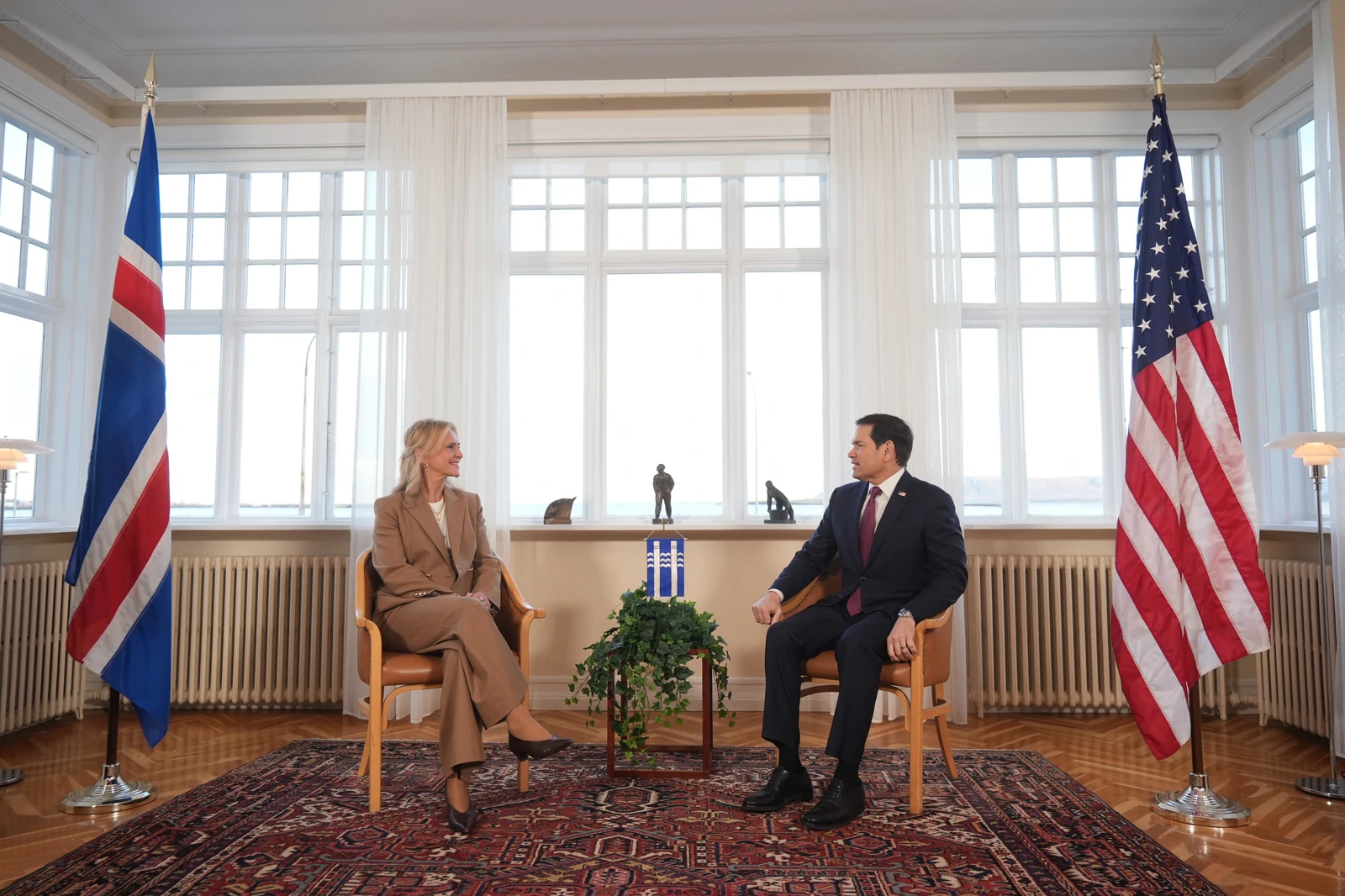

US Secretary of State Marco Rubio this week began a European trip with a visit to Iceland. There, he met his counterpart, Icelandic Foreign Minister Thorgerdur Katrin Gunnarsdottir, at Hofdi House, where Ronald Reagan famously met Mikhail Gorbachev 40 years ago during one of the most dramatic moments of the Cold War.
Rubio did not arrive with any grand new policy announcements on US-Icelandic relations but his visit was filled with symbolism, especially in the context of the Trump administration’s renewed focus on Arctic security.
Even though Iceland has no standing military, it has played a crucial role in the defense of the North Atlantic since the Second World War. As a founding member of NATO, it has served as the alliance’s unsinkable aircraft carrier in the North Atlantic. During the Cold War, Iceland formed a key part of the so-called GIUK gap, an area of intense focus for NATO as it monitored Soviet submarine movements between Greenland, Iceland and the UK.
For decades, the US permanently based thousands of troops in Iceland. But in 2006, the George W. Bush administration ended the permanent presence of American troops. In the years that followed, the US shifted to a rotational presence. It was not until after Russia’s first invasion of Ukraine in 2014 stirred concerns about stability and security in the Arctic on a scale not seen since the height of the Cold War that Washington began reengaging with Iceland.
Today, this rotational model remains in place but on a more robust basis, built predominantly around deployments of US P-8 Poseidon maritime patrol aircraft. The US and other NATO allies also deploy fighter jets to Iceland from time to time.
Rubio’s visit offered an opportunity to reassure Iceland and restore some calm to the relationship
Luke Coffey
In recent months, much of Washington’s Arctic focus has been on neighboring Greenland, which lies only 300 km from Iceland. But concerns arose in Iceland after President Donald Trump posted an image on social media last month depicting Iceland, Greenland, Canada, Mexico, Central America and the Caribbean covered by the American flag, with the entire landmass labeled “United States of America.” While marked down as usual Trump banter by many, Iceland’s government took it seriously enough to summon the US ambassador and make clear that it disliked the post.
Rubio’s visit, coming shortly after the new security agreement between the US, Denmark and Greenland, therefore offered an opportunity to reassure Iceland and restore some calm to the relationship.
The Trump administration has placed renewed emphasis on homeland security and America’s role in the Western Hemisphere. The geopolitical geography of the North Atlantic and Arctic makes clear that the North American continent cannot be secure unless places such as Greenland and Iceland are secure as well. To borrow an analogy from America’s recent wars in Iraq and Afghanistan, Greenland and Iceland serve as forward operating bases for the North American continent.
Rubio’s approach to Iceland may reflect lessons learned from the more aggressive approach taken toward Greenland. An agreement was reached on the sidelines of the UN General Assembly last month to expand the American military presence on the island and enhance regional security. But it came after serious damage to US-European relations caused by Trump’s refusal to rule out using military force to acquire Greenland.
There is no doubt that the Trump administration has been reestablishing America’s position in the Arctic
Luke Coffey
Compared with Greenland, however, Iceland has largely avoided the high-stakes political drama that has strained relations between Washington and its European allies.
There is no doubt that the Trump administration has been reestablishing America’s position in the Arctic. Putting aside the contentious Greenland debate, the US has participated in and led significant military exercises in the High North. It has also started the Nordic Bridge concept, designed to improve coordination across the military commands whose areas of responsibility overlap in the Arctic.
Yet, if one takes a closer look at national security policymaking during Trump’s second term, the approach to the Arctic shows how ad hoc and, at times, disjointed the administration’s approach can be.
The administration has invested significant political capital in Europe over Greenland and has repeatedly made the case that the Arctic is vital to homeland defense. Yet the region is completely ignored in the White House’s National Security Strategy that was published late last year. The word “Arctic” does not appear anywhere in the 33-page document.
This ambiguity and occasional incoherence may keep America’s adversaries off balance but it also creates challenges for allies and partners. It is difficult for them to understand how they fit into America’s view of the world when Washington pursues major policy objectives that are barely reflected, if at all, in its principal strategic documents.
Still, greater attention to the Arctic should be welcomed. The region is becoming increasingly important because of new shipping routes that could emerge as sea ice melts, the potential discovery and development of additional energy resources, and its growing economic and geopolitical significance.
America has been an Arctic country since it purchased Alaska from Russia in 1867 but few Americans think of their country as an Arctic power. Anything the administration can do to bring greater public awareness to the region and greater policy attention to Arctic security is therefore worthwhile.
That is why Rubio’s decision to make Iceland the first stop on his European trip this week was a good one. Iceland’s strategic importance is easy to overlook on a map but for decades its location has made it indispensable to the defense of the North Atlantic and, by extension, the US.
After the political drama over Greenland, Rubio’s visit to Reykjavik offered an opportunity for the US and its European partners, especially in the Arctic, to turn the page and focus on what they share: defending the North Atlantic, strengthening regional security and ensuring that the Arctic remains stable in an increasingly uncertain world.
Luke Coffey is a senior fellow at the Hudson Institute. X: @LukeDCoffey


