
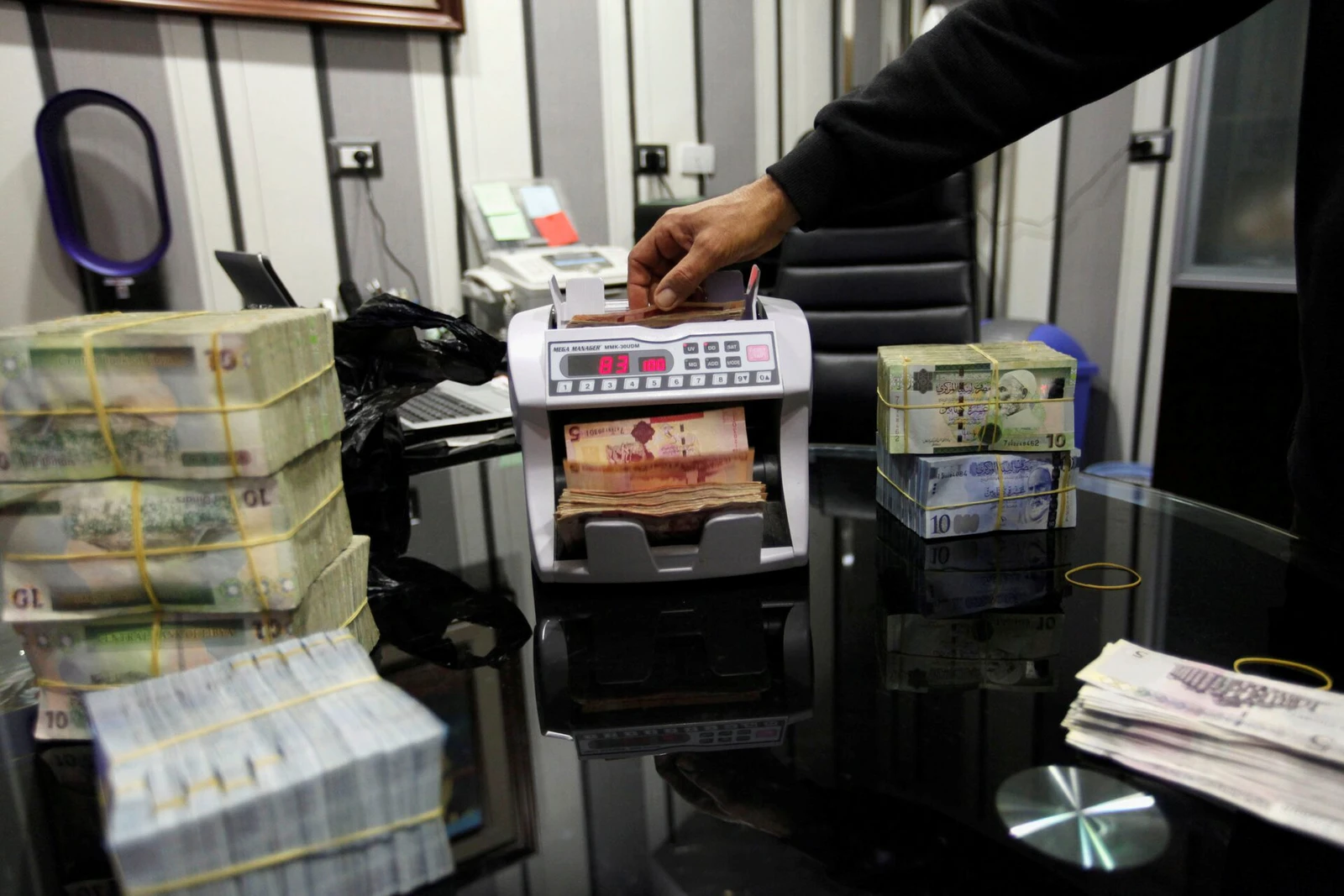

Libya entered this month pumping 1.43 million barrels of crude a day and banking more than $15.2 billion in oil export revenue in the first half of the year alone. The parallel-market dollar, meanwhile, climbed past 10.5 dinars against an official rate frozen near 6.5. Annual inflation had already reached nearly 17 percent in September; food and beverage prices were up by 21 percent, with clothing and footwear well over 25 percent. In a nutshell, a state with Africa’s largest proven reserves is watching its currency lose more than 45 percent of its dollar value even as tankers queue at its terminals.
The mechanics behind that contradiction run through Libya’s fiscal plumbing. A unified budget of 190 billion dinars, the first consolidated spending plan since 2013, was signed in April this year, yet recurrent outlays — salaries, subsidies, and transfers — absorb roughly 85 percent of it. The International Monetary Fund estimated a fiscal deficit of over a quarter of gross domestic product in 2025, with public debt nearly doubling in two years. Higher oil prices briefly covered the gap. However, the Central Bank of Libya still recorded a $4.7 billion foreign-currency deficit in the first nine months of 2026 as dollar obligations outran oil receipts.
Fuel has become the most expensive leak in that circuit. Libya imported $6.1 billion of refined products in the first seven months of 2026, roughly one-third of the value of its oil exports, and the UN estimates that 30-50 percent of those imports were diverted into smuggling networks, costing the treasury between $2.4 billion and $4.4 billion in nine months. Annual smuggling losses are estimated at $6.7 billion, with politically connected networks in both the east and west capturing the arbitrage between subsidized domestic prices and neighboring markets.
Those fiscal and criminal pressures converge on the Central Bank of Libya, the institution that allocates dollar access in a rentier economy. Governor Naji Issa’s resignation in August, the House of Representatives’ contested appointment of Fawzi Abu Khzam in early November, and the ensuing raid on the bank’s Tripoli headquarters turned a technocratic vacancy into a struggle over the last national lever of economic sovereignty.
Libya’s fragile political process is absorbing the shock at the worst possible moment
Hafed Al-Ghwell
Not long after, the US Treasury and Federal Reserve suspended dollar transactions with the central bank, citing the opacity of Abu Khzam’s appointment, and demanding binding controls on parallel spending to renew financial cooperation. Curiously, the suspension does not freeze Libya’s reserves. Instead, it constricts the clearing channels, letter-of-credit confirmations, and correspondent-bank relationships that keep imported food, medicine, and fuel moving.
Consequently, Libya’s fragile political process is absorbing the shock at the worst possible moment. The 4+4 agreement signed in August set up a 24-month runway toward legislative and presidential elections under a unified executive, yet the High Council of State rejected its outcomes. A currency that has become the reference price for household survival now prices the credibility of that roadmap. The dinar’s slide is a receipt for a sovereignty deficit that no oil windfall can cover.
Public payrolls are where the currency crisis becomes a political crisis in real time. Central Bank of Libya data show that the public wage bill alone consumed over two-thirds of everything the state spent. When the dinar loses value on the parallel market, the nominal cost of keeping 2.3 million public employees on the payroll rises faster than oil revenue can track, and the choice facing both authorities narrows to arrears, monetary financing, or another round of borrowing against future crude sales.
Unsurprisingly, teachers in Tripoli, Zawiya, Tarhuna, and Bani Walid have already suspended classes over unpaid entitlements and the absence of a unified salary scale; doctors have protested outside major hospitals; retirees have camped outside government buildings demanding a higher pension floor; and guards at the Zawiya refinery have partially shut its gates over unresolved financial claims. Each of those actions tests whether the 4+4 agreement signed in August can deliver the one thing that matters to households before elections arrive.
Additionally, the High Council of State’s rejection of the 4+4 outcomes, framed as a defense of constitutional legitimacy, has the practical effect of leaving the political process without a destination while the economic clock runs. Washington’s insistence that Abu Khzam’s appointment be reversed and that parallel spending be brought under control gives the US a lever, but it also hands spoilers a ready-made grievance: external imposition dressed as financial prudence.
Moreover, an IMF assessment in April identified that energy subsidies at roughly 20 percent of GDP and a wage bill near 30 percent of GDP are among the world’s largest, and that reform, paired with targeted social support, should not be delayed. The sequencing dilemma is genuine: Subsidy reform without a unified executive capable of administering cash transfers risks a price shock that dissolves the remaining political consensus, while delaying reform guarantees that the dinar’s slide accelerates and the eventual adjustment becomes more violent.
At present, there are only three possible pathways. Either a muddle-through scenario keeps the parallel rate oscillating between 9 and 11 dinars, inflation in the mid-teens, and the political process alive but paralyzed, with both authorities buying time through cash injections that erode reserves and credibility. Or, a disorderly adjustment, triggered by a prolonged American suspension or an oil-price fall, would push the rate upward, force another official devaluation, and collapse the 24-month election timetable into a contest over who controls the remaining dollar allocation. Alternatively, a reform coalition that resolves the central bank dispute through an audit acceptable to both Washington and Libyan factions, restores dollar clearing, and binds the 4+4 roadmap to a fiscal pact that lowers the rate. This could give the unification process an economic foundation rather than a rhetorical or theoretical one.
Ultimately, the choice will be made in the next few budget cycles, and the dinar is already pricing the outcome. Libya’s reserves can outlast its politics only if its politics first outlast its spending because the dinar will not wait for a unity government. In fact, it will tell ordinary Libyans whether unity was ever real.
Hafed Al-Ghwell is senior fellow and program director at the Stimson Center in Washington and senior fellow at the Center for Conflict and Humanitarian Studies.
X: @HafedAlGhwell


