


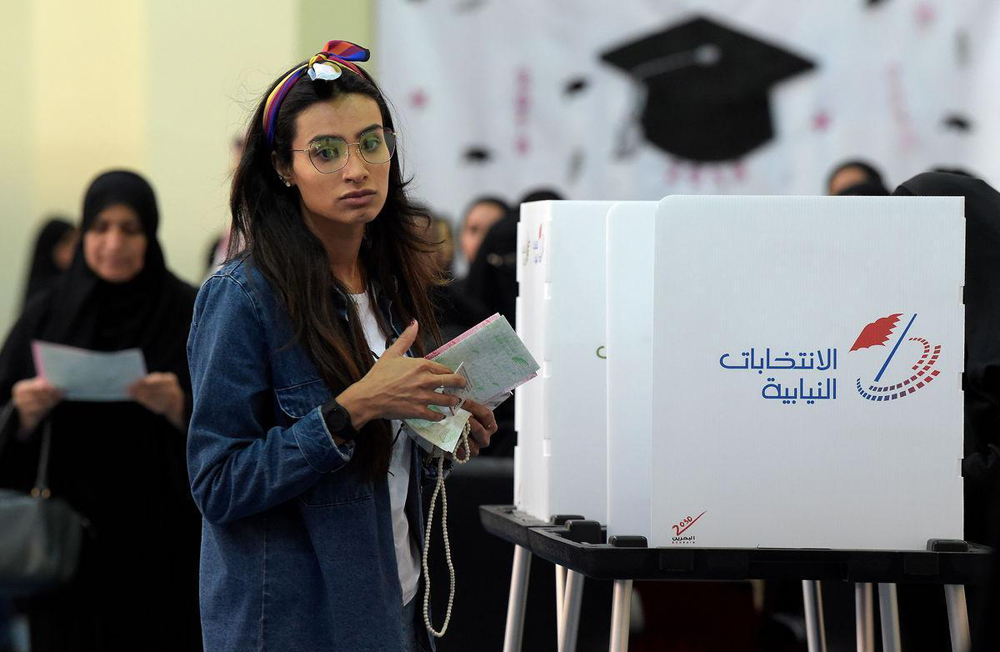
The Kingdom of Bahrain on Saturday witnessed a successful first round in the 2018 parliamentary and municipal elections. Nine MPs secured their seats, with a further contest for the remaining 31 seats to be held this Saturday. It was a very competitive election between predominantly independent candidates. Voter turnout was an unprecedented 67 percent, with Bahraini men and women going to the polls to cast their votes in a free and fair general election covered by independent judicial supervision, civil society observation and unbiased media coverage, despite calls from groups based in Beirut and Tehran for a boycott.
Bahraini authorities reported that 40,000 text messages were sent from Iranian servers to electors, falsely stating that they were no longer eligible to vote, in a failed attempt to sabotage the election. However, the will of the people reaffirmed the overlapping national consensus based on pluralism, tolerance and individual rights and freedoms, which was echoed in a very progressive demonstration of expression at the ballot box. So far, two female candidates have secured seats, with expectations of at least another two joining them in the legislature after the second round of elections, where they will make up an impressive 10 percent of the elected chamber.
Previous elections witnessed a domination of intolerant groups, which caused stagnation in the democratic process in Bahrain. Politics were determined by a generally radical Islamist outreach that acted in contrast with the contemporary Bahraini social contract, echoed in the principles of the National Action Charter, which was confirmed by Bahrainis in a national referendum in 2001, with an overwhelming 98.4 percent in favor.
A victory for reason is perhaps an understatement to describe the electoral process in Bahrain, where democracy extended beyond the procedural components of free and fair elections.
Dr. Khalifa A. Alfadhel
The structure of such groups illustrated an original position of religious dominance, where their leaders considered themselves morally unaccountable to anyone, and democracy to them was an instrument to establish a theocratic administration. Of course, this was evident not only in the 2006 and 2010 elections, but also in the first Bahraini parliamentary experiment in 1973, when radical MPs from the left and the right decided to join forces in order to present a formula for the miscarriage of democracy.
However, this has changed. The Bahraini judiciary banned the aforementioned intolerant political actors, who had their own concept of good that was inconsistent with the elements of a modern state, and practiced ideologies based on comprehensive doctrines that endorsed a dogmatic law-making outreach. The numbers indeed displayed that such groups had no impact on the Bahraini electorate, and their calls to boycott the election were unheard by reasonable citizens. Such regressive political groups are without doubt an unflattering episode of the past, where they refused — on many occasions — to participate in a constructive national dialogue and to be ingredients in any reform recipe.
A victory for reason is perhaps an understatement to describe the electoral process in Bahrain, where democracy extended beyond the procedural components of free and fair elections and Bahrainis decided to choose independent representatives instead of listening to the voices of radical proxies. Therefore, it is safe to say that the right to democracy in the Bahraini context saw the legitimate rejection of intolerant political rhetoric.
- Dr. Khalifa A. Alfadhel is a member of the board of trustees of the Bahrain Center for Strategic, International and Energy Studies (Derasat). Twitter: @kalfadhel


