
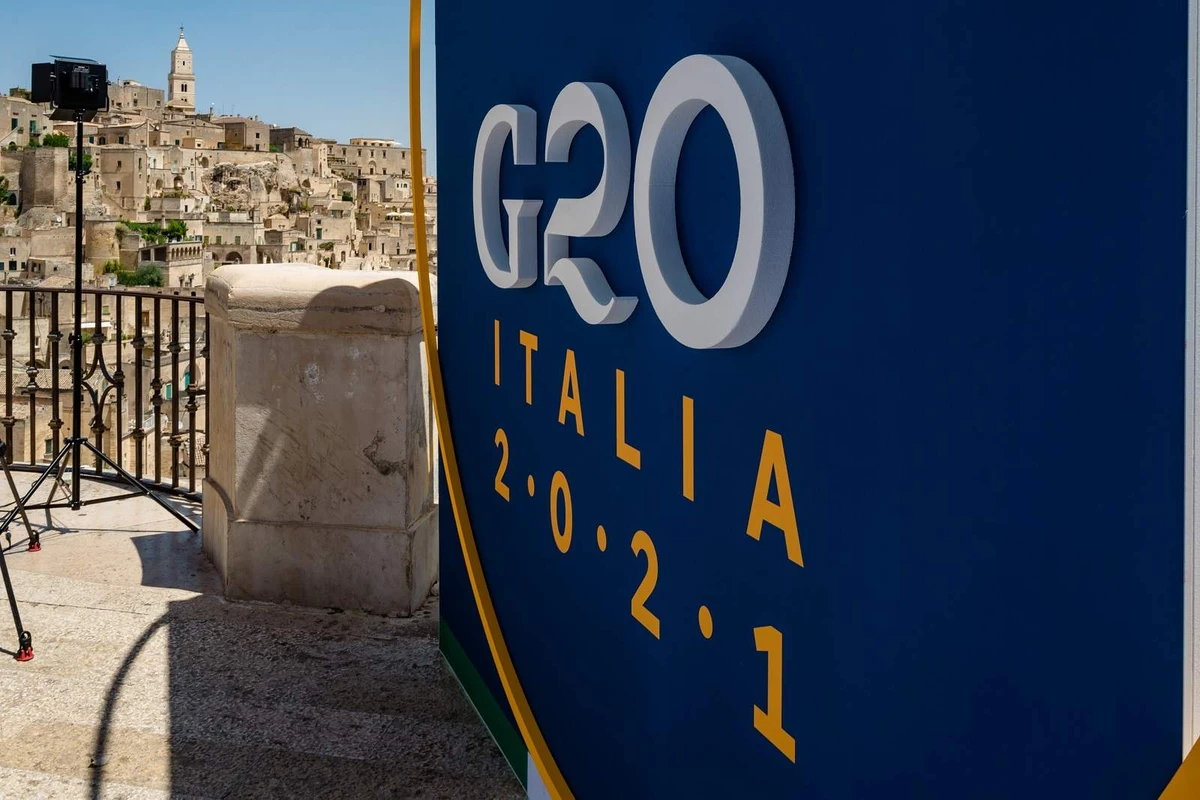

Italy kicks off a big October of G20 leadership diplomacy with an Afghanistan-themed summit next week. But the main event will be in Rome on the last weekend of the month with a meeting focused on broader issues, especially the pandemic and November’s COP26 climate summit.
These twin G20 summits will see world leaders in attendance from China, Germany, India, Japan, Indonesia, Australia, Russia, Brazil, the UK, Saudi Arabia, South Africa, Turkey, France, Italy, Canada, South Korea, Argentina, Mexico, the EU, and the US. Collectively, these powers account for some 90 percent of global gross domestic product, 80 percent of world trade, and about 66 percent of the global population.
With its proximity to next month’s COP26 summit, this year’s G20 events could be the most important since the 2009 meeting in London during the storm of the international financial crisis. While Italy is one of the club’s least prominent states, Prime Minister Mario Draghi is hoping to use his own political prominence and global connections to help the nation make an impact.
This process starts next Tuesday with the extraordinary summit on Afghanistan, which will focus on humanitarian aid, security, human rights and combating terror. The talks will also see the participation of the Netherlands, Spain and Qatar, in addition to the International Monetary Fund, the World Bank and the UN, with the goal of constructing a significant package of support to avert what Draghi fears may be a humanitarian catastrophe this winter.
Beyond next week, attention will quickly turn to other big issues, including the hoped-for post-pandemic economic recovery. IMF Managing Director Kristalina Georgieva this week said the world economy remains “hobbled” by the coronavirus crisis, as she revealed that her organization had cut its forecast for international growth this year. She said the most serious obstacle to a full recovery is the vaccine divide between rich and poor nations, and she said the global economy could face a cumulative $5.3 trillion loss over the next five years unless this is closed.
In the spring, the IMF proposed a $50 billion project aimed at ending the pandemic by vaccinating 40 percent of people globally by the end of 2021, and at least 60 percent by the midpoint of 2022. Doing so, IMF officials say, would inject the equivalent of $9 trillion into the global economy by 2025 due to a faster resumption of economic activity.
While the ambition of the IMF plan won’t now be realized, one of the prizes Draghi is still seeking from this year’s G20 summit is the development of a genuinely global, comprehensive response to the pandemic, which has been stymied to date. Western countries, for instance, are split on the issue of vaccine patent waivers, with Germany strongly against.
So even now not all G20 leaders have fully embraced the advice of World Health Organization Director General Tedros Ghebreyesus last year to come together to find joint solutions to the pandemic and “ignite a new global movement” to ensure it never happens again. If the challenge of bridging these pandemic-related gaps wasn’t big enough for Draghi, he must also try to marshal a consensus ahead of COP26. Italy is heavily vested in the outcome of November’s big event, as it is the UK’s partner in its organization, with preparatory meetings held in Italy in September and October.
One of the prizes Draghi is seeking from this year’s summit is the development of a genuinely global, comprehensive response to the pandemic.
Andrew Hammond
All of this highlights that this year could be one of the most consequential for the G20 since that 2009 meeting in London. Then, the multilateral forum, with UK Prime Minister Gordon Brown in the chair, coordinated an approximately $1 trillion stimulus package to bolster the global economy.
Draghi is well aware that, while the G20 is widely seen as having seized the mantle from the G7 as the premier forum for international economic cooperation and global governance, it has so far failed to realize the full scale of the ambition some have thrust upon it. This is, in part, because it has no formal mechanisms to ensure the enforcement of agreements by world leaders. Moreover, at a time of a continuing global health emergency, there also remain concerns among states outside the club about its legitimacy and composition, given it was originally selected in the late 1990s by the US and its G7 colleagues.
This issue has been picked up by the host of the 2009 summit, Brown, in the context of COVID-19 and he has urged the G20 to work much more closely with the 193-member UN to tackle the pandemic. However, important as this issue is, whether the Italian presidency will deliver on the upcoming summit’s potential will depend on whether intra-club divisions ameliorate or worsen in the days ahead.
- Andrew Hammond is an Associate at LSE IDEAS at the London School of Economics.


