
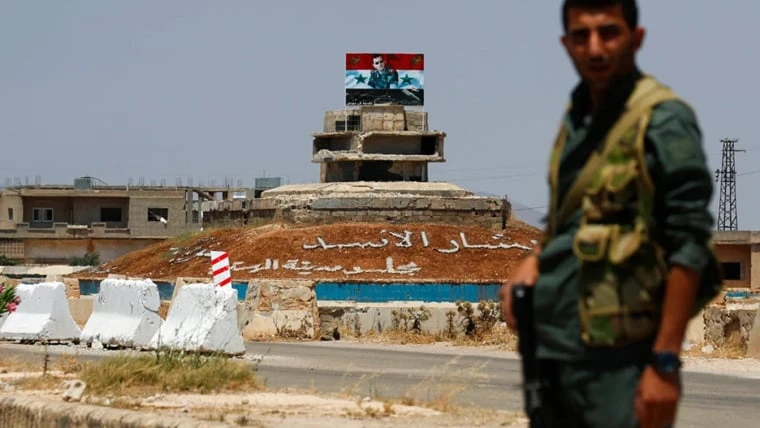

More than two weeks after a devastating earthquake rattled northwestern Syria, killing more than 5,000 and injuring many more, the battered country is now waking up to a chilling new reality: Daesh is reemerging. On Friday, news agencies reported that at least 53 Syrians, including seven regime soldiers, were gunned down by Daesh militants in the town of Al-Sokhna. An unspecified number of hostages were also taken. The civilians were reportedly collecting truffles in the desert east of Homs, in a province that is under government control.
The massacre came a day after US troops and soldiers of the Syrian Democratic Forces carried out a helicopter raid in the eastern Syrian desert that killed a senior Daesh leader. Four US servicemen were injured in the raid.
Reports have been circulating that Daesh sleeper cells have become active in recent months, carrying out attacks against US troops, SDF detention centers — where thousands of Islamist militants are being held — and regime positions. Since Daesh was defeated in 2019, less attention has been directed to the smaller groups that continue to be active in the vast and empty swaths of desert between Syria and Iraq. A number of deadly attacks against Iraqi soldiers, attributed to Daesh, took place last year.
According to Israel’s Meir Amit Intelligence and Terrorism Information Center, Daesh operatives carried out 2,705 terrorist acts around the globe in 2021, usually climaxing during Ramadan and with the group’s Iraqi province taking the lead in terms of the number of attacks carried out. The US Wilson Center has confirmed that the “group continues to be a highly active and lethal insurgent force in the Middle East, particularly in rural Iraq and Syria.”
The group’s ability to regroup at some lethal level in parts of Syria and Iraq should be a cause of concern for the region.
Osama Al-Sharif
Leading the fight against the militant group is the US and its local allies. In the case of Syria, it is the nonstate actor the SDF, while in Iraq it is relying more on the Iraqi army, which is assisted on some occasions by the Iran-backed Shiite militias of the Popular Mobilization Units. Both the SDF and the PMU are contentious players with controversial political agendas.
The US Defense Department said recently that US Central Command last year conducted 313 operations in Iraq and Syria as part of the mission to defeat Daesh. It added that more than 95 percent of those operations were in partnership with either the Iraqi security forces or the SDF.
Notwithstanding the fact that Daesh and its affiliates are active in other regions of the world, which means that the group remains a source of global instability, its ability to regroup at some lethal level in parts of Syria and Iraq should be a cause of concern not only for these two countries, but also their immediate neighbors.
The fact that the group’s nefarious ideology continues to attract young men and women should also worry leaders in this part of the world. Extremists fighting under various banners in parts of Iran, Afghanistan, Pakistan, the Sahara, Nigeria, the Horn of Africa and, in some cases, even in Europe and North America should inspire the revival of efforts to confront, contain and eradicate such groups.
In both Syria and Iraq, the need for a strong central government with a professional national security force is a prerequisite for draining the swamp once and for all. While the role of the US and other nations is essential, securing a conclusive victory against Daesh cannot be achieved without strong central governments. Unfortunately, that is currently not the case.
Foreign intervention is one of the reasons for the endemic weakness of central governments in Syria and Iraq. Each case is different, but in the end Daesh has managed to survive in one form or another even after its major defeat a few years ago. The US military presence in eastern Syria — the area where Daesh is most active — has failed to deliver that decisive victory.
In one case, according to Syrian researcher Mohammed Hassan, writing for the Middle East Institute, the Syrian government itself was implicated in the release of at least 200 militants in southern Syria, especially in the Deraa Governorate, at different intervals. At least two of those released went on to contribute to the resurgence of Daesh cells in that part of the country.
While some will argue that Daesh’s geographical area of activity has been markedly reduced in both Syria and Iraq, the fact remains that weak and inept central governments are unable to spread their control over all their territories. The militant group has been able to survive thus far and last week’s massacre is proof that it can wage attacks against hapless civilians, spreading terror and sending a clear message.
It took enormous resources to wage war against the so-called caliphate and its defeat came at a huge cost to life, infrastructure and archaeology. While the US cannot and should not stay in the region forever, efforts should focus on finding sustainable ways to make sure that the scourge of Daesh, or anything like it, does not emerge again.
- Osama Al-Sharif is a journalist and political commentator based in Amman. Twitter: @plato010


