
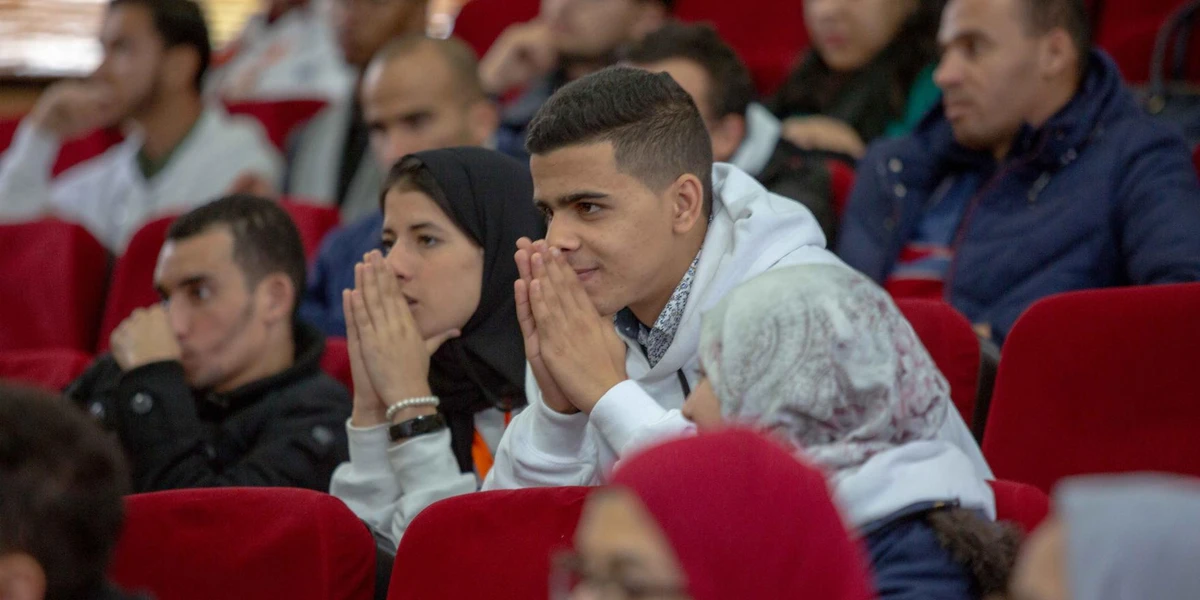

I took part in a four-day event of debates and discussions with about 50 Algerian youngsters last week. It focused on quality education, climate action, gender equality, and other major issues of our times. The event was organized by Young Mediterranean Voices as part of a month-long, region-wide program of debate competitions and national forums across eight southern Mediterranean countries (Algeria, Egypt, Jordan, Lebanon, Libya, Morocco, Palestine and Tunisia). The project was supported by the British Council, the Anna Lindh foundation, and the EU.
The main part of the event that I participated in was a series of debates organized by National Debate Forum Algeria with dozens of participants and facilitators. The debates were run in parallel Arabic and English tracks in a series of elimination rounds, building up to the final debates (in the two languages).
Most significantly, the debate motions were based on themes linked to the UN’s 17 Sustainable Development Goals (SDGs). This event focused on four SDGs: Quality education (SDG 4), gender equality and women’s empowerment (SDG 5), decent work and economic growth (SDG 8), and climate action (SDG 13).
The discussions aimed at achieving several important objectives: Firstly, to review those vital issues and challenges, capture the main arguments underlying them, and issue recommendations to policymakers and active organizations; and, secondly, train youngsters on critical thinking, communication, and the art of civil debate, all now widely recognized as important “21st century skills.” Indeed, it soon became clear that debates such as these should be widely adopted as ways of achieving SDG 4.
Debate motions included: Gender equality is essential to achieving peaceful societies; all countries should abandon the fight against climate change and adapt to its consequences instead; educational programs should be skill-based rather than information-based; and developing-country governments should encourage students to pursue graduate studies in their own countries.
The debates around education were particularly noteworthy. It was fascinating to hear youngsters from a developing country (Algeria) argue for or against a motion that called on governments to encourage students to pursue graduate studies in their own countries. The debaters raised a host of interesting points: Many of the bright students who study abroad end up staying there, thus worsening the drain of brains and talent from their societies, which need them most. However, home universities often do not offer the quality education and training that those smart brains need; and, moreover, studying abroad helps raise inter-cultural understanding and tolerance, not to mention acquiring the high technical competency that will benefit the home country if the students return. The problem then is how to ensure that the students return to their home countries, not whether they should seek the best universities and get the highest quality education they can.
Our world is changing fast and we need the essential skills and knowledge to be able to adapt to tomorrow’s world.
Nidhal Guessoum
Excellent debates also took place around whether educational programs should be skill-based rather than information-based. Debaters asked: What is the point of being fed many facts when we can easily Google them? What is the point of education if it does not prepare people for the real world? But can students acquire important skills without foundational knowledge? And, assuming they can, will they be able to use those skills effectively without the grounding of foundational knowledge?
The climate action debates were equally fascinating. I would have thought that the motion to give up the fight against climate change and instead just try to adapt to its consequences would easily be defeated. But not only did the motion win, the team arguing for it did a great job pushing arguments such as: The economic development cost of climate-action measures to third-world countries (such as Algeria); the failure of developed countries, particularly the US, to abide by the Kyoto and Paris agreements; and the fact that any positive impact of climate action will take decades, if not centuries, and we cannot afford that time.
Interestingly, on most of the motions, the debate teams ended up concluding that a balance between the two opposing positions is what is needed.
The final session was a panel discussion around quality education and the place of e-learning. Seeing more than 50 youngsters listen and ask questions in perfect English (in a country where English is barely the third language) about such a vital topic, and for more than two hours, was highly encouraging. I thus realized that debates and discussions are a potent tool to achieving the quality education that we were discussing.
Indeed, critical thinking, communication, assessment of digital information, and teamwork are some of the most important skills that must be acquired by students today for lifelong learning. Our world is changing fast (a highly connected, globalized world, a digital and online life, fast evolution of knowledge and technology, for example) and we need such essential skills and knowledge to be able to adapt to tomorrow’s world.
Education must prepare youngsters to be good citizens of the world tomorrow, when things will certainly be very different from today and will keep changing fast.
- Nidhal Guessoum is a professor at the American University of Sharjah. Twitter: @NidhalGuessoum


