

Islamophobia and anti-Arab racism have increased significantly during US election campaigns in the past decade, despite the successes Arab and Muslim Americans have seen at the local, state and national levels.
It is not enough to criticize an Arab or Muslim American candidate on the basis of their positions on politics, policies and government agendas. Critics have found it more effective to raise questions about their religion or ethnicity, including stereotyping Arab Christians as being Muslim.
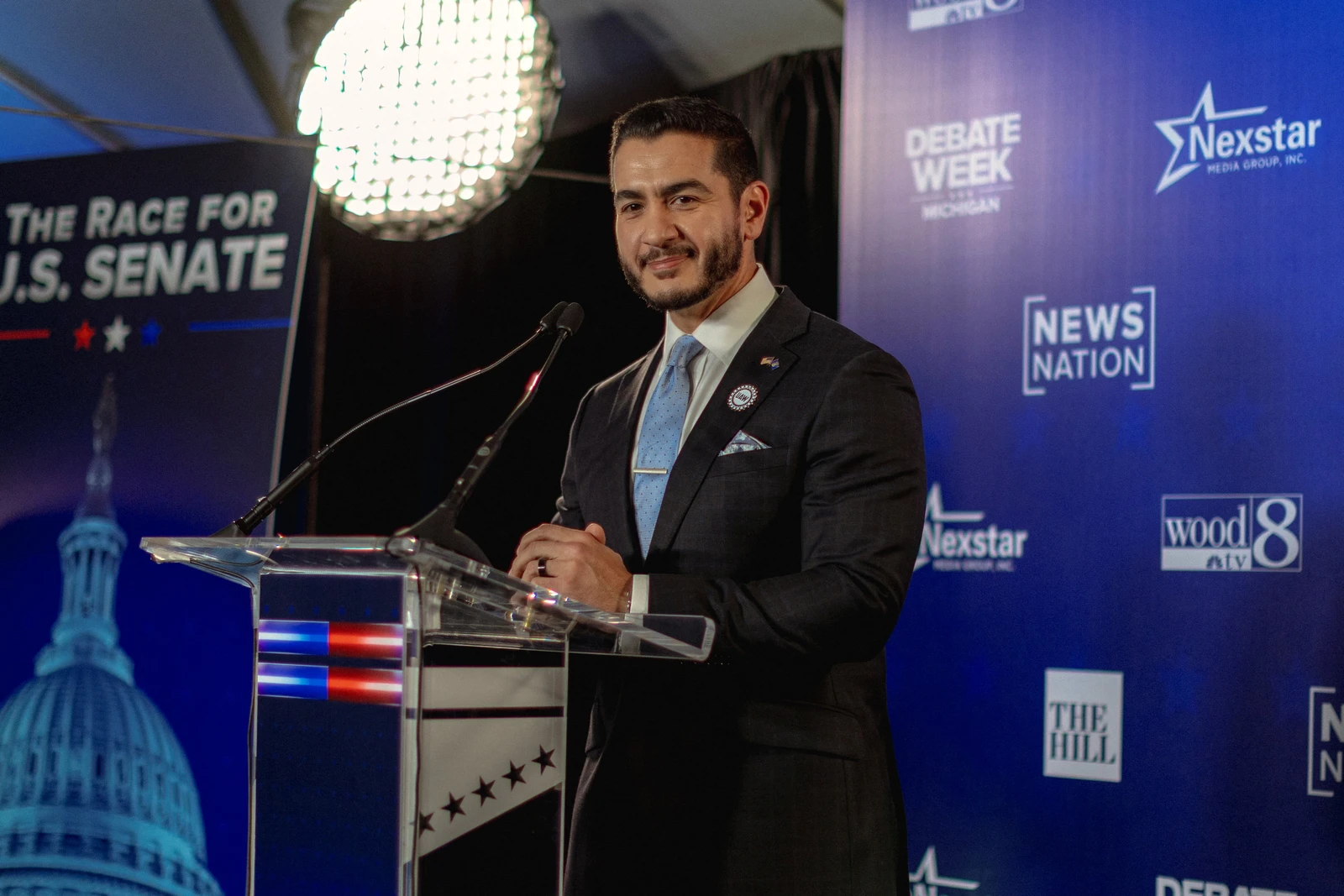
The most recent wave of Islamophobia focused on Michigan senator-elect Abdul El-Sayed, an epidemiologist, public health administrator, university professor, author and politician. His professional career has focused primarily on public health policy and administration, rather than treating patients.
But the prejudice has also touched others, including New York City Mayor Zohran Mamdani and 2018 Michigan congressional candidate Fayrouz Saad, who came fourth in a Democratic primary won by Rep. Haley Stevens.
El-Sayed in August defeated Stevens to win the Democratic nomination for this month’s Senate election. He ran against Republican Mike Rogers on Nov. 3 and won decisively.
As hateful as the campaign against El-Sayed has been, it is not unusual in US politics for religion to become an issue
Ray Hanania
Stevens went on to join the many Republicans who fanned the flames of Islamophobia through their criticism of El-Sayed. Most defended their actions by asserting they were focused on El-Sayed’s criticism of Israel, not on his religion.
But in many cases, the Islamophobia was obvious, such as when President Donald Trump told audiences he could call El-Sayed “Mohammed,” rather than by his real name, while also accused him of being a “jihadist” who would have to go through a metal detector when entering the US Senate building because he “was on the side of the terrorists.”
Vice President J.D. Vance reinforced Trump’s criticism, calling El-Sayed “very, very evil” and a “psychopath,” which is not the sort of language that is often heard in election campaigns. Retiring Alabama Republican Sen. Tommy Tuberville said El-Sayed was a “radical Islamist” who wanted to destroy America. And El-Sayed’s Senate opponent, Rogers, accused him of having links to extremist religious movement the Muslim Brotherhood. Many, including Texas Sen. Ted Cruz, said El-Sayed was seeking to impose “Shariah law” on Americans.
But as vicious and hateful as the campaign against El-Sayed’s religion has been, it is not unusual in American politics for religion to become an issue.
Long before Americans “worried” about the rising influence of Muslims in US society and politics, they were just as concerned about the rising influence of Catholics, who today make up about 31 percent of the American Christian population. That is a significant increase from 20 percent in the 1940s.
Much has changed in America over the past 65 years but racism and religious bigotry remain a problem in US society
Ray Hanania
In 1946, Catholic Democrat John Kennedy won the election for Congress for Massachusetts’ heavily Irish Catholic 11th District, before winning reelection in 1948 and 1950. In 1953, Kennedy defeated Republican incumbent Henry Cabot Lodge Jr., a Protestant, for the Massachusetts Senate seat. He was reelected in 1958.
These victories positioned him to announce his candidacy for president in 1959, winning the Democratic nomination in July 1960 while facing a torrent of anti-Catholic animosity that had also plagued his earlier election bids, although they had a much lower profile.
Much has changed in America over the past 65 years but racism and religious bigotry remain a problem in US society. They are just communicated and expressed in different ways.
In the 1960 presidential election campaign, Kennedy was up against a Quaker in Republican rival Richard Nixon. Critics questioned whether Kennedy would be loyal to America or to the Pope in the Vatican.
Back then, there was no internet or social media. Election campaigns relied heavily on mailers and flyers, local and national newspaper adverts, and radio and TV appearances. Kennedy’s campaign was plagued by accusations from Republicans that he would take orders from the Pope.
Nixon and other elected officials never publicly attacked Kennedy’s religion, with the Republican candidate even saying “I disapprove of the religious issue.” Most of the criticism came from the leaders of other religions. Kennedy responded to the criticism by insisting it was not an issue, famously declaring in a Sept. 12, 1960, speech in Houston, Texas: “I believe in an America where the separation of church and state is absolute.”
Clearly, the Islamophobic bigotry faced by El-Sayed has been far more pronounced and public than the anti-Catholic hatred expressed against Kennedy. Helping him confront the discrimination is his jocular, often comedic, attitude.
Rather than accusing his critics of racism or Islamophobia, El-Sayed turned to humor, calling Vance “habibi” and saying that the real issue is not “Shariah law” but rather “shawarma law,” while referencing his favorite Lebanese restaurant, Amo Sami’s Shawarma.
Ray Hanania is an award-winning former Chicago City Hall political reporter and columnist. He can be reached on his personal website at www.Hanania.com. X: @RayHanania


