
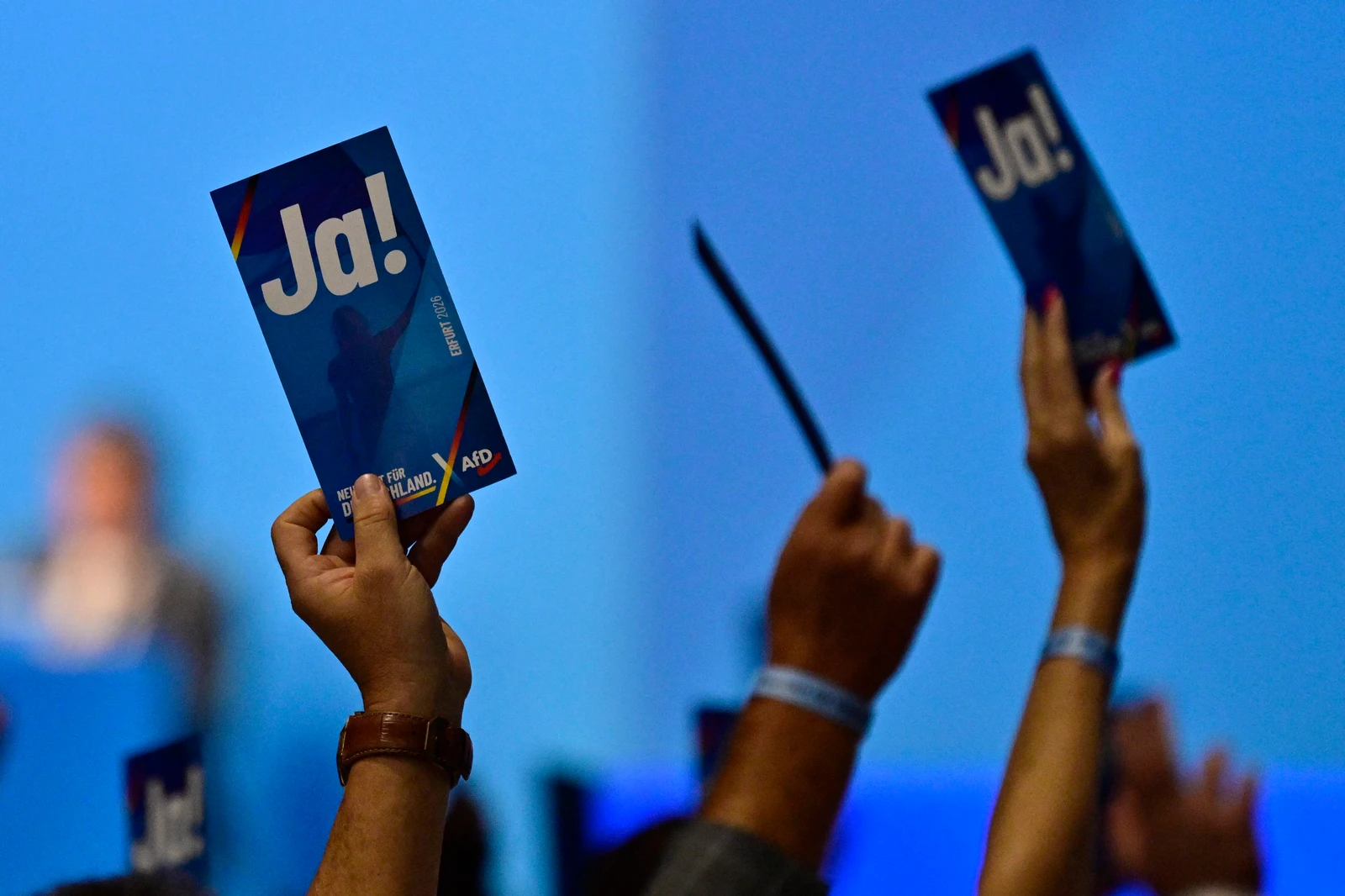

European politics has had yet another wake-up call. The startling success of Alternative for Germany in Saxony-Anhalt, where the far-right party this month received 43.8 percent of the vote and came within three seats of an outright majority, represents a harbinger of what is to come. This is the closest a far-right party has come to winning power in a German state since the Second World War.
The impact will be felt across the continent, representing a huge threat to immigrants, particularly Muslims.
Germany is the largest, richest and most powerful EU state. Understanding how Alternative for Germany has prospered matters.
Firstly, it is about the collapse of the mainstream parties. It is, in particular, a rejection of Chancellor Friedrich Merz and the Christian Democratic Union. Merz is on borrowed time, not least given the projected result of Sunday’s vote in the state of Mecklenburg-Vorpommern, where once again the Alternative for Germany received the largest vote share.
As with France and the UK, the traditional parties have been seen to fail. Voters are willing to experiment or even to protest. Traditional politicians must rethink their approach and perhaps be bolder, but at the same time not fall into the trap of becoming pale imitations of their far-right rivals. The Conservative Party in the UK has often tried to be even more right-wing than its rival Reform UK. It does not work.
Alternative for Germany’s anti-Muslim positions are as hostile as they can get, indulging in the most turbocharged of culture wars
Chris Doyle
The extreme right has been able to influence the agenda in many states, even when not in power. The Sweden Democrats, an extremist right-wing party with neo-Nazi roots, kept the outgoing right-leaning Swedish government in power for four years and helped kill off the open-minded, progressive Sweden of yesteryear. Last week’s victory for the center-left bloc may be welcome but the leading party, the Social Democrats, has moved more to the right in recent years, conceding many policy issues to the far-right agenda.
Secondly, these parties tap into widespread anti-immigration sentiment. Alternative for Germany’s slogan was “Germany for Germans.” It pushes the policy of “remigration,” which has become the siren song of the extreme right. It is a concept meaning voluntary return migration and has been kicking around for years — but what was previously embraced only privately is now done so publicly. The aim is not just to kick out regular migrants but also those citizens who have failed to “assimilate.” For Alternative for Germany, forced deportations are the future.
The more public embrace of this term in 2026 is remarkable. Back in January 2024, the recording of a meeting at Potsdam was leaked, in which the far right had gathered along with more mainstream figures. They discussed plans for mass deportations of immigrants, asylum seekers and non-assimilated citizens.
The public outrage was massive, with some of the largest anti-extremism protests in Germany’s history taking place. Remigration was Germany’s “Unwort des Jahres” (un-word of the year) for 2023. In 2026, it appears no longer to be toxic and Alternative for Germany is happy to embrace it, even as part of its 258-page governing manifesto. It has even targeted Ukrainian nationals for remigration.
Far-right parties are unlocking the gates to power. One has to wonder when the traditional parties will awake from their torpor
Chris Doyle
Remigration has also taken root as a rallying call for other far-right parties. There is even an annual summit on remigration to coordinate international efforts. The Freedom Party of Austria under Herbert Kickl included it in its 2024 election manifesto, “Fortress Austria.” This month, Kickl was demanding that remigration be inserted into the Austrian constitution.
Thirdly, the Alternative for Germany’s anti-Muslim positions are as hostile as they can get, indulging in the most turbocharged of culture wars. Muslims are freely depicted as culturally incompatible. The party endorses headscarf bans, wants to prohibit the construction of new mosques and generally exhibits hostility to Islam in all its forms. The Freedom Party of Austria calls for a ban on political Islam.
This goes hand in hand with a rise in anti-Muslim hate crime in many areas of Europe.
Much of this is based on the totally false claim — often pushed by influencers in the US — that Muslims are taking over Europe. The absurd notion that a caliphate will be established is too widely believed. The facts do not even come close to backing this up. Muslims in Europe are not becoming fanatical extremists either. They make up just 6 percent of the continent’s population. Moreover, Muslims in Europe have generally had decent success in assimilating.
All of this matters as 2027 will see a deluge of elections in Europe. France, Italy, Spain and Poland will all go to the polls. Marine Le Pen may win the French presidency. It should be stressed, however, that, unlike Alternative for Germany, Le Pen’s National Rally party is trying to appear less extreme, more reasonable. It is not embracing remigration but remains steadfastly anti-immigration. The implications of any National Rally victory would ricochet across Europe and beyond.
The far right is no longer on the margins. Its parties are unlocking the gates to power. One has to wonder when the traditional parties will awake from their torpor. They need a strategy and to propose solutions.
Chris Doyle is director of the Council for Arab-British Understanding in London. X: @Doylech


