
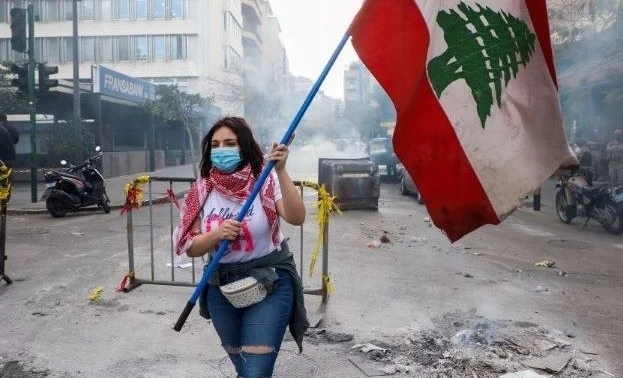

A Lebanese nowadays does not need COVID-19 lockdown rules to observe a semi-constrained existence permanently. Over the years, Lebanese people have gotten used to adapting and making do after four decades of civil strife, conflicts, wars and occasional near total collapse of state and society.
As Lebanon gears up for elections to be held on May 15, in the hope that a newly elected legislature can usher in a new government that is able to navigate the internal consensus and its heavy regional patronage to deliver basic services, the Lebanese have to be content with a Cinderella-like lifestyle of struggle. They must organize their daily existence according to the electric power supply schedule from the national grid and the many private local suppliers of energy at exorbitant prices.
Mothers rely on alternative privately owned generators’ schedules to decide when to use the washing machine or when it is possible to take a sick toddler to the doctor. Deliveries are tied to whether the lift is working, not if you were at home to receive the goods, and students rely on power banks to use computers to complete their assignments. Electric appliances in homes are constantly failing due to the irregular supply and freezers are rarely reliable to offer a drop of cooled water and on top of that, they are often empty due to the economic crunch.
A bankrupt government can barely run its power plants; alleged kickbacks to the political elite have permanently starved the national grid that has functioned at a slow pace long before the recent crisis. The alternative generators’ costs per average household are about $200 a month for a between 5 and 10 amp capacity, which is equivalent to more than a month’s salary for most Lebanese. Lifts in apartment blocks are subject to an independent fee factored into households’ monthly service charge. Many inhabitants of tower blocks have decided to opt out and keep fit going up and down the stairs as they have to choose between food on the table and the luxury of using a lift.
This is in a country where average earnings since the collapse of the Lebanese lira have plummeted, after Lebanon defaulted on its debts more than two years ago, thereby reducing the value of the Lebanese people’s earnings dramatically. The political stalemate and the absence of reform or any convincing rescue plan has led to inflation, and people have suffered from the capital controls imposed by the state as a way of preventing a run on banks. This means that creditors have to beg for a monthly $200 withdrawal from their own savings at banks, if they have any.
I can go on and write more about the Lebanese people suffering daily strife, but what has struck me the most while visiting recently is that Beirut, the city that used to never sleep, turns pitch black when the clock strikes midnight — like Cinderella everyone rushes home before the generators fall silent for the night.
Who is to blame and is there a way out?
The traditional political class that has been overseeing Lebanon’s descent into the gutters of history are busy campaigning and debating their elections’ manifesto. The new so-called revolutionary youth class that emerged after the October 2019 revolution is still calling to replace the antiquated political class but it is getting fed up with trying to get some of its candidates to parliament. The challenge, of course, is having a specially tailored electoral law that will surely keep most of their candidates out in favor of the dominant families and warlords.
One also notices that the various calls for reform continue to correspond with each person’s capital biases, which are deeply entrenched in his or her religious or secular values, sectarian priorities (at the expense of their national identity,) and commitment to regional proxies or axes — instead of making national interest supreme to all other discourses.
Everybody in Lebanon is a Cinderella waiting for a knight. Hopefully such knights will come armed with the Internet, a power supply and fresh dollars (a common term for newly transferred funds in dollars to differentiate from the funds and savings locked in the nation’s banking system), presenting the country with some hope of navigating local intransigence and delivering on the aspirations of trying to resuscitate their country.
The core problem remains that the leaders have all acknowledged the rife corruption but deny that they are responsible.
Mohamed Chebaro
I am pessimistic that these elections — if not postponed due to some last-minute adversity — could deliver any of that. I feel alarmed about how the political forces of Lebanon continue to amuse themselves by insulting each other, trading corruption accusations, when no one in Lebanon is under any illusion that these are mere representatives of foreign interests working to advance some peripheral geostrategic goals at the expense of the people's well-being.
The core problem remains that the leaders have all acknowledged the rife corruption but deny that they are responsible. The once-reliable Gulf countries, who underpinned for decades Lebanon’s reconstruction and economy, have pulled out their constant generous aid in recent years, protesting Iran’s supreme influence in Lebanon through Hezbollah.
Unless these elections result in applying urgent reforms that disregard the interests of the dominant political class and pave the way for foreign aid to trickle back in, they will be meaningless. Currently, 80 percent of Lebanese people are likely to get poorer, some of them skipping meals, while the currency could lose more than 90 percent of its value. Moreover, state debts are also likely to balloon beyond the 500 percent of its GDP. The Cinderella-style existence for the Lebanese is here to stay, until some national sense of cohesion triumphs in the face of an oppressive and heartless establishment clamping down on the Lebanese people’s right to live in peace, freedom and prosperity.
- Mohamed Chebaro is a British-Lebanese journalist, media consultant and trainer with more than 25 years’ experience covering war, terrorism, defense, current affairs and diplomacy.


