
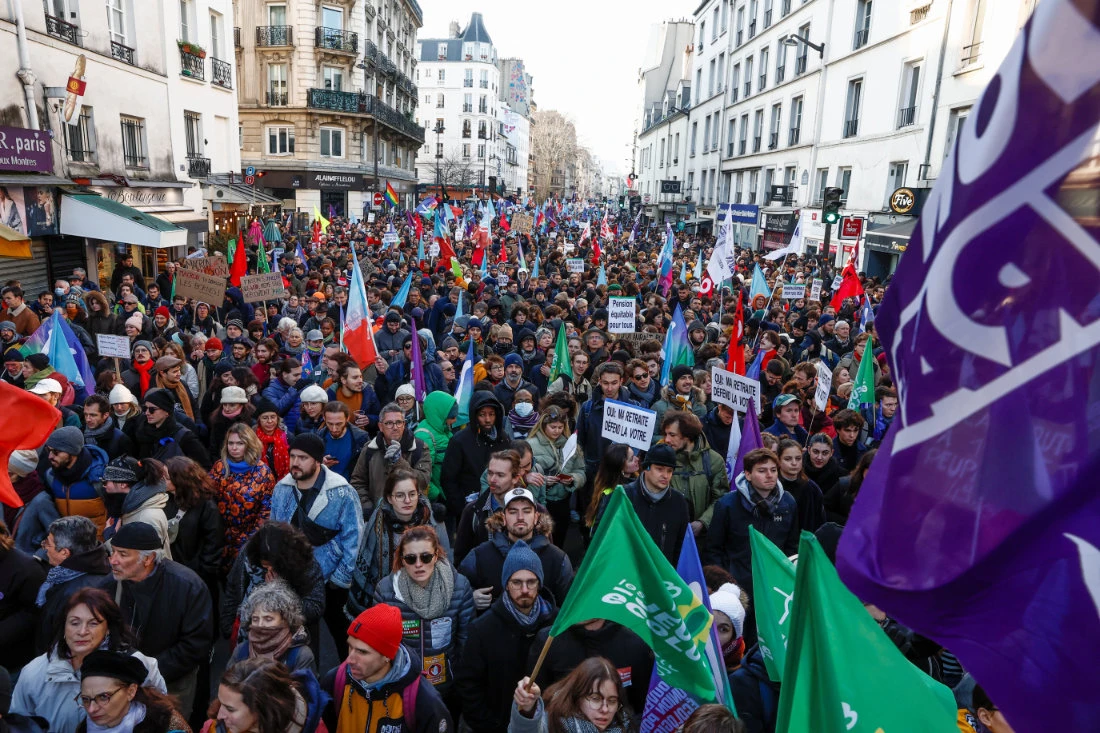

Encouraged by the massive turnout for Thursday’s nationwide strike in France against the pension reforms proposed by President Emmanuel Macron, trade unions have warned that their actions will intensify in the days ahead and have already called for another strike on Jan. 31.
The fresh strike action did indeed receive widespread support across various segments of the French economy and was not limited to public-sector employees, who are often accused of being spoiled by an overgenerous French state. While this criticism may apply to some public-sector workers, it is a fallacy when compared to the broader public sector and certainly the private sector, especially less-skilled or unskilled employees on the lower rungs of employment.
This is also true of most private-sector employees, barring a handful of segments such as finance or technology. Regardless, pension reform has long been on the list of things to do for several presidents for well over a decade. The concern is about the supposedly sharp growth in deficit that the pension system may face in the decades ahead, mainly due to an aging population. While some presidents have toyed with reform, but backed off in the face of a series of strikes, Macron has made it almost a matter of personal prestige to push through with change.
Macron tried hard in the first term, but had to withdraw in the face of opposition. Now he is trying to push through the reforms as one of his legacies, hence the importance he is attaching to this. However, it is hardly going to be a cakewalk for him as he has lost his majority in the French parliament and will have to depend on support from other parties to be able to propel the reforms through.
While it remains to be seen whether Macron will manage to convince other parties to take a stance that is evidently so unpopular, the main issue is, does France need pension reforms? In one word, no. Yes, the country is facing an aging population; yes, there is a deficit in the pension system, which is supposed to grow in the years ahead; and yes, some of the conditions at workplaces in France are highly regulated and burdensome for a modern work culture to thrive in.
But the devil is, as usual, in detail. France is still among the fastest-growing large EU countries, in terms of population growth and fertility rates. Its birth rate was 10.4 per 1,000 people, compared to 9.1 in Germany or 6.9 in Italy.
A total of €345.1 billion was collected under various pension schemes in the country and the nation registered a surplus of more than €3.5 billion in 2021, and last year, too, saw more money coming into the retirement kitty than being paid out. Even by the government’s own estimates the deficit is likely to be only around €7-€12 billion by 2030 — which is less than 0.5 percent of total tax collections and hence easily bridgeable by tinkering with the taxes paid by the richest 1 percent of the French population.
Macron should focus on raising additional revenues by taxing companies and the rich.
Ranvir S. Nayar
Yes, France has to cut its fiscal deficit in line with EU norms. However, since 2017, Macron’s entire focus seems to have been on how to generate more revenue by cutting government spending, with this year’s budget forecasting a growth of less than 0.6 per cent in public spending, the lowest in two decades. There is only so much more that the French government can hope to save by cutting corners, and each further cut will only lead to more heartburn among the poor, who are increasingly feeling, and being, left behind.
Though France is supposed to be one of the most egalitarian societies, the reality is somewhat different. Inequality has risen sharply since 2018 and has been exacerbated since the outbreak of COVID-19.
Since the start of his first term in May 2017, Macron has been called a “banker’s president” or the “president of the rich” due to his past in investment banking.
Unfortunately for Macron, his policies while in power over the past six years have gone a long way to reinforcing that opinion. He has slashed taxes on companies and done away with the wealth tax.
It is time that Macron recognizes the problems of the poor and finds ways to ease their suffering rather than cut away at the only support they have. According to the Organisation for Economic Cooperation and Development, France has one of the lowest shares of corporate tax as part of its total revenues, as well as the lowest in terms of personal income and profits and gains, while it is the second highest in tax collections to GDP ratios. High overall tax collections come almost single-handedly due to high social security taxes.
It is no secret that the wealth of the ultra-rich in France, like elsewhere in the world, has grown significantly in the past three years, driven by a stock market boom. This is also true of the wealthy and upper-middle classes who have had windfall earnings since the outbreak of the pandemic. Similarly, the profits of the corporate world have risen obscenely over the past decade.
Macron should focus on raising additional revenue by taxing companies and the rich. Even a minor rise in tax rates for the wealthy and large companies can generate a windfall that will not only cover the government’s fiscal deficit but also generate a surplus. It is not only morally the right thing to do but also democratic, as tax rises for companies or the rich will make a small dent in the enormous wealth of a minuscule minority while easing the pressure on the poor who currently bear the burden of not just their own needs, but also those of the super-rich.
• Ranvir S. Nayar is managing editor of Media India Group.


