
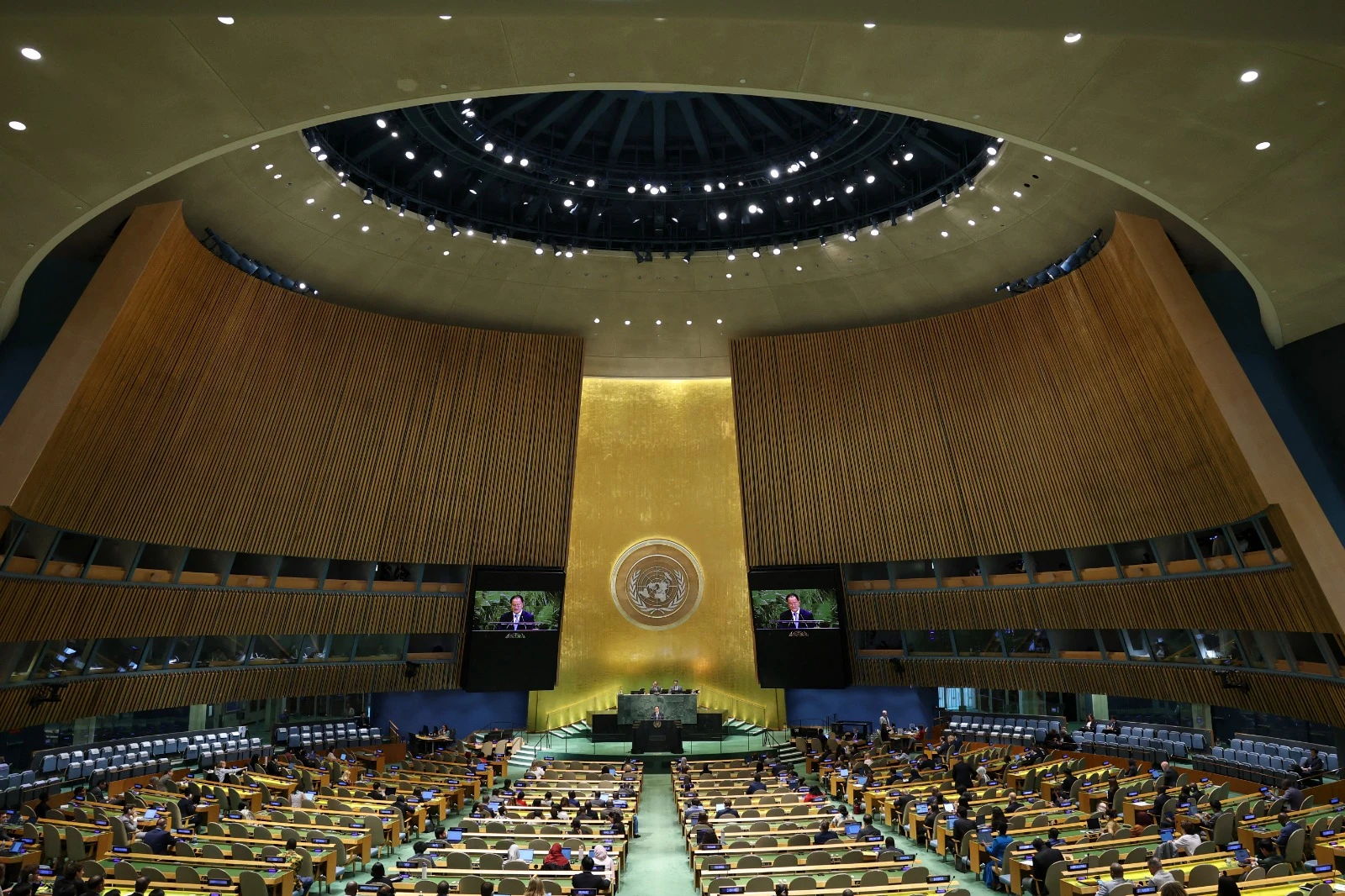

Sessions of the UN General Assembly have lost much of their glow and much of the hope once invested in them. Leaders go to renew their wager on an awakening of international legitimacy, however late. Before that, they go to address their own people from this international platform. But in reality, they are betting on a public relations spectacle taking place outside the hall of speeches and wishes.
In previous decades, the leaders of small states would paint their countries’ tears onto the walls of the UN. The General Assembly lived for a long time amid the clamor of the confrontation that dominated the world of two camps. The building in New York holds memories of raucous hours that captured the world’s attention: a scene of Soviet Premier Nikita Khrushchev banging the desk with his shoe; of Fidel Castro, with the allure of his charismatic personality, his beard and his olive-green fatigues, delivering a seemingly endless, fiery speech denouncing American imperialism and affirming himself as a thorn lodged in its side; and of Muammar Qaddafi tearing up the UN Charter and throwing it to the floor, flooding the Libyan delegation with astonishment, embarrassment and shame.
Time is an executioner that cuts the neck of dreams and illusions. Castro’s mausoleum suffers repeated power cuts for lack of fuel. His country writhes over the fire of crises, awaiting the hour of its fall into the hands of its neighbor and enemy, America. Castro is no longer a source of inspiration at home or abroad. Most likely, he would have felt terrible pain on being told that “General” Donald Trump had led his Venezuelan comrade Nicolas Maduro off to an American prison and struck a deal with his aides.
The world has changed. The Soviet delegate’s name has become the Russian delegate. The master of the Kremlin can no longer sit with the master of the White House as an equal to discuss the management of the world’s affairs. The heir of the Red Army has been fighting on Ukrainian soil for years and is enlisting the soldiers of Kim Il Sung’s grandson to reduce the number of bodies returning to the Russian frost. This long war befits neither great Russia nor its leader, Vladimir Putin. The statements of his shadow, Dmitry Medvedev, are regrettable; he speaks as though he is turning a nuclear bomb over in his hands and brandishing it at an aging Europe.
The people of the Middle East feel that Antonio Guterres’ organization has become a mere relief agency
Ghassan Charbel
This week, the people of the Middle East will not pay much attention to the speeches of the General Assembly. They feel that Antonio Guterres’ organization has become a mere relief agency, sending flour, tents and blankets to the victims of fires. It has fallen captive to the envoys of the great powers and to regional schemes. The world will certainly turn its attention to the summit when Trump receives his “friend” Xi Jinping, director of the “factory of the world” and the laboratory of artificial intelligence.
The eyes of the people of the Middle East will not turn to New York. If the UN had weapons other than wishes, it would have used them. Instead, the eyes of the people of the Middle East will be turned to Bab Al-Mandab. What happened there certainly goes beyond the intra-Yemeni conflict. It is a regional and international matter.
It is impossible to believe that the Houthis carried out their attack on their own initiative. Their history indicates that their weapons are Iranian and their decisions are Iranian. It is difficult to believe the world will agree to Iran’s attempt to win the title of policeman of the two straits.
To understand what happened in Bab Al-Mandab, one must pause at what US Central Command commander Adm. Brad Cooper said: that American forces had facilitated the passage of more than a billion barrels of crude oil through the Strait of Hormuz over the past two months and helped more than 2,000 commercial ships transit the chokepoint. But more serious than this was his statement that Iran had been unable to export a single barrel of oil due to the American naval blockade.
Most likely, the harshness of the American blockade pushed Iran to use its cards to provoke a major energy crisis at the global level and to limit the chances of the American Republican Party in November’s midterm elections. Seizing control of the Bab Al-Mandab Strait appears to be an Iranian punishment of Trump, who imposed the naval blockade.
Most likely, the harshness of the American blockade pushed Iran to use its cards to provoke a major energy crisis
Ghassan Charbel
The blockade’s effectiveness is confirmed by the continuing deterioration in the value of the Iranian currency. There are those who believe that Iran — which has come to fear that Iranians will take to the streets in protest at the mounting economic deterioration — is inclined to cause a major explosion in the region in the hope that it pushes the world to demand a final ceasefire, easing its exit from the present impasse, in which it is floundering. These people place the Houthi attacks on Saudi Arabia in this context.
Observers are inclined to speak of difficult months ahead if the Iranian decision remains captive to the semi-suicidal policies pursued by the generals of the Revolutionary Guard, with the blessing of the supreme leader.
The question is: Who will lead the region out of its present condition? If we exclude the possibility of America returning to direct military pressure, many believe that China is the only party qualified to play a role here if the Trump-Xi summit lays down a serious road map for coexistence, competition and cooperation between the two giants. The fate of the two straits concerns China, which depends on the region for its energy supplies, and its strong relations with Iran enable it to exert pressure to moderate Iranian policy. But does China want to leave its cautious style behind and engage in finding a solution for a region whose stability is crucial to its own economy as well as that of the whole world?
Bab Al-Mandab concerns the region and the world far more than the scenes of the General Assembly. From Ukraine to Sudan and on to Bab Al-Mandab, the keys appear to reside in the drawers of the president of the US, not in the drawers of the secretary-general of the UN.
Ghassan Charbel is editor-in-chief of Asharq Al-Awsat newspaper. This article first appeared in Asharq Al-Awsat. X: @GhasanCharbel


