

If a journalist digs into the recent memory of the Middle East, he fails to find beautiful or optimistic events. Those are completely absent or rare. Road signs are burdened with wars, collapses, assassinations, militias, poverty, deception and suicidal tendencies. They also bear the marks of ancient cities that had lost their spirit, role and youth, some of whom jumped into the “death boats.”
On Sunday, we realized that six months have passed since the beginning of the Al-Aqsa Flood. On Tuesday, we will mark the 21st anniversary of an American armored vehicle uprooting the statue of Saddam Hussein from Al-Firdos Square in Baghdad. The overthrow of Saddam’s regime left a bold mark on the region.
The fall of the Iraqi wall contributed to the birth of the current scenes. Iranian influence was allowed to flow into the region from Baghdad to Gaza. Maj. Gen. Qassem Soleimani was permitted to put into effect the Iranian constitution’s clause that pertains to “exporting the revolution.”
This helped him establish “small parallel armies” that today participate in different ways in the open conflict in the region. We will not delve further into the past years. We already know that the toll is painful.
Six months have passed since the start of the “flood” and Benjamin Netanyahu’s war on it. The toll is horrific. In none of the previous Middle East conflicts have we witnessed such intensity of killing, such a systemic approach and such ingenuity. May God forgive artificial intelligence for some egregious crimes.
The numbers are so cruel. In Gaza, 34,000 people have been killed, two-thirds of them women and children, in addition to 90,000 wounded. Famine knocks on tent doors and threatens 600,000 children. In Israel, 1,500 people have died, including 600 soldiers, while 200,000 have been displaced from their homes.
The economic losses in Israel are enormous. The cost of rebuilding Gaza exceeds all estimates. Netanyahu has returned the Gaza Strip to the “stone age,” trying to write off Hamas and Gaza together.
Six full months. The conscience of the world was late in waking up. This is something usual. But in recent weeks, the blood of Gaza’s children has been able to drip onto the walls of consciences and decision-making centers, especially in the West.
Scenes of the Nakba infiltrated parties and universities and occupied the screens. There has been increasing talk of double standards and the moral downfall of the West. The division appeared clearly in societies, warning of a widening gap between the components. The new facts forced the American administration to move from stressing that the war should not expand to demanding that it stop, instead of just allowing the entry of aid.
Sympathy for Israel has become an obvious burden. There has been increasing conviction in the West that any permanent ceasefire must be accompanied by a firm commitment to open the political horizon to a solution that provides for the establishment of an independent Palestinian state. Living with war turned into a kind of participation in it. Silence has also become costly to the image, interests and electoral campaigns.
In parallel, Israeli confusion has escalated at home. Netanyahu’s unrealistic slogans demanding complete victory, the uprooting of Hamas and engineering the next day in Gaza have been revealed. Israeli voices have risen to warn that Netanyahu’s stay will be a severe punishment for the Israelis themselves.
The security establishment participated in questioning Netanyahu’s method of managing the war and its slogans, which have pushed Israel to the verge of international isolation. In this context came the “angry” telephone call between US President Joe Biden and Netanyahu. In the same context, demands mounted to halt the US’ supply of weapons and ammunition to Israel or to at least slow down their delivery. Despite internal and external pressure, Netanyahu has resisted any attempt to achieve a truce.
Iran did not rush to turn the Al-Aqsa Flood into an opportunity for the “big strike” that was being discussed in the offices of the leaders of the so-called resistance axis. It chose not to engage in a large-scale war, which the US quickly cautioned of and supported its warning by sending naval fleets.
Tehran instead chose limited wars of distraction across the Lebanon front, Houthi drones and missiles in the Red Sea and occasional statements by some Iraqi factions about striking targets in Israel. The Iranian calculation may have been based on an old decision to avoid any direct conflict with the US, in addition to the fact that the state of disintegration in Syria and Lebanon would make any engagement in a wider war disastrous in every sense of the word.
Iran maintained “strategic patience” when Israel attacked its military shipments in Syria and targeted a number of Revolutionary Guard officers. It announced that it would respond “at the appropriate time and place,” but preferred to respond through its allies and under the umbrella of not causing a widespread war.
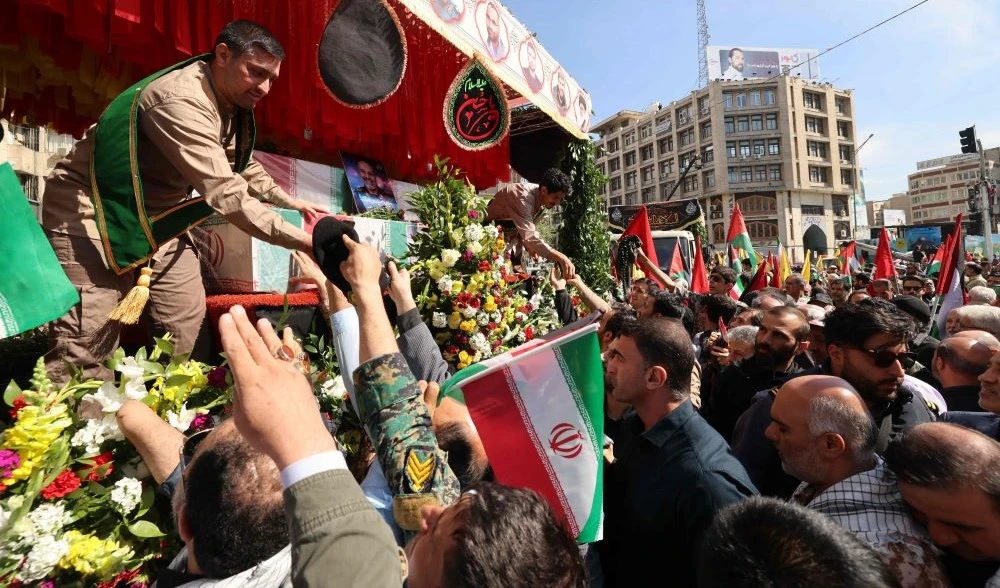
On April 1, Netanyahu took the game to the ugliest stage yet. He authorized the destruction of the Iranian consulate in Damascus. A senior IRGC commander, Brig. Gen. Mohammed Reza Zahedi, and six other officers with active roles were killed. The location of the attack, its outcome and its timing were all factors that made it extremely dangerous. Senior Iranian officials, led by the supreme leader, pledged revenge and to make Israel “regret” its action. If the world had lived, since the start of the flood operation, on the timing of the Gaza tragedy, then, after the attack on the consulate, it moved to Iranian time.
Last week, the countries of the Middle East, along with other major capitals, were preoccupied with one question: where will Iran respond? This question dominated screens and social media, accompanied by many parallel speculations.
Israeli voices have risen to warn that Netanyahu’s stay will be a severe punishment for the Israelis themselves.
Ghassan Charbel
Will we witness the fall of missiles and drones launched explicitly from Iranian territory against targets in Israel? If that is true, what will be the size of the strike? What will be the Israeli response to it? Will we see Israeli aircraft attacking targets in Iranian territory? What about the Iranian nuclear facilities? Will America participate in intercepting Iranian missiles? What will the next day be like? Can America stay out of a direct Israeli-Iranian confrontation?
It is obvious that we are in the most dangerous phase of the conflict that began six months ago. Netanyahu decided to shuffle the cards and is on the verge of expanding the conflict. Any direct Israeli-Iranian clash will plunge the Gaza war into a conflict over the boundaries of roles and spheres of influence in the region. In this war, the new alignment will not be in favor of Gaza. Moving from Gaza timing to Iranian timing may result in a new flood that is difficult to contain.
- Ghassan Charbel is editor-in-chief of Asharq Al-Awsat newspaper. X: @GhasanCharbel
- This article first appeared in Asharq Al-Awsat.


