
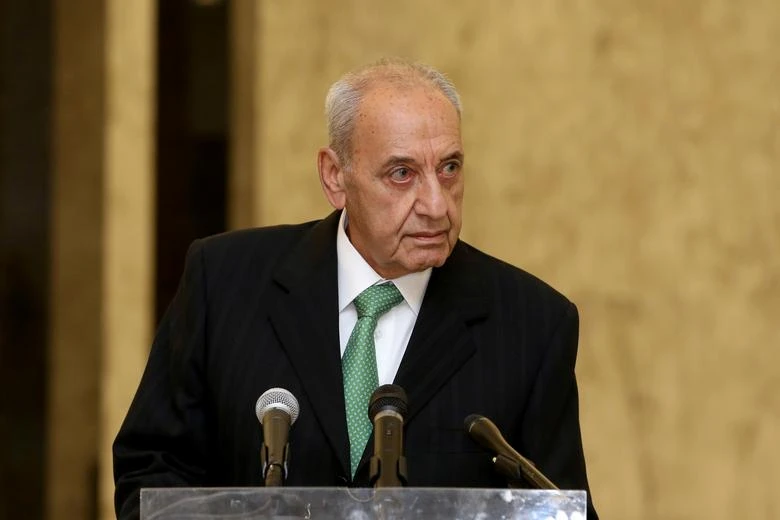

Following the failure of the French initiative, coupled with the criticism that President Emmanuel Macron unleashed on Hezbollah, Parliament Speaker and Hezbollah partner Nabih Berri last week unexpectedly announced that Lebanon was ready to demarcate its maritime border with Israel. This position, along with the soft stand of the Assad regime on the Abraham Accords, drives us to question whether the “resistance front” is crumbling or if these overtures are just time-buying maneuvers while waiting for the US presidential election.
In Lebanon, the political elite has reached a deadlock and is struggling to secure its survival. When Prime Minister-designate Mustapha Adib failed to form a government due to Hezbollah and Amal’s insistence on controlling the Ministry of Finance, Macron sent a veiled threat to Hezbollah. He said that the group does not respect the Lebanese and that it cannot be a political party while also operating as an army against Israel and a militia against Syrian civilians. This might mean removing the distinction between Hezbollah’s military and political wings and imposing sanctions on the group’s political figures, which would add to the existing crippling US sanctions.
In addition to the political impasse, more and more people now see Hezbollah as a stumbling block regarding a rescue package from the international community. Now that Berri’s close circle has been hit by the US’ sanctioning of former Finance Minister Ali Hassan Khalil, Hezbollah’s allies are feeling the heat, especially as Washington has promised that more sanctions are on the way.
So, in a sudden change of mind, Berri last week announced that Lebanon was ready to hold negotiations with Israel over the countries’ maritime borders. It is interesting to analyze this sudden shift by Berri, given that this issue has been on the table for the past 14 years. However, every time the US administration suggested talks on the subject, it was dodged by Berri and his adviser. It is in the interests of Hezbollah to have points of contention with Israel, the same way it is also in the interests of Israeli Prime Minister Benjamin Netanyahu, in order to maintain the legitimacy of their respective narratives. Netanyahu needs Hezbollah in order to justify his belligerent policies and Hezbollah needs the Israeli occupation to justify its arsenal.
After the withdrawal of Israel from southern Lebanon in 2000, Hezbollah put forward four conditions for giving up its arms. The first was that Israel had to give it the map of landmines it planted in the south. However, this demand is irrelevant as the area has since been cleared with the help of the UN and other friendly nations. The second condition was a prisoner exchange, which was conducted following the 2006 war. Hezbollah’s third condition for disarming was for the Lebanese Armed Forces to become strong enough to protect the country from any attack, and this has been achieved over the years with the help of more than $2 billion of American aid. The final condition was the departure of Israel from all Lebanese soil. This just leaves Shebaa Farms, the small village in the south of Lebanon, as the last point of contention.
Berri justified the border demarcation talks as a way of generating funds through gas extraction in order to support Lebanon’s ailing economy. However, given the difficult time Hezbollah is going through, the talks could offer the group a graceful exit. We have to remember last month’s bombing of its arms depot, which the party claimed was due to a technical error. However, in Netanyahu’s speech at the UN General Assembly last week, he said the group had another arms depot in Beirut and gave its specific location. Later, the Israeli Defense Forces released information on two additional sites. Lebanon’s Al-Modon news website on Sunday reported that Hezbollah could be infiltrated and that the Israelis could have the coordinates of all the group’s storage facilities. In this doomsday scenario, where Hezbollah faces the destruction of all its facilities in Lebanon, it would be better off voluntarily relinquishing its arsenal using a face-saving argument.
Meanwhile, unlike its patron Iran, Syria has kept silent on the Abraham Accords; and it even sent a subtle message that it might be open to following suit. Mahdi Dakhlallah, a senior Baath Party official, said on state-run TV last month that Syria would leave the resistance axis if there was a Russian-American consensus and a Palestinian state was established. This surprised his interviewer, who asked Dakhlallah whether this would be a long-term project. He answered that the situation might be very close.
Given the difficult time Hezbollah is going through, the border demarcation talks could offer the group a graceful exit.
Dr. Dania Koleilat Khatib
The Syrian regime is crippled by sanctions and is unable to consolidate Bashar Assad’s rule. Photos of long queues of people waiting to fill their cars with petrol are all over the internet, while Russian and Chinese companies are reluctant to invest in the country and become subject to US Caesar Act sanctions. In this difficult situation, could Iran’s proxies be defecting and warming to the US by making “goodwill” gestures toward Israel?
This could also be a time-buying technique, which the Iranian and Syrian regimes have mastered. Looking back at the negotiations with the US regarding the nuclear portfolio, the Iranians kept on enriching uranium, while maintaining and prolonging the talks, until their nuclear capabilities reached a level that allowed them to dictate the conditions they wanted. As for Assad, any observer of current negotiations in Geneva can see the same maneuver. The Syrian ruler has no intention of changing his behavior and has no interest in any political transition, but he keeps sending his delegations to Geneva to show the international community he is ready to negotiate, even though all he is doing is putting down hurdles to prolong the negotiations without reaching a binding agreement.
Hezbollah and Assad might be buying time, hoping for a Joe Biden win. What are the true intentions behind Hezbollah and Assad’s overtures? We won’t know until after Nov. 3.
- Dr. Dania Koleilat Khatib is a specialist in US-Arab relations with a focus on lobbying. She is the co-founder of the Research Center for Cooperation and Peace Building (RCCP), a Lebanese NGO focused on Track II. She is also an affiliated scholar with the Issam Fares Institute for Public Policy and International Affairs at the American University of Beirut.


