

The violence perpetrated by the Houthis has three interlocking dimensions whose continuation threatens to produce ever more severe repercussions for Yemen, the region and the wider international system. If left unchecked, they risk embedding patterns of impunity, deepening the humanitarian catastrophe and destabilizing global energy markets.
The recent escalation — marked by ballistic missile and drone strikes on civilian infrastructure in Saudi Arabia, intensified operations against Yemeni government forces and threats to energy facilities — demonstrates that the group has crossed critical thresholds of international law. The international community, particularly the UN Security Council, faces a test of its capacity to uphold the norms it has articulated.
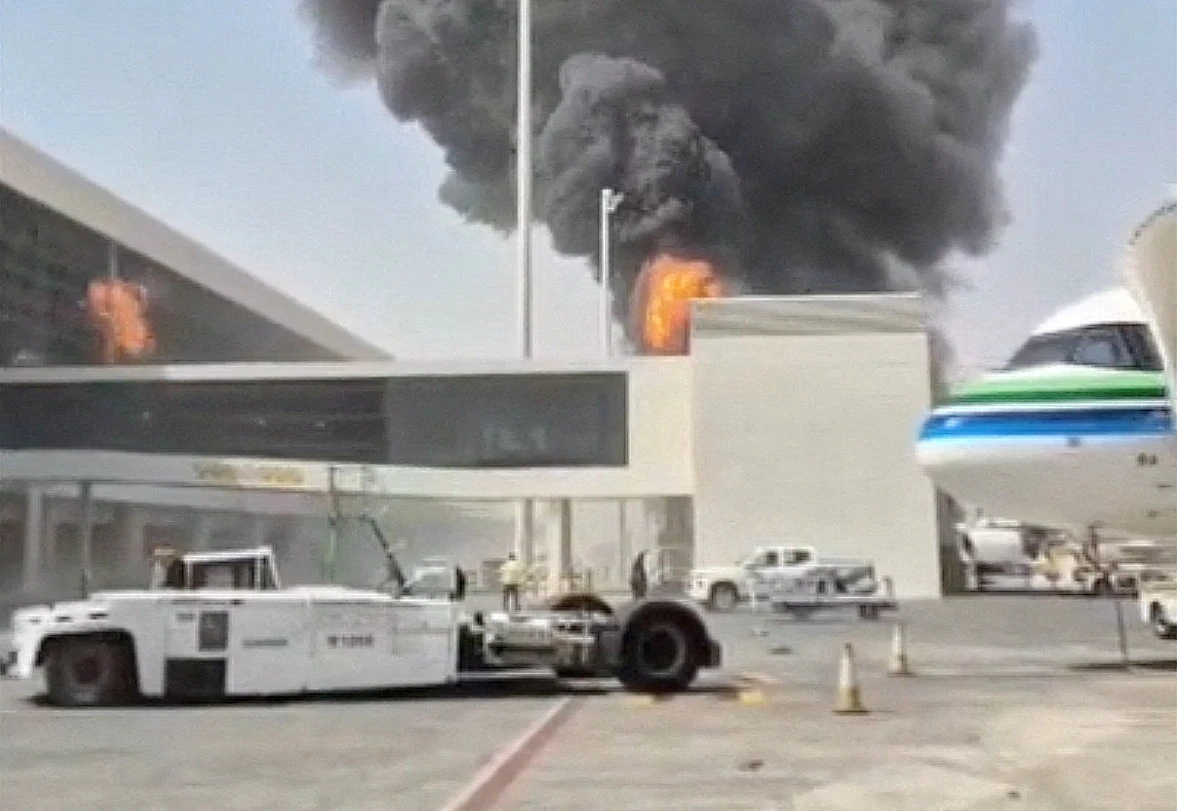
The first dimension is that the Houthis have engaged in acts that constitute serious violations of international humanitarian law, while the global response has remained largely declarative rather than operational. The attacks on King Khalid International Airport in Riyadh, which killed at least 13 civilians and wounded more than 300 others, together with repeated strikes on other Saudi airports and energy infrastructure, represent the deliberate targeting of civilian installations.
These actions violate the fundamental principles of distinction and proportionality under the Geneva Conventions. They also contravene successive UNSC resolutions, most notably Resolution 2216, which demand the Houthis cease military escalation, respect civilian objects and refrain from acquiring or deploying advanced weapons in violation of the targeted arms embargo.
The international community faces a test of its capacity to uphold the norms it has articulated
Dr. Majid Rafizadeh
The unprovoked character of the strikes directed at civilian aviation and residential areas near energy installations marks a clear shift, meaning that the Houthis chose soft targets whose primary function is civilian. Such conduct and the lack of a firm international response emboldens nonstate armed groups. When militia organizations observe that attacks on civilians elicit condemnation without decisive collective action, they are incentivized to expand the geographic and operational scope of their campaigns.
The present episode therefore tests the credibility of the UN system and the willingness of member states to translate legal obligations into coordinated political, economic and, where necessary, military measures. Silence or purely rhetorical responses risk confirming to the Houthis and like-minded actors that the international legal order can be challenged with limited consequences.
The second dimension concerns the trajectory of the conflict inside Yemen. By intensifying military operations against the internationally recognized Yemeni government and its forces, the Houthis are deepening an already protracted civil war. The group’s advances along the Red Sea coast, coupled with attacks on government-held areas including the presidential complex in Aden, have produced further displacement, civilian casualties and erosion of the remaining state institutions.
Yemen already suffers from one of the world’s most severe humanitarian crises. Continued Houthi offensives risk transforming the country into a more fragmented and enduring theater of internal conflict, comparable in scale and human cost to the devastation witnessed in Sudan. The recruitment of children, restriction of humanitarian access and deliberate targeting of civilian population centers compound the domestic catastrophe. Failure to constrain the Houthis therefore condemns Yemeni civilians to prolonged suffering and undermines any prospect of a sustainable political settlement.
The third dimension centers on energy security and the integrity of the rules-based international order. Houthi strikes on Saudi energy infrastructure, including facilities associated with Aramco, and threats directed at oil export routes and refining capacity introduce volatility into global energy markets. With Saudi Arabia being one of the world’s largest crude oil exporters, any disruption to the industry in the Kingdom elevates prices and imposes costs on importing states across every region. The Houthis’ actions thereby impose an economic penalty on the international community.
More fundamentally, the campaign constitutes an assault on the principles of diplomacy and international law. By treating civilian aviation hubs and energy assets as legitimate military targets and by threatening commercial shipping, the group challenges the norms that underpin peaceful interstate relations and freedom of navigation. The cumulative effect is a test of whether the international system can protect both the physical security of energy infrastructure and the legal architecture that regulates the use of force.
In light of these three dimensions, the UNSC must move beyond condemnation to enforceable measures. The presidential statement issued last week correctly identified the attacks on civilian aviation and energy infrastructure and reaffirmed the obligation to implement Resolution 2216.
The group is challenging the norms that underpin peaceful interstate relations and freedom of navigation
Dr. Majid Rafizadeh
Yet statements alone are insufficient. Member states should coordinate a calibrated response encompassing political isolation, tightened enforcement of the arms embargo, targeted economic pressure and, where necessary, collective military measures to degrade the Houthis’ capacity to launch further cross-border attacks. Parallel support should be extended to the Yemeni government so that it can restore territorial integrity and protect civilian populations. The Houthis have crossed red lines. The response must therefore be multidimensional: military where required for self-defense and deterrence, economic to raise the cost of continued aggression, and political to close diplomatic space for the group.
The Houthis operate as a known proxy of Iran, drawing weapons, technology, training and strategic direction from the Islamic Revolutionary Guard Corps and associated networks. Iran’s continued facilitation of this relationship is self-defeating. Escalation in Yemen and the Gulf increases the probability of broader regional conflict, invites greater external military involvement and compounds the economic pressures already confronting sanctions-hit Iran.
Iranian interests are not advanced by the indiscriminate killing of civilians or by the further isolation of Tehran. It is therefore in Iran’s own strategic interest to exercise its influence to compel the Houthis to cease attacks on civilian targets and to return to negotiations. Continued support for such operations constitutes a form of self-harm that ultimately strengthens the case for tighter international measures against both the proxy and its sponsor.
In conclusion, the Houthis have crossed red lines through the deliberate targeting of civilians and the commission of acts that violate core tenets of international humanitarian law and UNSC resolutions. Their violence is not confined to Saudi Arabia — it intensifies regional instability, deepens Yemen’s internal collapse and threatens global energy security and the normative foundations of the international order.
If the UNSC and the broader international community fail to act decisively — through coordinated military, economic and political instruments — the Houthis will be emboldened and the costs will be borne by civilians across the region and by economies worldwide. Iran, as the principal ally, must recognize that permitting these operations damages its own interests and it should immediately pressure the Houthis to halt. The violence must be stopped now. The alternative is progressive deterioration domestically, regionally and globally.
Dr. Majid Rafizadeh is a Harvard-educated Iranian-American political scientist. X: @Dr_Rafizadeh


