
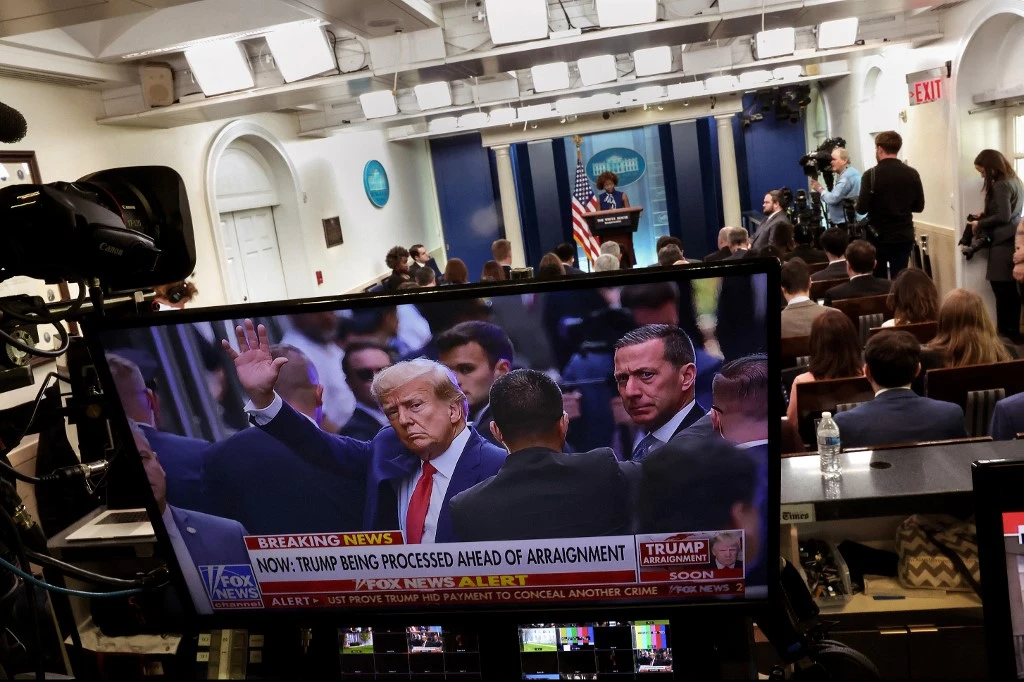

Two weeks ago, during a Future Investment Initiative Institute event in Miami, Arab News Editor-in-Chief Faisal J. Abbas made a brief and sharp comment on US media. He said that, in America, the distinction between news and opinion had become a gray area. He argued that the root of this phenomenon had to do with the fact that the long-standing fairness doctrine, which mandated public broadcasters to give equal time to both sides of an argument, was abolished under President Ronald Reagan. As a result, today, “people who watch Fox News have a completely different understanding of reality than people who watch CNN or MSNBC,” Abbas said, adding that social media only intensified the problem.
The greatest threat facing the US today is polarization. The media has been used as a tool by politicians to cultivate their own audience and construct an ideology. Unfortunately, while the US is supposed to be a civic and modern state, in which the main concern should be citizens’ dignified well-being, today the discourse is completely ideological. This is because politicians only think from one election cycle to the next. And they are driving media content.
Instead of the media acting as a fourth estate that ensures balance in the political discourse, it is being driven by partisanship and political divisions. Since politicians are only concerned about the next election, they use the most controversial and polarizing issues to garner support. They adopt ideological stances that do not really make an important difference to the daily lives of the average American citizen. Hence, issues such as gender identity and abortion are emphasized and take center stage in the public discourse. On the other hand, issues that affect the daily lives of ordinary Americans, such as deteriorating living standards, increasing homelessness and the unaffordability of rent and of college educations, are not being tackled.
One reason for this approach is that politicians use provocative issues to galvanize people. Another reason is that these controversial issues are easy to deliver on. Issues such as banning abortion or regulating sex education in schools only require a decision. By contrast, complex issues such as fighting poverty or improving living standards require intensive work and offer only longer-term benefits.
Instead of the media acting as a fourth estate that ensures balance in the political discourse, it is being driven by partisanship and political divisions.
Dr. Dania Koleilat Khatib
Today, when I listen to the discourse in the US, I think I am in a third-world country where leaders feed people ideology because they have nothing else to give them. They are not interested in delivering good governance and a decent standard of living.
In the US, the public discourse drives election campaigns. Campaign promises evolve to become public policies. Unfortunately, as today’s election campaigns unfold, we see how ideological issues are gaining prominence. It is either about promoting “wokeness” or killing it. No one talks about the real issues facing the average American. To improve policies, the political discourse has to change and start focusing on real issues.
So, what should be done? Reinstating the fairness doctrine is important as a start. However, the situation is much more difficult than in 1987 because of social media, where anyone can post anything and claim it is news. Nevertheless, the US government has a role to play in taming this polarization. The first step is to change mindsets. People in power should start thinking as statespeople and not as politicians. Instead of seeking to create an “other” and make popular gains by demonizing it, they need to start thinking about how to bridge the gap and bring people together by focusing on the issues that face the average American, regardless of whether they are conservative or liberal. The public discourse should change; it should become more grounded in everyday realities.
The US media also has a responsibility to assume in order to overcome this polarization and the pedantic narrative that is plaguing American public discourse. The media should highlight the deficiencies in the US system that are affecting the quality of life of the average citizen. The second objective should be to discuss issues that unite Americans. While the prevailing public discourse labels people as either liberal or conservative, the media should create a narrative that bypasses divisions and partisanship. The third objective should be to suggest executable solutions that will improve the quality of life of the average citizen.
Instead of falling into the trap of the blame game, the media should host commentators who are solution-oriented. The media should spread awareness among the general public on the real issues instead of being distracted by secondary issues brought up by politicians. This will end up redirecting the public discourse toward real and important issues and decreasing polarization.
- Dr. Dania Koleilat Khatib is a specialist in US-Arab relations with a focus on lobbying. She is president of the Research Center for Cooperation and Peace Building, a Lebanese nongovernmental organization focused on Track II.


