


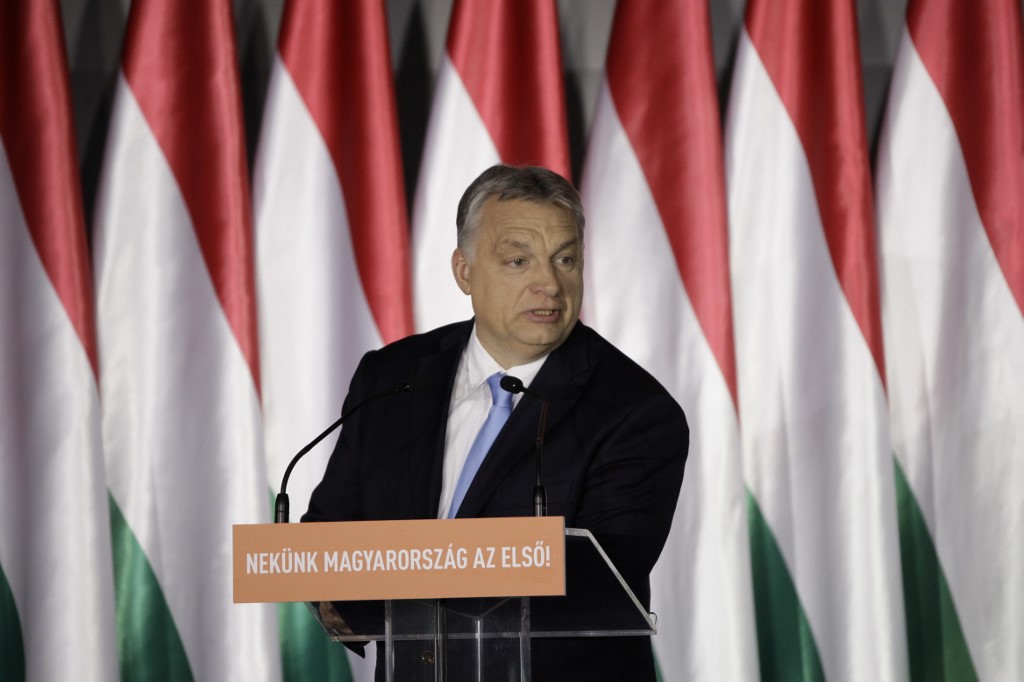
Hungarian Prime Minister Viktor Orban declared that “the age of liberal democracy is at an end” after his third successive electoral victory last year. “It is no longer able to protect people’s dignity, provide freedom, guarantee physical security or maintain Christian culture.” Europe’s imploding political center ground is in a state of defensive confusion, while right-wing forces of anarchy and division surge toward the corridors of power.
I’m a regular visitor to Scandinavia and often marveled at these nations’ benevolent worldview and “socialist” social model, defined by progressive, tolerant values and high living standards for all. However, in last year’s Swedish elections the far right scored its best-ever result. Last week in Finland, the far-right Finns Party gained additional seats with a rabidly anti-immigrant agenda. These results represent a hollowing-out of the political center ground, as citizens have begun to favor far-right and far-left parties.
This polarization is in evidence in most Western nations, not least the US, where Donald Trump continually panders to his conservative base, leaving Democrats torn between confrontation and pragmatism. Western politics has long oscillated between a center-left and center-right “liberal consensus,” jointly committed to primacy of the rule of law and democratic values. This centrist consensus is dissolving, leaving nations increasingly divided and ungovernable.
France has been rocked by mass protests (featuring extreme left and right tendencies). Spain’s Popular Party hopes to distract voters from recent corruption scandals through a sharp lurch to the right ahead of forthcoming elections. Meanwhile, having won the Israeli elections on a platform of theft of Arab lands, Benjamin Netanyahu looks intent on leaping into bed with the country’s extreme right.
After being goaded into a ruinous Brexit referendum by the populist right, the UK finds itself paralyzed and polarized between entrenched “hard Brexit” and “Remainer” camps, with vengeful Brexiteers agitating that Britain should crash out of the EU without a deal, irrespective of the catastrophic consequences. With Britain now almost certainly compelled to participate in the EU elections, a collapse of confidence in mainstream politicians may fuel a surge of protest votes for the newly formed Brexit Party. Meanwhile, Jeremy Corbyn’s leadership has tugged the Labour Party toward the far left, prompting some centrist MPs to break away and establish a pro-Remain party.
The far right’s Europe-wide impact has habitually been diluted by mutual hostilities. As one MEP noted: “If your main line is that you hate foreigners, it’s a bit difficult to work with foreigners.” Nevertheless, Orban, US alt-right ideologue Steve Bannon, and Italian Interior Minister Matteo Salvini have labored to establish a “transnational supergroup,” engaging closely with like-minded leaderships in Poland and Austria. Poland’s Law and Justice Party, Hungary’s Fidesz, the Italian League, Alternative for Germany, Marine Le Pen’s National Rally, and Greece’s Golden Dawn are among the factions that could capitalize on an expected increase in public support in May’s EU elections to unite as a transnational bloc.
Although these elements are not expected to win a majority, they could wield tremendous influence over legislation; for example, allying with the center-right to force through anti-immigration measures, or exacerbating chaos and dysfunction within EU institutions, particularly if they are able to claim chairmanship roles in major committees. Having made careers out of anti-EU rhetoric, these figures now see the EU as a Trojan horse for attaining continent-wide superiority. France’s Le Pen called for a “European alliance of nations” to “save Europe from the European Union that is destroying it.” Austria’s interior minister has called into question the European Convention on Human Rights over its migrant protections.
The European extreme right can no longer simply be ignored, so it is a question of whether it can be contained
Baria Alamuddin
For 70 years, the far right was an impotent force in European politics, having been discredited by Nazism, while the mainstream media and political parties tended to conspire to ignore, ridicule and marginalize these elements. Extremist factions often ended up in legal jeopardy for hate speech, incitement, anti-Semitism (particularly Holocaust denial), flirtations with violence, or financial misdemeanors. Until relatively recently, it was unusual, and somewhat shocking, to see far-right figures represented in the media — now they are everywhere. The European extreme right can no longer simply be ignored, so it is a question of whether it can be contained.
Liberalism has struggled to respond because of its laudable commitment to freedom of speech and open democracy. So how to respond to those who abuse these values to seize power and undermine democracy itself? Anti-democratic elements inciting racism and religious hatred should, by definition, be excluded from the democratic process. As prerequisites for political participation, parties should prove their active commitment to the rule of law, political pluralism and respect for the rights of all.
Failure to police these values allows authoritarian elements to surge to power on dishonest populist platforms. After they hijack the governing system, these fascists inevitably dismantle democratic institutions, seeking to retain power permanently. If Europe’s liberal values are to prevail, liberalism must learn to defend itself.
In recent days, Facebook banned a number of British far-right entities. Such action is a necessary but insufficient step. Those immersed in the internet’s melting pot of extremist ideas frequently migrate from far right to far left and back again — it is the same hotchpotch of anti-establishment, xenophobic, conspiracy theory-laden rhetoric that, in other contexts, has also nourished Islamist extremism. Russian trolls ruthlessly cultivate both ends of the spectrum as a route to subverting Western democracy.
In my travels across Europe, I meet liberals who are unnerved by growing political extremism in their own localities, yet often fail to see the bigger continent-wide picture. This is partly why I keep returning to this theme: None of this is normal or tolerable.
Rather than busying itself unsuccessfully trying to put out fires in its own backyard, Europe’s liberal mainstream must regain its identity, self-confidence and globalized worldview in order to holistically confront this extremism; before the extremists themselves become the mainstream and banish liberalism to the political margins.
• Baria Alamuddin is an award-winning journalist and broadcaster in the Middle East and the UK. She is editor of the Media Services Syndicate and has interviewed numerous heads of state.


