
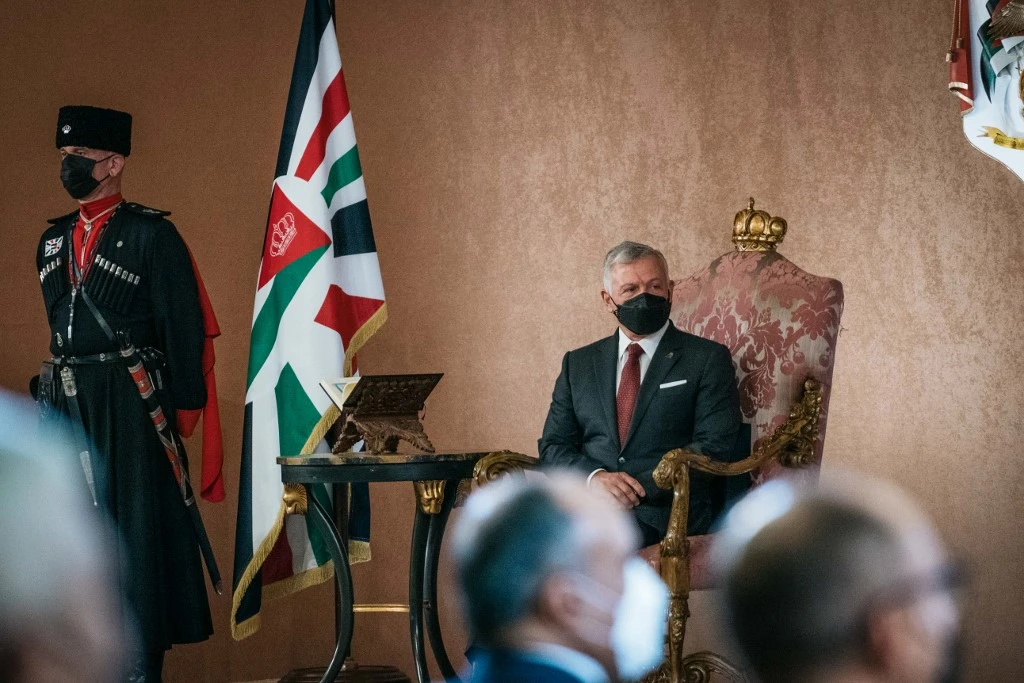

Jordan’s lawmakers have begun their initial debate of constitutional amendments sent by the government, along with two pieces of legislation. The proposed political parties and election laws were drafted by a royal committee that was assigned the task of modernizing the kingdom’s political life. When King Abdullah appointed the committee, he gave his personal guarantee that the government would not interfere in its work or alter its suggestions. And that is what happened, except that the government unexpectedly bundled the constitutional amendments with the draft laws that were sent to parliament.
The objective of drafting new election and political parties legislations was to move the country — gradually and over a number of election cycles — to full parliamentary governments; something the king himself talked about following the Arab spring. The last time Jordan had a government that was made up of political parties was in the late 1950s. With the collapse of that government, political parties were banned until the early 1990s, when parliamentary life resumed.
At first reading, the two draft laws, if adopted, would signal a major shift in the country’s political life. Since the mid-1990s, successive governments have adopted variations of the single-vote system that was aimed at curtailing the influence of the Islamists and limiting the number of their representatives in the lower house. While the single-vote system did just that, it had a damaging effect on other aspiring political parties — now numbering more than 50, with very little public recognition and almost no presence in the lower house. The void was filled by independent candidates relying on their tribes and/or financial means. Over the years, the system produced weak and pro-government deputies that had no political programs at the national level. Public frustration with submissive parliaments led to lower voter turnout and even lower confidence in the credibility of the legislative branch.
Meanwhile, the king appointed the head of the government and key Cabinet ministers and, with the increasing limitations of the legislature, the executive branch suffered little oversight, while enjoying considerable and largely unchecked powers. It is no wonder that Jordan’s political landscape is often described as stale and barren.
With mounting economic pressures and high unemployment and poverty rates, Jordanians have become increasingly frustrated with the way the country is run by appointed governments. Under these circumstances, the king took the move to revive the political scene and put the country on the road toward parliamentary and accountable governments. That journey may take a decade or more. But that is not the issue that is irking lawmakers and constitutional and legal pundits. For them, the proposed constitutional amendments are seen as a preemptive move by the “system” to derail future parliamentary governments by increasing the powers of the monarch and creating a fourth branch of government under the title of the National Security Council.
Whoever suggested these amendments has failed to appreciate the far-reaching damage they could do to the symbol of the state and to the state itself
Osama Al-Sharif
Jordan’s constitution confines the general mandate to the executive branch, which governs in the name of the king, who is not accountable. The proposed amendments are sure to alter that basic pillar and create constitutional loopholes that would blur the well-defined lines separating the various branches of the state. Critics have gone as far as warning that the amendments, if approved, would turn the kingdom into an absolute monarchy, while sterilizing future governments. The proposed National Security Council, headed by the king and including the prime minister and other Cabinet members, will become a new branch of government. Who this new body will be accountable to is not clear.
Whoever suggested these amendments has failed to appreciate the far-reaching damage they could do to the symbol of the state and to the state itself. The logic behind them, if any, would have been to immunize the state against a radically ideological parliamentary government that may be formed in the future. The intentions may have been noble and honest, but the solution is far from ideal and it does not serve the interests of the country. It also reflects an anxiety about the premise that Jordanians can one day rule themselves.
In the end, while the government did not interfere in the proposals of the royal committee, it did add a blatant caveat to what was supposed to be a lifeline for Jordan’s stale political life.
This is a quid pro quo formula that is almost impossible to resolve. Any embrace of the proposed amendments, which would be challenged by legal and constitutional pundits, would pave the way for the passage of the two pieces of legislation that would put Jordan on the long road toward forming parliamentary governments. To reject them would make the whole deal null and void. The question is, even if the deal goes through, would the new constitutional reality allow for the revival of political life in Jordan?
• Osama Al-Sharif is a journalist and political commentator based in Amman. Twitter: @plato010


