
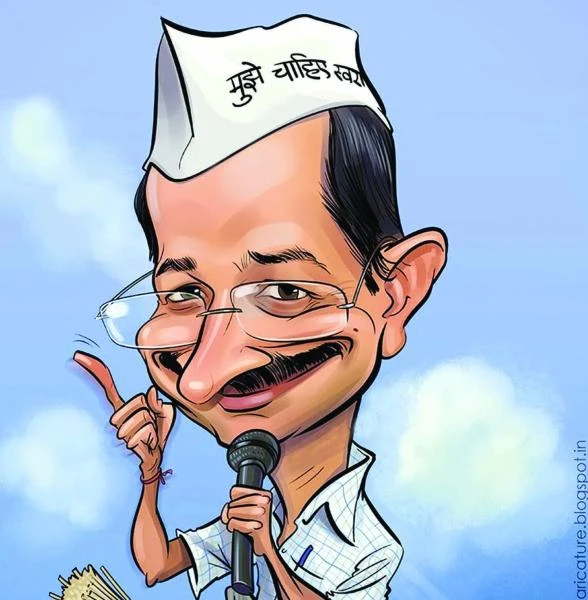

Arvind Kejriwal, leader of the Aam Aadmi Party (AAP), has been ruling the Indian news airwaves since April 5, 2011 when septuagenarian Gandhian Anna Hazare unleashed first of his agitations against the United Progressive Alliance (UPA) government.
For about 18 months he remained under the shadow of Hazare. But in November 2012 he kicked aside the Anna Hazare crutches and started walking on his own when he launched the AAP. Fast forward a year later and Anna Hazare, the guru, was nowhere and his avowed disciple Kejriwal had overthrown him — both in the popularity charts as well as in the Indian media: Print, electronic and digital.
Today Kejriwal is a far taller figure than his guru Anna Hazare who had mesmerized the whole of India like never before too long ago. Hazare peaked up too early (when Indian general elections were still a good three years away) and lost his iconic connect with the masses. His repetitive slogans and his much too predictable anarchist strategies based on street power play were responsible for his fall.
A similar fate seems to be in store for Kejriwal, Hazare’s disciple, who is repetitive and predictably whimsical in his ways.
What a pity! A man who had fired the imagination of millions of Indians and conjured up a vision for clean, corruption-free governance for his countrymen is hurtling down to new lows everyday, largely because of his misplaced priorities and an inflated ego.
Like a Shakespearean tragic hero, Kejriwal’s “hamartia” (tragic flaw) is his hubris. And like a Shakespearean tragic hero, he brooks no dissent and heeds no counsel as he feels that the entire world has ganged up against him.
Like a Shakespearean tragic hero, he will have his nemesis. This nemesis awaits him when the Indian general elections are held in less than 100 days from now.
Kejriwal’s AAP still has stars in its eyes and wants to contest 400 Lok Sabha seats, out of a total of 543. Till Jan. 21, he looked set to repeat AAP’s stunning political debut in Delhi assembly elections barely six weeks ago. His party with 28 seats did not emerge as the single largest political party in the 70-member Delhi assembly and yet Kejriwal ended up becoming the chief minister of Delhi, thanks to outside support from the Congress, which has eight legislators.
But from Jan. 21 his support base has eroded sharply (though he would never agree to this!) and chances of his replicating his party’s Delhi victory nationally have withered considerably.
On Jan. 21, the Delhi chief minister started his sit-in protest from the Rail Bhavan front lawns in Lutyen’s Delhi. Rajpath, the venue of the nation’s main Republic Day function on Jan. 26, was less than 200 meters away. The Prime Minister’s Office in South Block on the Raisina Hills was less than a kilometer away.
Kejriwal began his agitation, with Republic Day five days away, claiming that it would be an indefinite one. His demand was a trifle considering all the damages that he threatened to inflict on the Indian nation state: Suspension of five Delhi Police officers who dared to disobey illegal orders of his lawless Law Minister Somnath Bharti for taking action against African nationals for unproven and unsubstantiated charges of running a drugs and sex racket.
On Jan. 22 evening he abruptly called off his agitation after Delhi Police sent two of the five officers on leave. The climax was as anti-climatic as the whole agitation itself. During these two days, Kejriwal liberally indulged in the exercise that he, his ministers and his party office-bearers have a penchant for: Shooting off their mouths and refusing to believe in the age-old dictum “Speech is silver, silence is golden.” He repeatedly admitted his detractor’s allegation that he was an “anarchist” and said: “Yes, I am an anarchist.”
During his two-day-long agitation he repeatedly threatened to disrupt the Republic Day and exhorted his supporters to throng the agitation venue. His appeals fell on deaf ears and not many people came. The peak strength of his supporters during the agitation was a couple of thousand, a far cry from a few weeks ago when hundreds of thousands of people had thronged Ramlila Maidan to witness his swearing in as Delhi chief minister.
True to his style, he threatened to take recourse to street power play even when he took salute as the Republic Day chief guest at the Delhi state function.
Like a Shakespearean tragic hero, Kejriwal’s hubris is propelling him to his downfall without him being aware of it. He can’t see what is visible to the world around him: that he has lost the plot and the goodwill that he had earned for over past three years.
The biggest beneficiaries of this sordid drama would be the political system that he had opposed so ably and admirably. The biggest losers will be the Indian public or the “aam aadmi,” whose cause he had been espousing.
Kejriwal has written his own political epitaph. This is the supreme irony in this black comedy of Indian politics in recent times.
- The writer is a New Delhi-based political commentator who tweets @Kishkindha


