
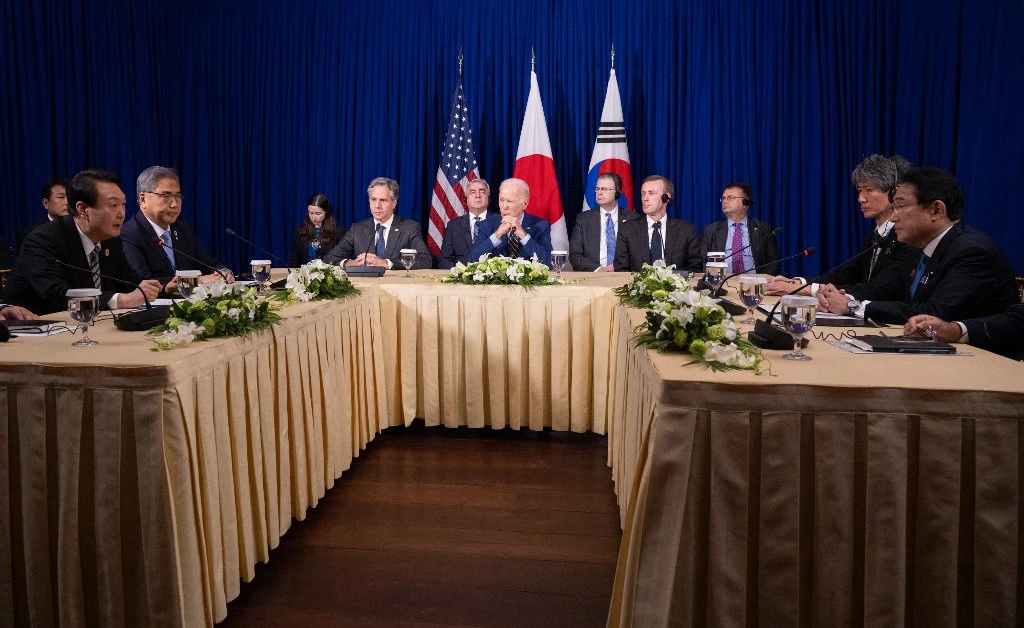

This week, a new trilateral arrangement is bringing Japan, South Korea and the US closer together on the strategic and tactical level. The grouping is yet another security construct necessary for the Northwest Pacific threat environment. This trilateralism helps to generate new programs in other key Pacific Ocean locations, bringing a sense of stability in an increasingly contentious neighborhood. There have been some key successes in organizing and cooperating on these nations’ security interests.
This concept of triangulation is an important, dynamic function in diplomacy and security. Triangular diplomacy is not new, but in the current geostrategic context the concept is increasingly useful to halt multipolarity and preserve Western policy credibility. In this vein, successive Korean and Japanese governments have been seen as a “balancer,” a “hub,” or even a “middle power.”
To go one step further, there are three so-called middle power conceptualizations related to three possible East Asian triangulations, which hold significance for all three countries’ foreign policy in the Northwest Pacific. North Korea sees this alliance building and is calling it “Pacific NATO.” China was also unhappy with the new trilateralism, accusing it of “politicizing” the region.
Specifically, research shows that this triangulation can best be described as the US-China-Japan triangle, the South Korea-North Korea-Southeast Asia humanitarian geoeconomic peace and development triangle, and the South Korea-Japan-Association of Southeast Asian Nations geopolitical triangle. This last triangular feature was a factor in President Joe Biden’s meeting with the South Korean and Japanese leaders at the ASEAN Summit in Phnom Penh, Cambodia, last week. This event illustrated the trajectory of the triangulation toward greater interoperability on multiple policy levels as a result of malign and malicious behavior by East Asian state actors.
The US, South Korea and Japan can be a political and economic engine against China, North Korea and Russia
Dr. Theodore Karasik
At the UN General Assembly in September, US Secretary of State Antony Blinken, Japanese Foreign Minister Yoshimasa Hayashi and South Korean Foreign Minister Park Jin met to reaffirm their commitment to strong triangular cooperation as “ironclad alliance commitments.” This language is important at this particular juncture based on bad behavior by North Korea.
These bilateral meetings came two months after a trilateral meeting on the sidelines of the NATO summit in Madrid, Spain. These were all important steps toward the triangulation seen today that is bringing Seoul closer to the US-Japan nexus.
These countries have synergies in advanced warfare and electronics, stimulus of trade and innovation, and an alignment of high-tech industries that, bound together, can be a political and economic engine against China, North Korea and Russia. The three sides also agreed to share “real-time missile warning data” to cope with Pyongyang’s missile launches.
Seoul and Tokyo can now embolden their General Security of Military Intelligence Agreement. Thus, in the triangulation conceptualization, Washington is giving full support to its “extended deterrence,” or force projection, to defend South Korea and Japan. The three countries are increasingly reinvigorating their bilateral and joint military drills and “demonstrations of force” in response to North Korea’s provocations in terms of its incredible uptick in various missile tests.
In addition, triangulation by the three countries helps to develop a more robust Pacific Ocean security architecture that keeps in mind the stability of the entire oceanic expanse. In this configuration, they are able to more strongly influence outcomes in other parts of the Indo-Pacific by being guided by a unified vision. An Indo-Pacific doctrine is the overarching security aspect that helps this triangulation target key security dilemmas.
One particular focus is Pacific Island partners, especially in terms of agriculture and food stability, but also the availability of fresh water and economic viability. This triangulation also wants to bolster engagement with ASEAN and, within the ASEAN-led architecture, to maintain a peaceful and stable region. Issues in the ASEAN countries become easier to coordinate on, especially how to resolve Myanmar’s humanitarian and political crises.
It would be remiss to say that triangulation works all the time. It can have its blowback or an exclusionary issue with other states by showing too much favoritism and thus alienating other countries or governments. This factor is why there is such a focus on the ASEAN member states. South Korea, Japan and the US want to avoid the mistake of leaving any like-minded government out of any policy processes.
Clearly, triangulation is allowing more robust cooperation between allies to strengthen the rules-based economic order and promote prosperity in the Indo-Pacific region. It is meant to be a trendsetter, allowing for deeper alliance-building by its inclusion in the Australia-UK-US security organization as part of a multilayered approach. The emergence and development of multiple Indo-Pacific-themed security organizations over the past few years is now being augmented by greater trilateralism. It is an approach that may be producing benefits, especially with the full cooperation of all three sides of the US-South Korea-Japan triangle.
- Dr. Theodore Karasik is a senior adviser to Gulf State Analytics in Washington. Twitter: @tkarasik


