
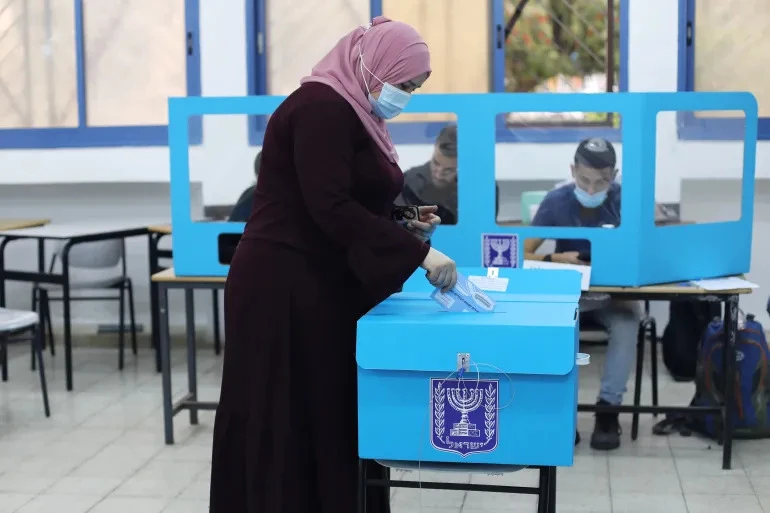

Israel’s Palestinian parties landed 19 seats in last week’s Knesset elections, provoking the ire of hard-liners in the country. Prime Minister Benjamin Netanyahu accused them of fraud and of stealing the elections. While everyone was talking about the pleasant surprise of the Palestinian parties’ success, no one looked closely at the dynamic, namely at a particular faction of the Palestinian population of Israel: the people of the south, the Bedouin population of the Naqab.
We are talking about more than 300,000 people in the Naqab, including Bir Al-Saba. According to my source, the people of the Naqab gave 125,000 votes to the United Arab List (Ra’am) led by Mansour Abbas and 20,000 to the Joint List. What drove so many people in the south to vote was their constant marginalization by successive governments. Ra’am is based on an Islamic movement. Such movements are by nature very active at the grassroots level. Ra’am is also very effective in working with the marginalized factions of society. Initially, the movement came from the south, the hub of disfranchised Palestinian communities in Israel.
Ra’am represents the southern wing of the Islamic movement inside Israel. This movement split into two branches in 1996, with the northern branch being led by Sheikh Raed Salah and the southern by Sheikh Abdullah Nimar Darwish. The latter was later developed by Abbas. The party represents a mixture of its Islamic background and the defense of the civic and national rights of Palestinians inside Israel. It is characterized by its high degree of pragmatism. While many Palestinian citizens of Israel take the position of boycotting the government, Ra’am seeks change from the inside, through engagement. Though it is an Islamic movement, it works on issues that directly affect people’s lives and does not really tackle ideology.
What drove so many people in the south to vote was their constant marginalization by successive governments
Dr. Dania Koleilat Khatib
The south now has more representation in the Knesset than ever before. Waleed Al-Hwashle and Ibrahim Al-Turi are both now members of the parliament from the south. Al-Turi, a pharmacist from Rahat, secured seventh position on the Ra’am list as its Bedouin representative. Rahat is the largest Palestinian Bedouin city in the south, with a population of 82,000. It is a large city, a forced settlement and most of its residents have been displaced from other places inside historic Palestine. It voted extensively for Al-Turi.
Voter turnout in the Naqab last week reached 80 percent for the first time. According to Mansour Nasasra, an expert on the Bedouin population of the region, “This was phenomenal. Even astrology cannot give an explanation for such an outstanding turnout.”
According to Nasasra, this reflects a new awareness. “Everyone went to vote to prevent the destruction of their house — this is why the population was galvanized. They also want the recognition of their villages and their vote was a kind of objection to (National Security Minister Itamar) Ben-Gvir and the lack of recognition of the Bedouin villages,” he said. In the last year, at least three villages have been destroyed in the Naqab. Villages like Tel Arad, Al-Dahiya and Al-Sir no longer exist. Nassara said: “Every morning, people wake up to a demolition.”
In the south, people feel they are facing an existential threat and they hope that, if Ra’am enters the government and proposes change, it will prevent the demolition of their homes and will help push the government to recognize their lands. Through their political representation, the people will be able to put forward the proof of their ownership of the land.
They have the activism and the political will to push the case of the Palestinian citizens of Israel and to induce change
Dr. Dania Koleilat Khatib
Nasasra, the author of “The Naqab Bedouins: A Century of Politics and Resistance,” said that last week’s election proves what he argued in his book. The people of the Naqab are aware and they have the activism and the political will to push the case of the Palestinian citizens of Israel and to induce change inside Israeli society.
The people of the region hope that Abbas’ party will bring them the recognition they have longed for and will stop the demolition of houses. When Ra’am was part of the Naftali Bennett-Yair Lapid government of 2021-22, it brought about partial recognition for a handful of villages. People saw some results, even though they were modest. They now hope to build on this achievement.
Their hope will grow if Gadi Eisenkot is able to form a government with the backing of the Palestinian parties. Basically, the people had a tacit agreement with Abbas: they would vote for his list and in return they would expect him to provide them with security. They want to secure their land. They want access to basic infrastructure and services. They want to be able to build on their land — for their children to marry and build homes without fearing that they might be destroyed the next day.
This bout of activism should be studied. It highlights a new awareness. Today, the Palestinian citizens of Israel are set to play a big role. In a highly divided society — a society that does not really know where it is heading or what it wants — the Palestinian citizens are showing they are united as a community, they have a clear vision and are adopting a smart strategy. The south, which no one was paying attention to before, is leading this change.
Dr. Dania Koleilat Khatib is a specialist in US-Arab relations with a focus on lobbying. She is co-founder of the Research Center for Cooperation and Peace Building, a Lebanese nongovernmental organization focused on Track II.


