
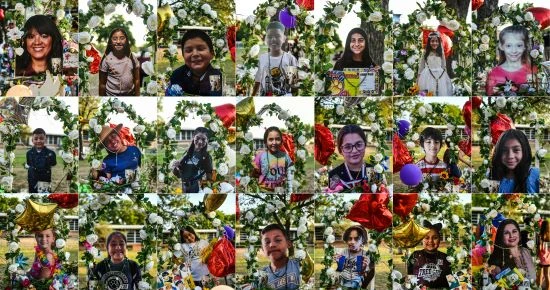

In the days following last week’s mass shooting in an elementary school in Texas, many Americans have expressed anger about the ongoing lack of legislative reform after such incidents. The issue of guns is one of several key areas where Americans experience deep divisions that are blocking effective solutions. Guns, abortion, racial justice and climate change present urgent problems for American society, but political factors make it difficult to discuss realistic solutions.
After every high-profile mass shooting, many Americans ask why their society allows such terrible events to continue. One factor is that, while many Americans feel sincere grief and anger, those who are not directly affected cannot indefinitely sustain those emotions. Also, Americans disagree about who or what is to blame and how to respond. Opponents of gun control argue that guns are not the problem, instead blaming mental illness, the moral breakdown of families, a lack of religion, the internet and more. Proponents of restrictions on guns acknowledge that multiple factors can drive someone to violence but note that easy access to weapons capable of quickly killing multiple people is a key enabler of mass murder.
Polling finds that slightly over half of Americans want more restrictions on guns. There are deep partisan divides on many proposals, such as reinstating a ban on assault weapons, though bipartisan majorities favor some specific reforms, such as preventing mentally ill people from accessing guns and expanding background checks. However, even when a majority of Americans support reform, politicians often choose not to act. Activists and lobbyists play a larger role than public opinion in shaping policy. Opponents of gun control are very active in the Republican Party. The firearms industry has an interest in selling more guns, while there is limited corporate engagement in gun control. The US federal system further complicates matters, with varying federal and state policies.
The issue of guns highlights some factors that also create policy paralysis in other areas. In early May, a draft Supreme Court decision was leaked, suggesting that the court is likely to overturn a previous ruling that ensured some abortion rights for all American women. Abortion has long been a divisive issue. On the more extreme “pro-choice” end of the spectrum, advocates argue that women should have the right to make decisions about their bodies. On the more extreme “pro-life” end, advocates argue that abortion is the murder of unborn children. Polling shows that a plurality of Americans prefer a balance of restrictions, with some options for abortion, but their voices are drowned out by the increasing fervor of advocates on both sides.
Racial justice is another area that has received growing attention in recent years. Polls indicate that a slight majority of Americans believe the renewed focus on the history of slavery and racism is a positive development, but there is a wide partisan gap. Pew Research Center data shows that 74 percent of Democrats believe that a lot more needs to be done to address racial and ethnic inequalities, while 77 percent of Republicans say only a little or nothing needs to be done. Republicans and Democrats deeply disagree about whether and how to teach about racism in schools. Furthermore, among those who believe that more needs to be done to address inequality, there is a divide between those who want to reform current systems and institutions and those who believe they must be completely rebuilt.
The deep divides on racial justice are very activating for voters, activists and politicians. Polling from the University of Massachusetts Amherst found that 67 percent of Republicans believe that growing numbers of immigrants threaten the loss of American culture and identity. Racial justice issues strike at the heart of American identity, with fundamentally different partisan views on what it means to be American. This issue raises existential fears among Americans on both sides, making it extremely salient to elections and politics.
Climate change poses a more tangible existential threat. Polling shows that about 72 percent of Americans now believe that climate change is happening, and there is bipartisan support for some measures, such as planting trees and improving vehicles’ fuel efficiency. However, polls also show partisan divides, with a large majority of Democrats accepting that human activities play a major role in climate change, compared to a minority of Republicans, and most Democrats wanting the government to do more, compared to few Republicans.
The issues of guns, abortion, racial justice and climate change are different in many ways but share several factors in US politics. Partisan divides run deep; in a two-party system, this easily leads to political paralysis. Most Americans have relatively moderate views on these topics, but small groups of dedicated activists shape politics. Once an issue becomes entwined with deeply held identities, it becomes very difficult to hold pragmatic, solutions-oriented discussions. People on both sides feel fundamentally threatened.
Even when a majority of Americans support reform, politicians often choose not to act.
Kerry Boyd Anderson
Furthermore, a fragmented and polarized mediascape ensures that Americans lack a shared set of facts. Lack of information complicates the situation, with many Americans missing key facts on guns, abortion, race and climate change, often ceding more space to activists who can appear knowledgeable and certain. It is very difficult for people to engage in nuanced discussion when they feel threatened, lack common ground and make sweeping assumptions about the other side before a discussion even starts.
Another shared thread between these issues is that they are hurting America’s reputation abroad. They are also hurting Americans. The deep divisions and the interests of activists and politicians are blocking nuanced understandings of the problems and pragmatic solutions.
- Kerry Boyd Anderson is a writer and political risk consultant with more than 18 years of experience as a professional analyst of international security issues and Middle East political and business risk. Her previous positions include deputy director for advisory with Oxford Analytica. Twitter: @KBAresearch


