
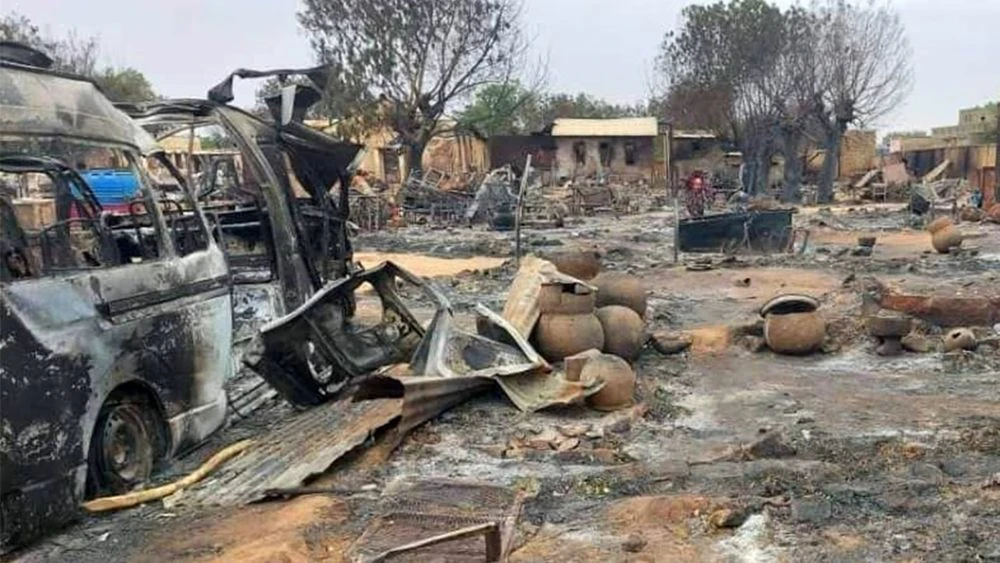

Sudan is approaching the end of the third year of its devastating and bloody civil war. The Sudanese conflict can be characterized not only as one of the most severe crises facing the international community, but also one of the most neglected.
What began as a power struggle between rival military elites could lead to a comprehensive collapse of political authority, social cohesion and economic life. In addition, the war has become a regional destabilizer and latent global risk.
If the international community continues to disregard the Sudan war or not view it as a priority, the risk of the country becoming a permanently fractured state grows, with consequences that will reverberate across Africa, the Middle East and beyond. And because of the scale, duration and systemic nature of the conflict, it demands a far more robust international response and sustained humanitarian engagement.
The humanitarian consequences of the war have reached new levels. Large segments of the population face chronic insecurity, not only due to violence but also the collapse of the basic systems required for survival. Food production and distribution networks have been shattered, which has led to widespread hunger and the emergence of famine-like conditions in multiple regions.
In addition, healthcare infrastructure has been destroyed or rendered inaccessible. This has turned illnesses that are normally treatable into life-threatening conditions and enabled the spread of communicable diseases.
Furthermore, education systems have all but ceased to function in many areas. This has deprived an entire generation of children of schooling, which is most likely going to embed long-term developmental damage into the future of Sudan.
But we should also look beyond the material damage and deprivation. The war has eroded the social fabric itself. We can witness how displacement, ethnic targeting and widespread and pervasive insecurity have weakened communal trust and undermined traditional coping mechanisms.
The longer these conditions persist, the more difficult it will be to secure a resolution to the war, as well as hampering postconflict recovery, as human capital is lost and social bonds are irreparably damaged.
Meanwhile, the regional consequences of Sudan’s war should not be disregarded, as they are equally severe and increasingly tangible.
Neighboring states have absorbed massive refugee flows, often in situations already characterized by economic fragility and political instability. Sudden influxes of displaced populations place immense pressure on host communities because they strain public services, create social tensions and increase competition for scarce resources.
At the same time, we should pay attention to the proliferation of weapons and armed actors linked to the Sudanese conflict. This proliferation ratchets up insecurity across borders, particularly in the Horn of Africa and the Sahel. In other words, these dynamics can entrench cycles of violence that extend far beyond Sudan’s territory.
Instability in Sudan has strategic implications for Red Sea security, Nile Basin politics and regional trade routes. This links the conflict to broader geopolitical concerns involving the Middle East and global maritime commerce. So, Sudan’s war should not be viewed as an isolated civil conflict.
Unfortunately, despite these escalating consequences, international engagement has remained inadequate and fragmented. There is a need for a structured and sustained framework to exert meaningful pressure on the warring actors. The framework should also offer a credible pathway toward de-escalation.
One significant dimension of international engagement has been the sustained diplomatic role played by Saudi Arabia, which remains one of the few states to have consistently invested political capital in seeking a resolution to the Sudan war. In coordination with the US, the Kingdom last month presented the Sudanese army chief with a structured diplomatic initiative.
The initiative proposes a three-point framework designed to halt hostilities, enable unimpeded humanitarian access and initiate a credible transition toward civilian governance. This effort reflects not only Riyadh’s regional influence but also its willingness to engage directly with the key actors in pursuit of de-escalation, underscoring Saudi Arabia’s vital role as a central mediator in any viable peace process.
A coordinated approach involving the US, Saudi Arabia, Egypt and the UAE also offers a viable foundation for such a framework. Each of these actors brings distinct forms of leverage and legitimacy. The Kingdom holds regional economic and political weight, while Cairo has direct security and strategic stakes in Sudan’s stability, with African leadership essential for regional legitimacy and long-term sustainability. By working together, these states can align incentives by imposing coordinated pressure and supporting a negotiated process that moves beyond symbolic ceasefires toward a political resolution.
Instability in Sudan has strategic implications for Red Sea security, Nile Basin politics and regional trade routes.
Dr. Majid Rafizadeh
The humanitarian dimension of the crisis should also not be forgotten, as it demands urgent and continued attention. Unfortunately, humanitarian assistance in Sudan has been restricted and constrained not only by funding shortfalls but by insecurity and access restrictions.
In a nutshell, resolving the war in Sudan should be at the top of the international community’s agenda for 2026. Continued international neglect risks entrenching a condition of irreversible state failure, with consequences extending far beyond Sudan’s borders. We should pay more attention to the mass humanitarian suffering, institutional collapse and cross-border destabilization.
The sustained diplomatic involvement of Saudi Arabia demonstrates that purposeful external action remains both possible and consequential. The advancement of a structured framework aimed at halting hostilities, enabling humanitarian access and initiating a transition toward civilian governance is critical.
- Dr. Majid Rafizadeh is a Harvard-educated Iranian-American political scientist. X: @Dr_Rafizadeh


