
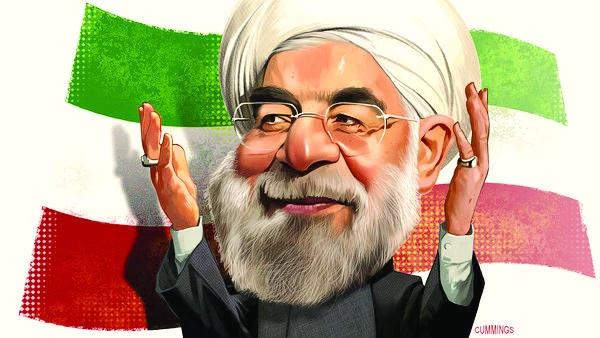

IT was hoped that the election of the new Iranian President, Hassan Rowhani, about whom the United States has expressed optimism as a more moderate alternative to former President Mahmoud Ahmadinejad, would bring about a change to the Iranian attitude toward the nuclear crisis which in turn would improve the rocky relations between Iran and the West. However, in Israel it was widely believed that Iran’s nuclear policies were unlikely to change under the moderate cleric and former nuclear negotiator Hassan Rowhani. On July 14, in the weekly Cabinet meeting, Benjamin Netanyahu, the Israeli prime minister launched a rhetorical offensive against Iran, accusing it of moving “closer and closer” to building a nuclear weapon and stating that Israel may have to act before the United States does. He ironically described Rowhani as a “wolf in sheep’s clothing” who would “smile and build a bomb.” Israel has issued veiled warnings for years that it might attack Iran. However, many of the commentators on this issue express one of two viewpoints; one is that Israel is serious about striking. This viewpoint is wrapped up in the ideological cover that Iran represents the pro-Palestinian side. The other viewpoint reduces the seriousness of Israel initiating a strike against Iran for which evidence of Iran’s cooperative relationship under the Shah’s regime is commonly cited.
Even after the emergence of an anti-Israeli regime under Khomeini, some level of covert relations continued between the two countries. Under Khomeini, Iran’s sharing of vital intelligence with Israel led to the destruction of Iraq’s Osirak nuclear reactor in 1981. Israel also played its role as a bridge between the US and Iran in the release of American hostages from Lebanon (1982) in return for Tehran receiving vital strategic weapons to use against Iraq (the Iran–Contra scandal). So, the role played by the new Iranian President Hassan Rowhani or the former President Ahmadinejad toward Israel and America is merely an extension of the previous roles. Therefore, the relationship between them is one of integration and not conflict. I would refute both hypotheses as they neglect the chronological path of the relationship between Iran and Israel. This relationship has gone through many stages; it started with the “Strategic Partnership” during the days of the Shah, then “Distant Alliance” when Ayatollah Khomeini took power in 1979 to the cold war between Iran and Israel after 1991, ending up with “Current Hostilities” after the 2003 Iraq war.
Therefore, the Iran-Israel relationship is governed by the logic of strategic interests and not by ideology. This article will focus on the “Strategic Partnership” stage, and future articles will continue the discussion on the same issue.
The “Strategic Partnership” stage during the days of the Shah was governed by the so-called “Alliance of the Periphery” or “Periphery Doctrine.” This theory or doctrine was developed by David Ben-Gurion, the first Israeli prime minister, and sought alliances with non-Arab states of the Middle East periphery (specifically, Turkey and Iran) in an attempt to maintain a balance of power against Arab states, primarily Iraq, which were in a state of war against Israel. In 1950, Turkey and Iran were the first Muslim countries to establish diplomatic relations with Israel, so the objectives of Israel at that time coincided with the policies of the governments of Turkey and Iran. Turkey sought integration with the economies of the free market and democracies in Europe as a member of the North Atlantic Treaty Organization (NATO) and a candidate for membership in the European Union; and the Shah of Iran was a key ally of the United States, which paved the way for dialogue between Israel, Iran, and Turkey.
This relationship between Iran and Israel later developed into the strategic partnership.
Prior to the 1967 war, Israeli Prime Minister Levi Eshkol visited Iran and met with the Shah in order to confer with him on the upcoming war against Egypt, and to ensure Israel’s petroleum reserves during the war. Indeed, at the beginning of 1967, Israel had a reserve stock of Iranian oil that was enough to cover all its needs for three months. This support was maintained throughout the War of Attrition from 1967-1970 as the Shah continued to supply Israel with Iranian oil. However, the overthrow of the Shah’s regime, and the advent of Ayatollah Khomeini to power in 1979 represented a major setback for the “peripheral policy.” Iran cut off its relationship with Israel and this is where Khomeini was first quoted as calling for the destruction of Israel.
However, the next article will analyze this ideological hostility between the Islamic revolution and Israel, and investigate whether the conflict between Tehran and Tel Aviv is ideological in core or related to the major shifts in the geopolitical map of the region and its consequent rebuilding of the axles and allies in a new form.
• This is the first of a four-part series of articles.


