
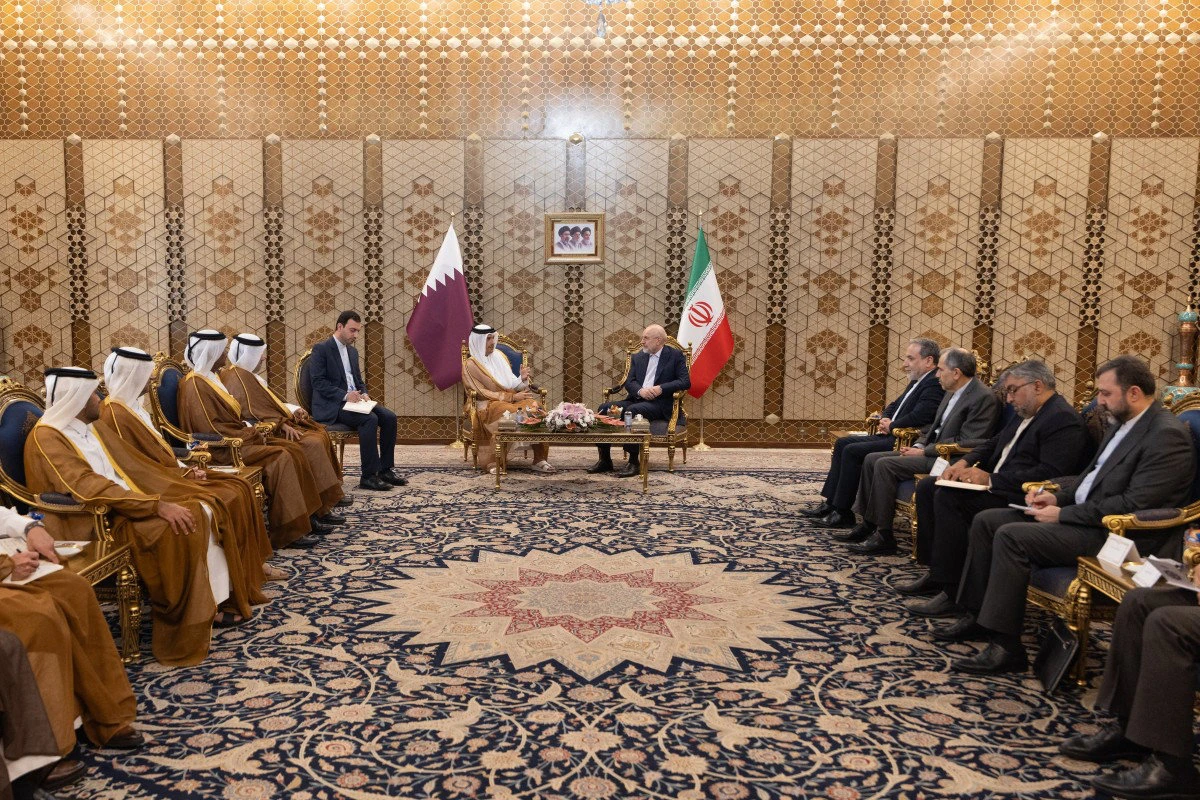

Qatari mediators returned to Tehran on Friday to revive negotiations between the US and Iran, following last month’s presentation of a seven-day proposal for reciprocal confidence-building measures. Tehran has dismissed the proposals as unacceptable but discussions continue.
After eight months of war, the disagreement remains largely unchanged, with Iran wanting the American blockade of its ports and restrictions on oil exports lifted before addressing its nuclear program, while Washington insists that nuclear concessions feature from the outset. The dispute over sequencing has repeatedly frustrated attempts at reaching a settlement and the latest proposal seeks to overcome it through a series of reciprocal commitments.
For the Gulf states, however, the question goes beyond breaking the diplomatic deadlock, extending to whether their growing involvement in negotiations will give them a meaningful say in shaping the terms of any eventual settlement.
That involvement has expanded considerably in recent weeks. Saudi Defense Minister Prince Khalid bin Salman last week traveled to Tehran alongside Pakistani army chief Field Marshal Asim Munir and Turkish intelligence chief Ibrahim Kalin. Three days earlier, the foreign ministers of Saudi Arabia, Pakistan, Turkiye and Egypt met their European counterparts in Istanbul to discuss the conflict, attacks on Saudi Arabia and freedom of navigation. Oman has also been negotiating with Iran over maritime access through the Strait of Hormuz.
Maritime arrangements alone cannot guarantee that military escalation will not resume elsewhere in the region
Zaid M. Belbagi
Taken separately, these initiatives might suggest competing diplomatic tracks, with regional governments seeking their own understandings with Tehran. However, Riyadh explicitly described its Tehran mission as supporting the mediation led by Qatar and Pakistan, while Doha has acknowledged its coordination with regional partners. The emerging picture is one of increasingly complementary efforts, although the extent to which they are being coordinated remains uncertain.
There is considerable value in this collective, multitrack diplomacy. Doha has maintained contact with Washington and Tehran throughout the conflict, while Pakistan has played a central role in efforts to negotiate a cessation of hostilities. Saudi Arabia brings political weight and the direct security interests of a country facing renewed Houthi attacks. Turkiye maintains channels to Tehran and Western governments, while Oman has the experience and geographical position to tackle the technical difficulties of reopening the Strait of Hormuz. The latter’s discussions with Iran in August covered a temporary shipping corridor, mine clearance, traffic management and longer-term arrangements for the strait.
These are distinct but interdependent negotiations. Securing an understanding over sanctions will accomplish little if commercial vessels remain exposed to attacks, while maritime arrangements alone cannot guarantee that military escalation will not resume elsewhere in the region.
Gulf concerns cannot be adequately addressed through a bilateral understanding that concentrates on US and Iranian demands
Zaid M. Belbagi
The June Islamabad memorandum of understanding provided a precedent for such an approach. Subsequent negotiations in Switzerland established a high-level committee and separate working groups on nuclear questions, sanctions, monitoring and dispute resolution. The agreement nevertheless unraveled, exposing the difficulty of securing compliance when the parties disagree over their respective obligations.
Qatar’s latest proposal reportedly follows a similar logic, seeking to break the impasse through a short sequence of reciprocal measures rather than requiring either Washington or Tehran to make substantial concessions in advance. Such an arrangement could prove useful, provided that every step is measurable, independently verified and conditional on corresponding action. Without credible enforcement, Iran could obtain relief from economic restrictions while postponing nuclear commitments, just as Washington could secure initial concessions without delivering the guarantees necessary for a lasting settlement.
For the Gulf states, the stakes extend considerably beyond the nuclear negotiations. Washington’s priority remains constraining Iran’s nuclear program and reaching an acceptable end to its military confrontation. Tehran seeks sanctions relief, renewed oil exports and an end to the blockade. Gulf countries, meanwhile, have experienced the conflict through missile and drone attacks, damaged infrastructure, disrupted aviation and uncertainty over maritime trade.
Their concerns cannot be adequately addressed through a bilateral understanding that concentrates on American and Iranian demands. Reopening the Strait of Hormuz would alleviate immediate economic pressure but it would not resolve the threat posed by Iran-aligned armed groups or prevent another round of American or Israeli military action from reigniting the conflict. For the Gulf, the durability of any settlement will therefore depend on commitments that extend beyond the immediate demands of the two principal belligerents.
The Gulf Cooperation Council’s Oct. 18 communique recognized this distinction. Its members supported regional mediation while insisting on participation in negotiations affecting their security and on addressing Iran’s nuclear and missile programs, drones and support for armed proxies. This provides a basis for a collective negotiating position despite the differences that have traditionally shaped Gulf relations with Tehran.
Qatar and Oman have long favored maintaining diplomatic channels, Saudi Arabia is battling threats along its southern border and the UAE has its own strategic and commercial considerations. Complete uniformity is neither realistic nor necessary. The difficulty arises when concessions negotiated through one channel are disconnected from obligations pursued through another.
Ending the war remains an urgent priority for a region whose economic development depends on secure trade routes, reliable energy infrastructure and investor confidence. Yet another failed agreement would weaken confidence in diplomacy and leave Gulf governments facing the same vulnerabilities that preceded the conflict.
The region now possesses considerable diplomatic influence through its relationships with the principal belligerents and its ability to mobilize partners beyond the GCC. Whether this influence produces a more secure regional order will depend on the degree of coordination behind the current initiatives.
If today’s parallel initiatives are tied to a common GCC framework, diplomatic diversity becomes leverage. If they are not, Tehran and Washington will continue negotiating with the Gulf states individually while the region bears the consequences collectively.
Zaid M. Belbagi is a political commentator and an adviser to private clients between London and the Gulf Cooperation Council. X: @Moulay_Zaid


