
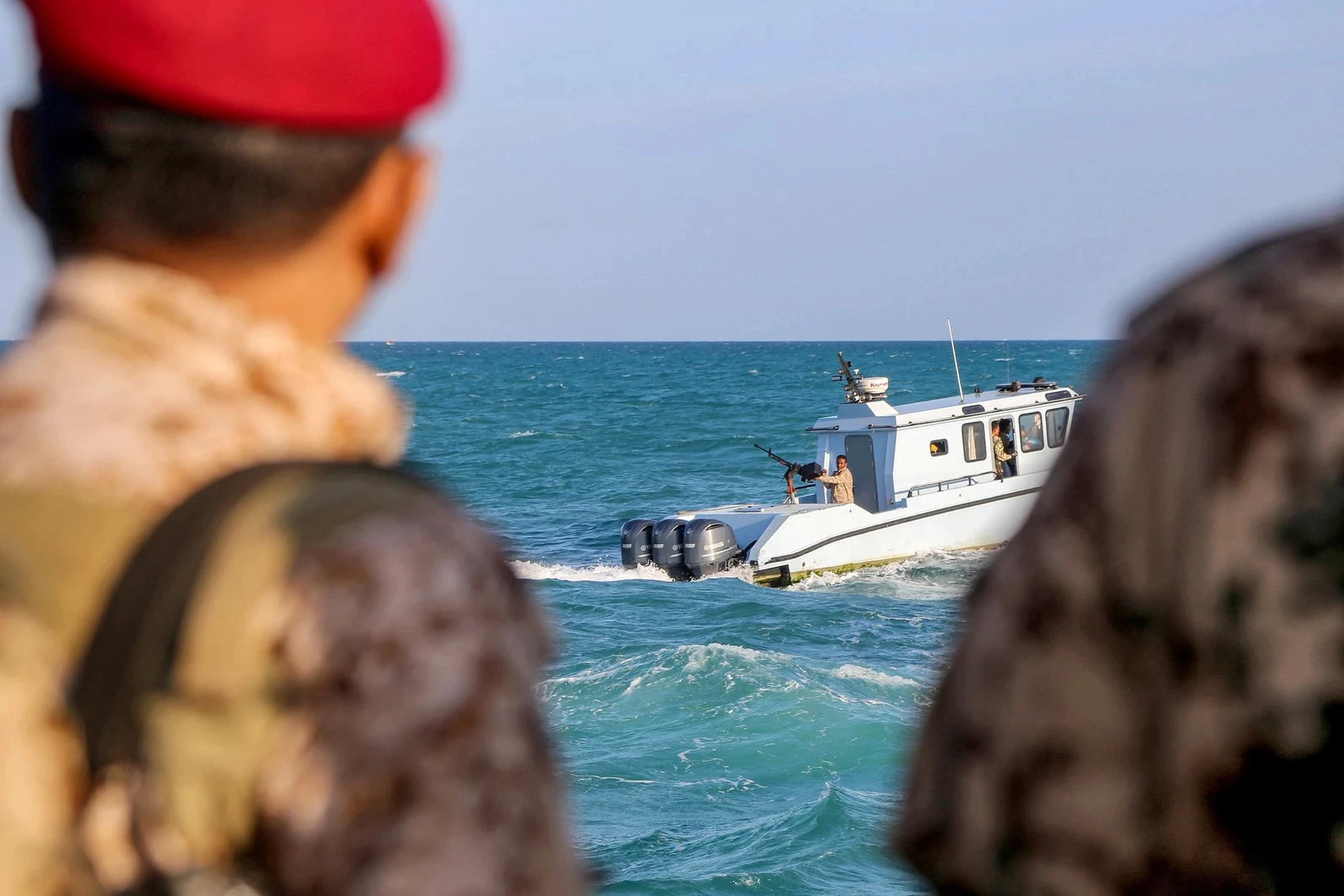

Coordinated attacks by Iran and its Houthi proxy resumed last week after a lull in the fighting during August. The apparent objective is to control both the Strait of Hormuz and the Bab Al-Mandab Strait. Iran resumed attacks on shipping in the Gulf and the Houthis renewed their attacks on Saudi Arabia and parts of Yemen held by the internationally recognized government. The Yemeni government is trying to stop the Houthis’ march and it needs genuine support from the international community.
For days, the Houthis have besieged forces loyal to the government in the coastal city of Mokha, about 180km south of Hodeidah and 80km north of Bab Al-Mandab. It would be a major setback if the news about the fall of Mokha is confirmed, making it even more urgent to support the government in reversing Houthi advances and denying them access to the coastal area facing the strait and the hills overlooking it.
The hostilities resumed on Aug. 30, when the US said it had targeted two Iranian launchers on Larak Island after observing Iranian forces preparing to launch rockets carrying sea mines toward the Strait of Hormuz. Iran subsequently attacked neighboring countries and ships crossing the strait — a drill Tehran has perfected since the start of the war in February.
On Sept. 2, Mohsen Rezaei, Iran’s new security chief, announced a “new strategy.” In a post on X, he wrote: “You will soon witness that Iran’s new strategy across the battlefield, diplomacy and countering the economic siege will shatter your foundations.”
Apparently on Tehran’s instructions, the Houthis shattered their four-year-old truce with the government on July 3
Dr. Abdel Aziz Aluwaisheg
On Tuesday, Iran said it had attacked more than a dozen vessels trying to pass through the Strait of Hormuz and announced a large expansion of the no-go zone extending beyond its territorial waters. While the number of ships struck is disputed, it is clear there has been an uptick in the number of attacks and the accompanying rhetoric.
Apparently on Tehran’s instructions, the Houthis shattered their four-year-old truce with the government on July 3, when Iran dispatched a flight by Mahan Air to Sanaa, in violation of the Yemeni government’s ban. The carrier belongs to the Islamic Revolutionary Guard Corps and has been banned by many countries, including Yemen, as it is known to ferry fighters and arms to Iran’s proxies. When the airline tried to land another plane at Sanaa airport on July 13, the government prevented it from doing so. However, it managed to land in another Houthi-controlled area, carrying what is believed to be a planeload of armaments and military advisers, accompanied by a Houthi delegation.
Almost immediately after returning from Iran, the Houthis started attacking Saudi Arabia, Red Sea shipping and government-held areas of Yemen. As Iran and the US reengaged in talks in August and paused fighting in the Gulf, the Houthis also tempered their provocations. But when Iran resumed fighting in the Gulf, the Houthis followed suit.
On Sept. 3, they launched a large offensive against government positions in coastal regions and the hills overlooking the Red Sea in an attempt to control the Bab Al-Mandab Strait. The clashes spread to Yemen’s interior, with government forces gradually gaining the upper hand there while apparently losing ground along the coast. On Tuesday, the Houthis struck the cities of Abha, Khamis Mushait, Jazan and Najran in Saudi Arabia’s southwest, injuring 73 civilians, including women and children. With these continuing attacks, all previously established channels of communication between the Houthis and Saudi Arabia appear to have broken down.
The aim of the Houthi attacks is to get closer to Bab Al-Mandab and threaten shipping from the hills overlooking the waterway
Dr. Abdel Aziz Aluwaisheg
This week’s unprovoked attack elicited widespread condemnations and expressions of support for Saudi Arabia. Pakistan expressed its “unwavering solidarity.” Defense Minister Khawaja Asif said that the three-nation Makkah Joint Defense Agreement between Pakistan, Saudi Arabia and Turkiye could become operational in the event of aggression against the Kingdom.
Asif warned that “unprovoked aggression or spillover of whatever is happening in Yemen into Saudi Arabia will definitely make this agreement operational.” He added: “No one should have any doubt in this. We are bound by the terms and conditions of this pact. God willing, we will honor them in case there is a need.”
The UN, Gulf Cooperation Council, Organization of Islamic Cooperation, Arab League and many others condemned the Houthi attacks on Saudi Arabia.
US Secretary of State Marco Rubio stressed: “The US has a very strong defensive military relationship with Saudi Arabia and we're watching those events very closely.” He added: “The Houthis, in many ways, are agents and proxies of the Iranians. I think behind some of this is clearly the Iranian hand.”
Iran’s statements give evidence to Rubio’s remarks about those links. Iranian leaders have repeatedly threatened to disrupt maritime traffic in the Bab Al-Mandab Strait. In April and later in June, Ali Akbar Velayati, a former foreign minister and close adviser to Iran’s supreme leader, said that the strait’s security should not be taken for granted, adding that “the resistance has the capability to lock both waterways.”
Also in June, hard-liner Rezaei, then-senior adviser to the supreme leader and a former commander-in-chief of the IRGC, told CNN that the conflict could spread to other maritime routes, including the Indian Ocean, Mediterranean Sea, Red Sea and Bab Al-Mandab. The threats from Rezaei have become more bellicose since he was appointed secretary of the Supreme National Security Council on Aug. 10.
According to a report by Reuters, the closure of Bab Al-Mandab was discussed during the Houthis’ visit to Tehran in July. They were asked to stand ready to close the Red Sea oil route when needed. They returned to Yemen on July 13 and immediately began attacking both Saudi Arabia and government positions, coincidentally with new threats in the Iranian official media about the closure of the strait.
It has become clear that the aim of the Houthi attacks is to get closer to Bab Al-Mandab and threaten shipping from the hills overlooking the waterway. Already, maritime traffic in that area is less than half of what it was in more peaceful times. But if they succeed in reaching the strait, international shipping could stop in Bab Al-Mandab just as it has in the Strait of Hormuz. This is part of Iran’s grand strategy of controlling them to disrupt energy supplies from the region.
The oil markets understand the situation, with the Brent oil price jumping above $101 on Wednesday, the highest in months. The price will likely go up if the fighting continues — and it will go through the roof if the Houthis manage to close this strategic chokehold, through which more than 10 percent of world trade passes.
The government of Yemen is fighting to prevent this nightmare scenario from coming to pass and is seeking to safeguard freedom of navigation. It needs the generous support of the international community to complete the job and deal effectively with the multiple threats it is facing.
First, in fighting terrorist groups, such as Al-Shabab in Somalia, Al-Qaeda and Daesh, which are going to take advantage of the situation, especially since some of them are known to work with the Houthis. Second, in preventing southern separatists from helping the Houthis by interfering with government forces trying to reach the front lines. Third, in helping clear sea mines and interdicting weapons Iran is likely to send to the Houthis.
The Yemeni government needs international support as its meager resources and defense supplies could run out if the war is prolonged.
Dr. Abdel Aziz Aluwaisheg is the GCC assistant secretary-general for political affairs and negotiation. The views expressed here are personal and do not necessarily represent those of the GCC.
X: @abuhamad1


