

Elections matter, my friends. US President Donald Trump’s decision to authorize “pulling the trigger” to take out Iranian Quds Force commander Qassem Soleimani and a senior Iraqi militia commander will prove to be a remarkable, historical epoch in US policymaking. It is doubtful that anyone else, from either party, would have taken this bold move.
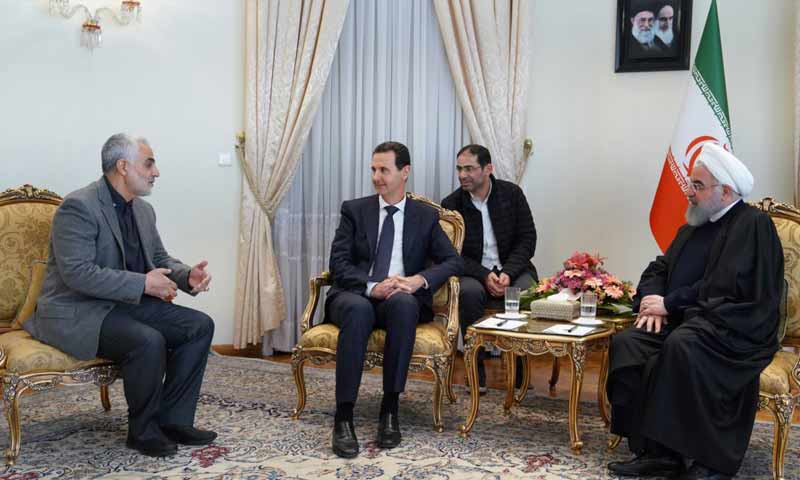
To truly understand how Soleimani’s neutralization will reverberate, we should pay special attention to his extraordinary investment of time and resources into Syria and the endeavor of propping up his longtime ally Bashar Assad.
Soleimani was never a negotiator. When Assad was at his nadir in mid-2012, it seemed that most of the world, save for Iran, had written off his chances of survival. But Soleimani decided to double down. It is little wonder, then, that in my travels throughout northwest Syria this week that I received nothing but wide smiles and praise for “Abu Ivanka” (Trump) when I asked locals how they felt about the elimination of Soleimani.
Soleimani personally oversaw every logistical detail of moving materiel and fighters into Syria. Drawing on the Hezbollah-enabled network and Iraqi Shiite militants like Kata’ib Hezbollah, which he had created to fight the US, he gave the order that no expense would be spared to keep Assad in power. Soleimani doubled down again in 2015, when renewed battlefield losses and unexpected attrition forced him to plead for Moscowto intervene.
The Iranian commander’s Syria campaign is instructive of his approach to statecraft. If you recall the ultimatum that he sent to Gen. David Petraeus in 2007, it said: “General Petraeus, you should know that I, Qassem Soleimani, control the policy for Iran with respect to Iraq, Lebanon, Gaza, and Afghanistan.” Four years later, he would add Syria to that portfolio.
Soleimani’s greatest fear — what he viewed as the greatest threat to the Islamic Republic and its proxies — was not American hellfire from above, but the popular will of the peoples in the region, Sunni and Shiite alike, rising up against the order that Ayatollah Ali Khamenei was attempting to establish to subjugate them. The images of Arabs rising up in Baghdad’s Tahrir Square and the Iranian consulates burning in Najaf and Basra would have been seen as just as existentially threatening to Soleimani as the anti-regime graffiti spray-painted by a group of schoolchildren in Deraa, southern Syria, where that country’s revolution began in 2011.
His obsession with Syria was evinced by some of the key Shiite militant commanders killed alongside him. Abu Mahdi Al-Muhandis, the founder of Kata’ib Hezbollah, had been instrumental in the Quds Force’s efforts to recruit militants to fight in Syria on behalf of Iran.
In addition to Al-Muhandis, Soleimani raised a new cadre of militant commanders including Akram Al-Kaabi, the leader of Harakat Hezbollah Al-Nujaba, and Qais Al-Khazali, head of Asa’ib Ahl Al-Haq. They all sent thousands of foreign fighters into Syria over the years and were responsible for massacres and the demographic re-engineering of the country. All of them also received operational and ideological training and armsfrom Hassan Nasrallah’s Hezbollah over the years.
The special terror designations imposed in 2018 and 2019 by the US against key Hezbollah operatives in Syria and Iraq, as well as the reimposition of severe sanctions against the financial network that laundered funds to fuel the slaughter of the Syrian people, would never have been possible under the Joint Comprehensive Plan of Action (JCPOA) nuclear deal.
A number of international sanctions on Soleimani would also have been lifted if the JCPOA was fully implemented. In other words, he would have been given free rein to conduct his activities if Trump had not put an end to the Obama-era deal.
Ultimately, detractors of Trump’s executive decision on the nuclear deal must confront a zero sum game: You can’t push for efforts to protect civilians in Syria from systemic ethnic cleansing planned and executed by Hezbollah’s Quds Force-enabled transnational network and simultaneously argue for the implementation of the JCPOA as it stood in full. One had to be sacrificed in order to achieve the other.
Soleimani’s continued operational role in the Syrian and Iraqi battlefields, which from his perspective where inexorably linked, was mutually exclusive to any hopes of ending the unmitigated tragedy befalling Syrian families.
In that regard, Secretary of State Mike Pompeo was right to highlight Soleimani’s complicityin the deaths of hundreds of thousands and displacement of millions in Syria. That role has been glaringly and shamefully omitted or glossed over by the vast majority of media networks as they rushed to cover the Soleimani funeral.
Does Soleimani’s death mean that Iran’s gains in Syria will now be reversed? Perhaps not, but there is now the slightest margin, where none existed before, to set the foundations for undoing what Soleimani set in motion in Syria.
Most observers do not fully understand the level of detail that Soleimani was involved in when planning the mass demographic remapping of Syria by ethnicity. He was not just an operational commander; he looked at Syria through a ruthless historical lens and sectarian paradigm that had long colored his strategic outlook. Soleimani was Syria’s Heinrich Himmler. The transportation, the funding, the planning, and the ability to construct a wide international bureaucracy with the sole purpose of slaughtering any and all that threatened the Assad regime — only he could have done it so horrifically well.
There is now the slightest margin, where none existed before, to set the foundations for undoing what Soleimani set in motion in Syria.
Oubai Shahbandar
The scoreboard is now heavily against Iran’s attempts to re-engineer the region in Soleimani’s image. It is perhaps telling that Soleimani’s gravest miscalculation, underestimating Trump, proved his undoing. His attempt to replicate in Iraq the macabre work he carried out in Syria — the killing of protesters, establishing a proxy state, etc. — can now perhaps be undone.
The Quds Force has lost the irreplaceable Soleimani, along with senior deputies and longtime Iraqi proxy Al-Muhandis, and also faces popular upheavals against its proxy political orders in Iraq and Lebanon. Meanwhile, stubborn Syrian rebels continue to hold on against all odds, and the entrenchment of anti-Hezbollah and anti-Iran sentiment among wide sections of the Muslim world in response to Iranian-supported atrocities in Syria and Iraq will not be forgotten any time soon. That growing anti-Iranian sentiment was even recognized by Iran’s intelligence service, according to documents recently leaked to The Intercept.
In his death, let us never forget that the carnage Soleimani unleashed in Syria ought to be and will be his permanent legacy.
- Oubai Shahbandar is a Syrian-American former Pentagon official. He is currently working on a documentary on Syria. Twitter: @os26


