
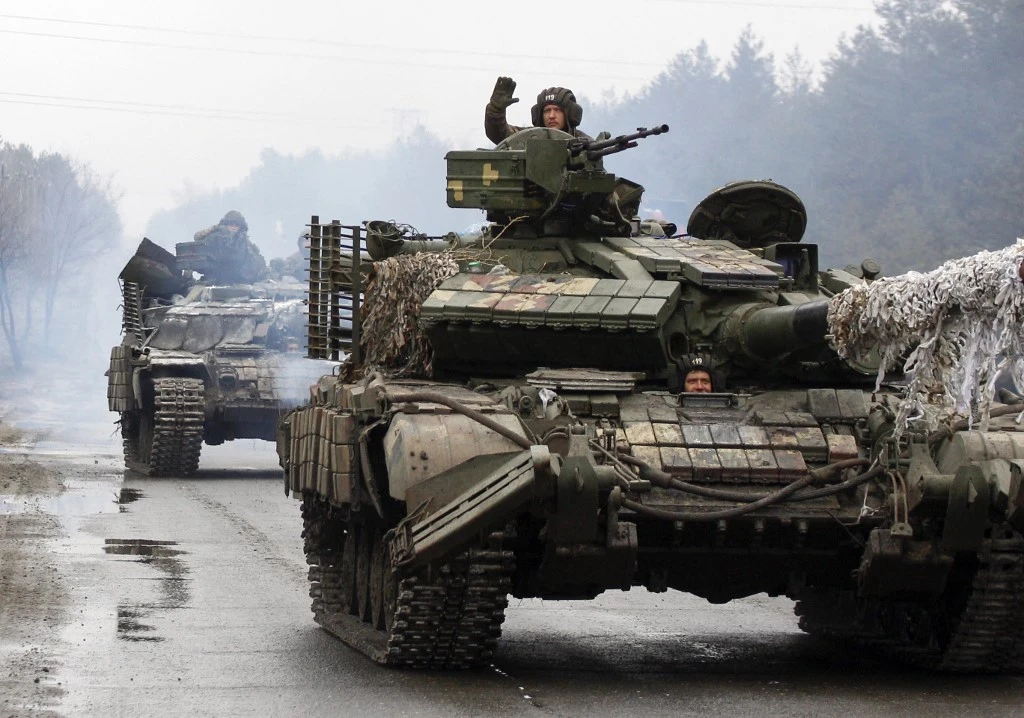

When Russia’s tanks began rolling into Ukraine late last month, they did not only crush an internationally recognized border and violate the sovereignty of a neighboring country — they also demolished the world order as we have known it since 1945.
On Thursday, Feb. 24, 2022, the post-1945 security architecture, and its post-Cold War variant, collapsed, leaving the dream of those who established the UN, and the charter they wrote for it, torn to shreds.
When this debacle is over, hopefully with as few casualties and as little devastation as possible, it will be time to design a new international security architecture that can nip such existential threats in the bud.
This is not to say that since the Second World War collective security has not previously faced extreme challenges, from proxy wars and even a major nuclear crisis for example. But the current situation represents a total breakdown of acceptable norms of behavior. Before our very eyes, a major power has invaded a neighbor with no shred of a casus belli (provocation or justification).
For years the UN Security Council has failed in its duty, as defined by the UN Charter, of “primary responsibility for the maintenance of international peace and security.” The utterly unprovoked and unjustified Russian invasion of Ukraine has left this truly meaningless.
It was not only the horrors of the Second World War that motivated the post-war generation to make an immense investment in the creation of a collective system designed to ensure that such conflicts could never happen again; it was also the very real fear that a Third World War would mean the end of humanity as we know it as a result of the addition of nuclear weapons to the equation.
In the wise words of the author William Glasser: “Since there will be no one left to talk peace after the next war, it makes good sense to break with tradition and hold the peace conference first.”
But now, for the first time we have a country that possesses nearly 6,000 nuclear warheads, a country that as a permanent member of the Security Council is one of those entrusted with preserving world peace, has implicitly threatened the rest of the world that if anyone intervenes on behalf of Ukraine it will unleash its nuclear arsenal.
As much as it is still inconceivable that Russia’s threats will translate into the use of nuclear force, one should nevertheless treat Moscow's words with the necessary caution. Much of the strategic thinking behind the Cold War deterrence of the last century was based on the irrationality of instigating a nuclear cataclysm. There was a consensus about the logic of MAD — mutual assured destruction — which served as a practical, as much as a psychological, reassurance that the nuclear powers would not exploit their doomsday military capabilities in any way other than passively, as a means of mutual deterrence.
Much of the strategic thinking behind the Cold War deterrence of the last century was based on the irrationality of instigating a nuclear cataclysm
Yossi Mekelberg
Moreover, day by day, hour by hour, Russia has managed to achieve what many thought impossible: To unite the forces who believe in democracy, freedoms, human rights and the decency of human existence, and compel them to fight back.
This has been greatly inspired by the admirable resistance and steadfastness of the Ukrainian people and their president, Volodymyr Zelensky, as they are confronted not only with a much greater military force but also by the realization that this is no time for the world to falter in the face of such a powerful force bent on imperial conquest.
Instead of furthering the case for Russia’s concerns about NATO’s eastern expansion toward its borders, Moscow has instead achieved the opposite effect and made it more imperative for countries such as Sweden and Finland, not to mention Ukraine itself, to join the Western collective security alliance to prevent or stop aggressive actions such as the one unfolding now.
Within a matter of days, Germany — which for historical reasons has been more comfortable to rely on diplomacy rather than military might when it comes to international security and is always reluctant to intervene in overseas conflicts — decided under recently elected Chancellor Olaf Scholz to sharply increase its spending on defense. In addition, it sent 1,000 anti-tank weapons and 500 stinger missiles to Ukraine and paused its planned Nord Stream 2 gas pipeline project with Russia.
Thus, Russia’s miscalculated adventure in the Ukraine has brought Germany back onto the world stage in a meaningful manner for the first time since 1945.
It is more than likely that the global security architecture will undergo significant changes as lines are clearly demarcated between those who would still engage in old-fashioned aggression against other countries, and those who would like to return as soon as possible to an agenda of global development and address issues that continue to threaten all of us, such as climate change, poverty and hunger, and current and future pandemics.
• Yossi Mekelberg is professor of international relations and an associate fellow of the MENA Program at Chatham House. He is a regular contributor to the international written and electronic media. Twitter: @YMekelberg


