


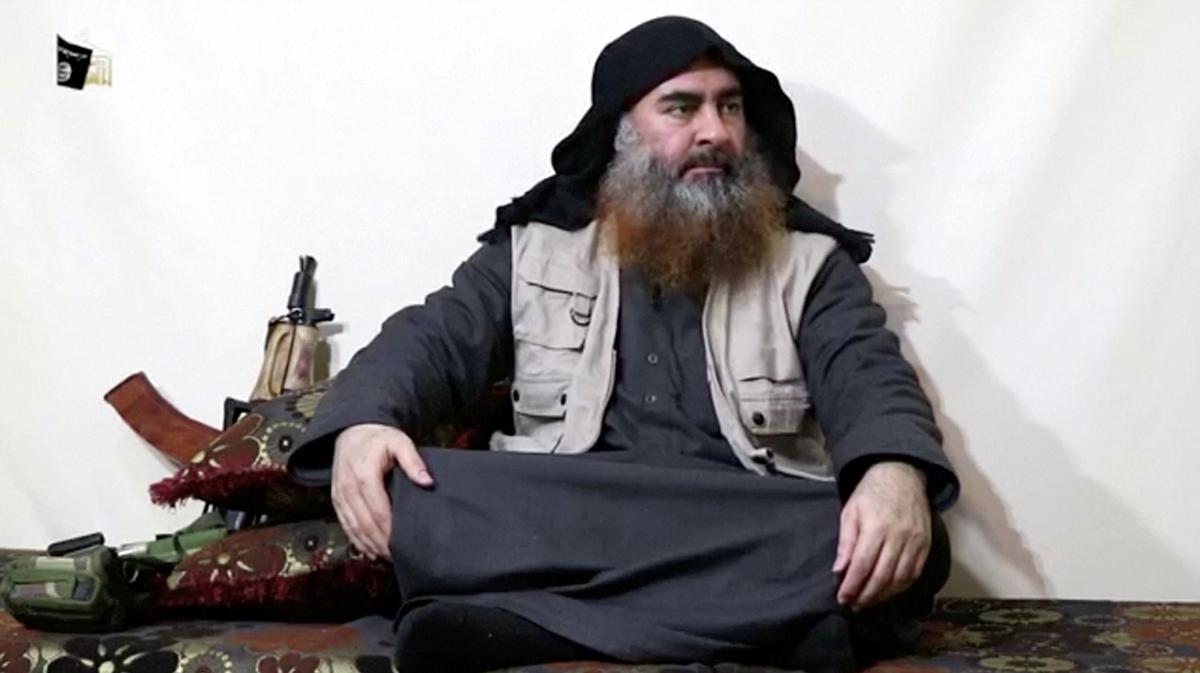
We have had quite a time of it on the terror front recently, haven’t we? To take the example of just one group, Daesh’s last stand at Baghouz in Syria, its inspiring of attacks on security targets in Congo and Saudi Arabia and on Christians in Sri Lanka, and now, linking them all, the pre-Ramadan reappearance of Abu Bakr Al-Baghdadi (who has clearly not been overdoing the diet during his time underground) have all followed in quick and sometimes bewildering succession. In Iraq and Syria, even after the loss of territory, Daesh never stopped seeking to regularly strike its enemies — just like it and its predecessors did after 2003.
Over the last six months or so, we have also seen white right-wing extremist attacks on synagogues in Pittsburgh and San Diego and on a mosque in New Zealand — part of a trend that has been building for some years. Some people say that is the real wave of the future, fueled by growing social, cultural and economic anomie in the heartlands of the West. Others say that is nonsense and that the big threat remains the exploitation of under-governed spaces in the Middle East, North Africa, the Pakistani-Afghan borders and Southeast Asia by violent, millenarian and transnational Islamist groups intent not just on overthrowing regional governments but remaking the global order. They are prepared to fight “until doomsday,” as Al-Baghdadi has again made clear for the slower learners among us.
Only in February, Donald Trump proclaimed that Daesh had been eliminated, in an echo of Barack Obama’s presumptuous description of them as a junior varsity team, and — in a different context — George W. Bush’s equally vainglorious claim of “Mission Accomplished” in Iraq. Yet we know that the group has managed to retain significant accumulated wealth from its time controlling territory and the allegiance of a core group of foreign fighters, perhaps as many as 30,000. And here they are again, popping up like a bad jinni to tell us that they never really meant to establish a territorial base simply in Syria or Iraq, that they have instead created wilayats all over the world, and in any case continue to colonize more important territory — the minds and hearts of the impressionable and discontented.
Meanwhile, in Idlib, the Al-Qaeda-connected groups, Hayat Tahrir Al-Sham and its dissident offshoot, Hurras Al-Din, seem to have consolidated their authority through the violent suppression of other groups and are digging in against pressure from the Syrian regime and its backers. Al-Qaeda in the Arabian Peninsula has once more shown its resilience and adaptability in the mess that is Yemen. In Somalia, Al-Shabab has not gone away, nor has Boko Haram in West Africa. In Iran, there are reports of increasing activity by violent separatist groups in the southeast, and some stirrings in the Kurdish regions.
And, in all this excitement, we should not forget the increasingly coordinated activities of Iran, its armed proxies in Iraq, Syria and Lebanon and its agents of influence across the world, from Caracas to Canberra. Turkey, of course, accuses anybody with links to the Kurdistan Workers’ Party of terrorism. Even in Northern Ireland, we have seen attempts by revanchist former members of the Provisional IRA to fan the flames of sectarian violence, even if they only manage to murder young journalists.
The stated ambitions of Daesh, Al-Qaeda and many right-wing extremists may be ludicrous. But they take them very seriously.
Sir John Jenkins
If you actually look at measurements like those of the Global Terrorism Index, you will find that the cumulative total of victims has actually declined over recent years. But that is misleading. These indices measure all victims, and most of them are found in areas where armed conflict has broken out, or is endemic. So Iraq, Syria, Afghanistan, Somalia, Libya and Yemen have accounted for the vast majority of terror casualties over the last 15 years or so. When conflict dies down, as it undoubtedly has in Iraq and to an extent in Syria, then the numbers go down. But the underlying causes — social, cultural, economic and political — on which terror feeds have not disappeared. And this gives an opportunity for the highly organized, motivated and ideologically committed groups that commit or sponsor most terror attacks to thrive. They also create a response; by design.
Just as in Iraq after 2003, attacks by the precursors of Al-Qaeda in Iraq and Daesh produced an equally brutal response by armed Shiite groups, often sponsored by Iran, so attacks on the West by Al-Qaeda and Daesh — and the consequences of the disorder they have created in parts of North Africa and the Levant — have given oxygen to far-right extremists. And there will always be causes that such groups can use to claim victimhood and therefore the right to retaliation. If it’s not the Great Mosque at Samarra, it’s the Rohingya in Myanmar, the Sayyidah Zaynab in Damascus, Al-Aqsa Mosque, the Uighurs, or the Field of Blackbirds in the Balkans. These are fitted into a reductionist and violent narrative of victimhood, a subset of the wider identity politics that are reshaping political systems across the world.
And this retreat into a new tribalism is the real danger. To join a sect is to claim privileged victim status. It is to define the political community as the righteous and the just and everyone else as “The Other” and, therefore, “The Enemy;” something Islamists and Western right-wing nationalists have in common with each other, along with Sayyid Qutb, the theorist of the modern Jahiliyyah, Carl Schmitt, the Nazi jurist of the state of exception, and a range of millenarian and obscurantist lunatics through the ages.
In 2015, shortly after I left the British diplomatic service, I was interviewed by the BBC. They asked me what I thought the future was for Daesh and similar groups. I said that they certainly needed to be physically defeated in Iraq and Syria, which some disputed at the time. But you can’t defeat an ideology with bullets. The ideology of Islamism — and all Islamisms have a doctrine of physical force, no matter what their advocates might claim — was already a century old. There were no signs that it was losing its power to attract adherents. And it had already provoked a response in those it targeted. It was a dialectic of separation, of hate and counter-hate. The consequences would be with us for the rest of my lifetime and well beyond. I was surprised when the interviewer queried this. It was hardly a new observation after all.
Now no one really questions it. But perhaps a better way to think about what is happening is not so much about terror and non-terror — both terms that are notoriously hard to define, even more so in an age of asymmetric conflict and deniable aggression — but about what we most value in our current political, social and economic dispensations and what are the most serious threats to them from all sources. That way we can plan more rationally and collectively to combat these threats across the board. Some of them come from violent terrorist groups, some from their state sponsors, some simply from states — little green men, deniable cyberattacks, the covert shaping of opinion or simply fake news — some from within our own societies, from our own reactions or over-reactions, amplified by social media and the sheer speed of global communication networks.
The stated ambitions of Daesh, Al-Qaeda and many right-wing extremists — like those of some states who also overestimate their power — may be ludicrous. But they take them very seriously and are prepared to inflict enormous damage in the process of proving that they are impossible to achieve. We must therefore be prepared for the long haul. That means accepting that this is a struggle for collective security. That can only succeed if it is based on genuinely ethical national resilience, applied intelligence (in all its various senses), the technological competence to stay ahead of the opposition (for example in cyber, remote or drone technologies), a willingness to trust in cooperation and, above all, sustained political purpose and a sense of proportion. We’re in this together — for the long haul.
- Sir John Jenkins is an Associate at Policy Exchange. Until December 2017, he was Corresponding Director (Middle East) at the International Institute for Strategic Studies (IISS), based in Manama, Bahrain, and was a Senior Fellow at Yale University’s Jackson Institute for Global Affairs. He was the British ambassador to Saudi Arabia until January 2015.


