
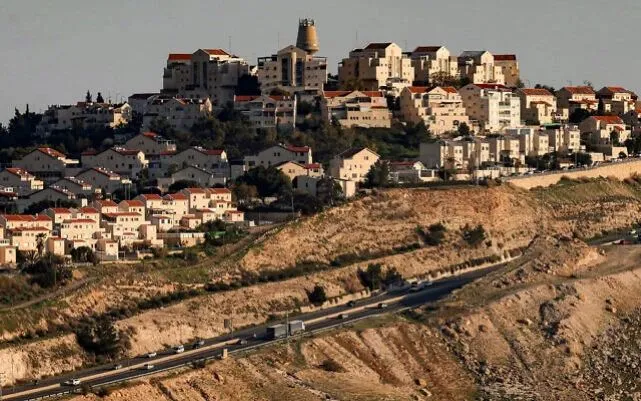

Israel has launched bids for the E1 settlement. Contractors must meet the deadline of Oct. 19, less than two months away. UK Prime Minister Andy Burnham has announced he will impose harsh sanctions on the settlements. World leaders have issued condemnatory statements. However, if no concrete action is taken, the West will totally lose its credibility.
The leaders of the UK, France, Germany, Italy, the Netherlands, Canada, Norway, Australia, New Zealand, Sweden, and Belgium issued a joint statement declaring the Israeli government’s decision to publish construction tenders “unacceptable.” The statement also highlighted surging settler violence against Palestinians. The signatories urged the government of Israel to retract its plans “immediately.”
However, Israel is known for its contempt for international law. Israeli officials know they can do whatever they want and the US will come to protect them. The Trump administration has been especially soft on Israel when it comes to the issue of settlements. Israel will also take advantage of the current situation. The US will likely use its capital to negotiate what it sees as a more pressing issue with Israel: Iran.
If the US has to choose between pressuring Israel to relinquish on the building of a settlement or relinquishing on hitting Iran, it would probably choose the latter. It would be a priority for the US to pressure Israel to accept whatever it negotiates with Iran in order to stop the war and open the Strait of Hormuz, without allowing the Israel lobby to sabotage the deal.
The countries that issued the joint statement understand that E1 will kill the two-state solution. The question is: What are they doing about it?
Dr. Dania Koleilat Khatib
The bid did not come out of the void. Israel knows it has leverage with the US that it can now use. Israel has a history of making concessions on regional issues in return for having a free hand with the Palestinians. The countries that issued the joint statement understand that E1 will kill the two-state solution. The question is: What are they doing about it?
Of course, we in the region know the West’s hypocrisy. While publicly condemning Israel and showing sympathy for Palestinian civilians, Western countries do all they can to lend a hand to Israel under the pretext of its right to exist or right to defend itself. However, the situation is now different.
“E1 is not just another settlement. While all settlements are equally illegal under international law, the impact of E1 is far more devastating than the others. It will drive a wedge through the West Bank, severing it into two fragmented cantons — Ramallah and Nablus to the north, and Bethlehem to the south — with zero geographical contiguity between them. It will also contribute to sealing off East Jerusalem from its West Bank environs,” said Daniel Seidemann, a Jerusalem-based attorney who for decades has been tracking Israeli settlements.
E1 will totally fracture the Palestinian territory, rendering contiguous geography impossible. Whatever will result after E1 will not be economically viable. Most importantly, it will detach Palestinian territory from East Jerusalem, which is supposed to be the capital of the future Palestinian state. The two-state solution is already on life support; E1 will remove the breathing tube that is keeping it, even in theory, alive. The international community has for the past 25 years condemned Israel settlement expansion and warned that Israel would reach the point of no return. Yet no one has taken any action that caused Israel to strategically change course.
Sometimes Israel conducts a public relations stunt and pretends to change its mind, for a while, until Western ire subsides. Sometimes it places projects on hold, waiting for the right moment to put them back into action. Nevertheless, Israel has never relinquished its overall goal of taking over the entire West Bank. E1 is a red line that should not be crossed. If crossed, the West will lose what is left of its credibility, already gravely damaged by allowing the genocide to happen. If it allows E1, will anyone believe the West anymore?
Andy Burnham admitted that the UK should have taken tougher action against Israel regarding Gaza. Now it is time for Burnham to show he is serious.
Dr. Dania Koleilat Khatib
The UK government has cautioned Israel against moving forward with its plans. However, what does that mean other than empty words of condemnation? Andy Burnham admitted that the UK should have taken tougher action against Israel regarding Gaza. Now it is time for Burnham to show he is serious. The UK and its co-signatories should back their words up with action.
After Oct. 19, the government of Israel plans to open sealed bids from developers and award contracts to construct the first 1,234 housing units in E1. Once signed, construction becomes inevitable. The UK and other countries should take immediate practical steps: Target any contractor bidding for the project and any bank offering a bank guarantee for the bid. Banks and developers will face the choice of earning some money from the Israeli government or being cut out of Europe.
Actually, those countries, in addition to their own sanctions, should use their weight inside the EU to make sure the bloc places sanctions on whichever developer bids for the project and the banks offering the guarantee, as they are engaging in flagrant violation of international law. Targeting banks is very effective. Banks are legally obligated to evaluate, report, and mitigate risk to central banks, governments, and the public. No company can bid without a bank guarantee.
This should set a precedent. Any company or institution — even governmental institution — implicated in settlement activity should be sanctioned. Any individual living in a settlement should be sanctioned. This will isolate the settlements and pressure Israel to change course. It would not only save the prospect of a Palestinian state, but also save Western countries’ own credibility in front of the world, and most importantly, in front of their own people.
- Dr. Dania Koleilat Khatib is a specialist in US-Arab relations with a focus on lobbying. She is co-founder of the Research Center for Cooperation and Peace Building, a Lebanese nongovernmental organization focused on Track II.


