
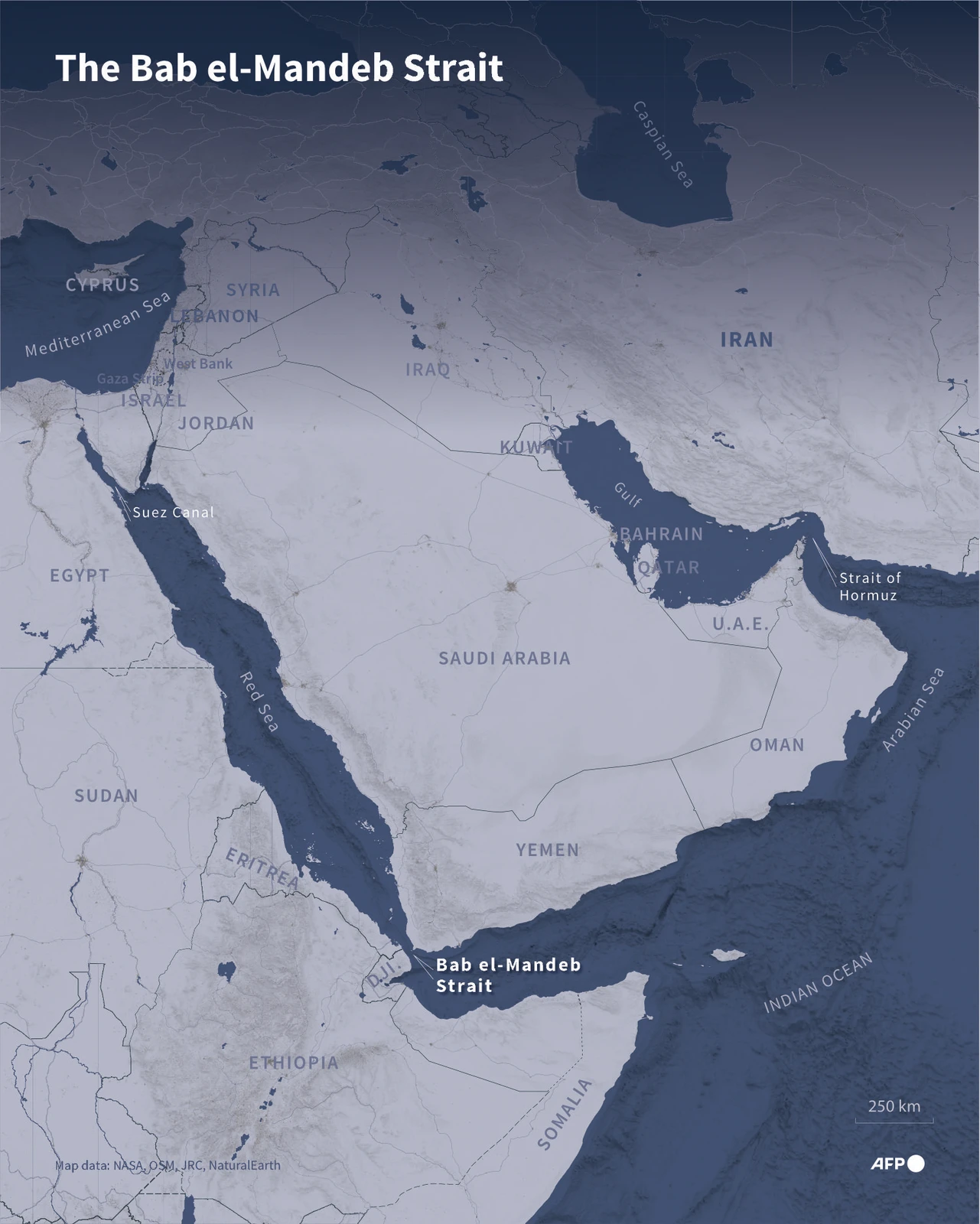

The crisis in the Strait of Hormuz is at a stalemate, with both the US and Iran claiming control of the strategic waterway. Even so, the closure of the strait, whether full or partial, has wreaked havoc on global energy prices, Gulf oil exports and economies around the world. Yet, with all eyes focused on the Gulf, another strategic chokepoint is edging closer to becoming another flashpoint. The southern Red Sea, where the Bab Al-Mandab Strait links the Gulf of Aden to the Suez Canal, could soon descend into a regional conflict with global repercussions. If so, the crisis could widen to engulf the volatile Horn of Africa.
The Houthis, Iran’s rebellious proxy in war-torn Yemen, upset the power play when they took the port city of Mokha and Perim Island last month. They occupied a strategic territory that can disrupt shipping at the southern entrance of the Red Sea. But the legitimate government forces have waged a counteroffensive that this week succeeded in retaking Mokha and key positions near the Bab Al-Mandab Strait. That offensive now aims at restoring control over the entire Red Sea coast, with the final aim of conquering Sanaa.
The Houthis have also struck energy and civilian targets in Saudi Arabia through ballistic missile and drone attacks. In return, Riyadh is redoubling its backing of the legitimate government in Aden and reiterating its right to self-defense. While Iran has denied ties to the Houthis’ latest attacks, it is clear that Tehran hopes to use the Bab Al-Mandab card if the US resumes the war and diplomatic efforts falter. Simply put, Tehran and its proxies will do anything to raise the cost of the war for all.
The current operation in Yemen has a lot to do with curtailing the Houthis and reversing their latest gains because whoever controls the approaches to the strait holds a lever over Riyadh, Cairo and global shipping.
It is clear that Tehran hopes to use the Bab Al-Mandab card if the US resumes the war and diplomatic efforts falter
Osama Al-Sharif
Against this backdrop, Riyadh’s new mutual defense pact with Turkiye and Pakistan has passed its first real test. On Monday, the three nations agreed to activate their collective defense commitment amid ongoing threats. They also appointed Retired Lt. Gen. Numan Mahmud of Pakistan as the alliance’s first secretary-general, for a three-year term, as part of efforts to establish its institutional structure.
Not far away, the Horn of Africa is emerging as another flashpoint between rival camps. Last December, Israel officially recognized Somaliland, the breakaway region that declared independence from Somalia in 1991. Tel Aviv’s calculus is largely geopolitical. Somaliland sits opposite Yemen at the mouth of the strait and Bloomberg reported that Israel was exploring setting up a base there to gather intelligence and operate against the Houthis, who during the war on Gaza had targeted the port of Eilat.
Officials in Hargeisa, the capital of Somaliland, see Turkiye and Mogadishu as the more immediate threat. “We want Israel to support us against Turkiye,” a senior adviser was quoted as saying last week. Since 2011, Turkiye has built an extensive foreign military presence in Somalia, including its largest overseas base. Ankara signed a 10-year maritime agreement with Somalia and in January it deployed F-16s to Mogadishu, officially to bolster operations against Al-Shabab. With Israel’s military ambitions in Somaliland becoming clear, the prospects of a Turkish-Israeli clash in the Horn of Africa should not be discounted.
Meanwhile, the Ethiopia-Eritrea dispute has escalated, polarizing the region even further. Eritrea last week severed diplomatic ties with Addis Ababa after Ethiopia closed its embassy in Asmara and expelled 10 Eritrean diplomats. Ethiopia accuses Eritrea of backing an armed alliance led by the Tigray People’s Liberation Front, a charge it denies. Asmara, for its part, accuses Prime Minister Abiy Ahmed’s government of expansionism and of pushing to establish a sea outlet on Eritrean shores.
That dispute brings Egypt into the picture. Cairo is already at loggerheads with Ethiopia over the Grand Ethiopian Renaissance Dam. Recently, Egypt has hosted the leaders of Eritrea, Sudan and Somalia, while the African Union urged all sides to refrain from escalation. Ethiopia’s army chief is now accusing Eritrea, Sudan and Egypt of backing rebels.
This checkered geopolitical theater, with fast-changing realities and alliances on the ground, points to a combustible scenario
Osama Al-Sharif
Sudan is the lynchpin that ties these threads together. Its civil war has become a proxy competition that has deepened the Red Sea geopolitical fault line. Control of Sudan’s wealth, coast and ports has become part of the same struggle for access, leverage and influence among different rivals.
This checkered geopolitical theater, with fast-changing realities and alliances on the ground, points to a combustible scenario.
These intricate but interconnected conflicts should not be viewed as separate from what is happening in the Gulf. Iran’s relationship with the Houthis links Yemen to the wider confrontation with Washington and the stack of crises in the southern Red Sea offers Tehran a way to raise the cost of the current stalemate. A miscalculation between the US and Iran could ignite a major conflict in the southern Red Sea, while a clash among regional players, as is the case in Yemen today, could do the same.
Washington and its key regional partners must not ignore the brewing crises in the Red Sea. They should pursue a comprehensive approach that treats the Red Sea basin as one strategic space. That means a regional security dialogue. It means decapitating the Houthis and restoring the legitimate government in Yemen. It means urging the rival nations to weigh the costs before turning Somaliland and Somalia into military outposts. And it means refusing to treat Sudan’s war, with its huge humanitarian toll, as a sideshow.
The weaponization of geography, first the Strait of Hormuz and now Bab Al-Mandab, shows how fragile global trade and supply chains have become from a macro point of view. These chokepoints have become tools in geopolitical struggles involving regional rivals that quickly evolve into global crises. The Red Sea is fast becoming one of these crucial flashpoints and the window to head off the worst is closing fast.
Osama Al-Sharif is a journalist and a political commentator based in Amman. X: @plato010


