


A former Lebanese president once described the country’s relationship with the US as an elevator ride. He would say that together they decided to take an elevator to the 25th floor of a building. Everybody gets in and the button for the 25th floor is pressed. The elevator starts moving but, when it reaches the 12th floor, the US team presses the button for the 19th floor. The elevator opens on 19 and the US team gets out. So you are left with a very short period of time to ask yourself: What should I do? Follow them or continue to the 25th floor as previously agreed?
This was a way of describing President Richard Nixon’s foreign policy strategy and what Henry Kissinger referred to as the great powers’ central tenet of being unpredictable. This unpredictability was clear when Nixon applied the original “pivot to Asia” and made a breakthrough in relations with China, which was initially aimed at counterbalancing the Soviet Union during the Cold War. However, these ties lasted well beyond the end of the Cold War and China has now become an integral part of the world economy, as well as a competing and strong global economic power.
Despite its many changes and phases, there is one point of US foreign policy that has never been unpredictable: Total commitment to Israel’s security and friendship. But now, for the first time, mainstream voices — mainly in Democratic Party circles and think tanks — are calling for a review of this relationship and even a downgrade.
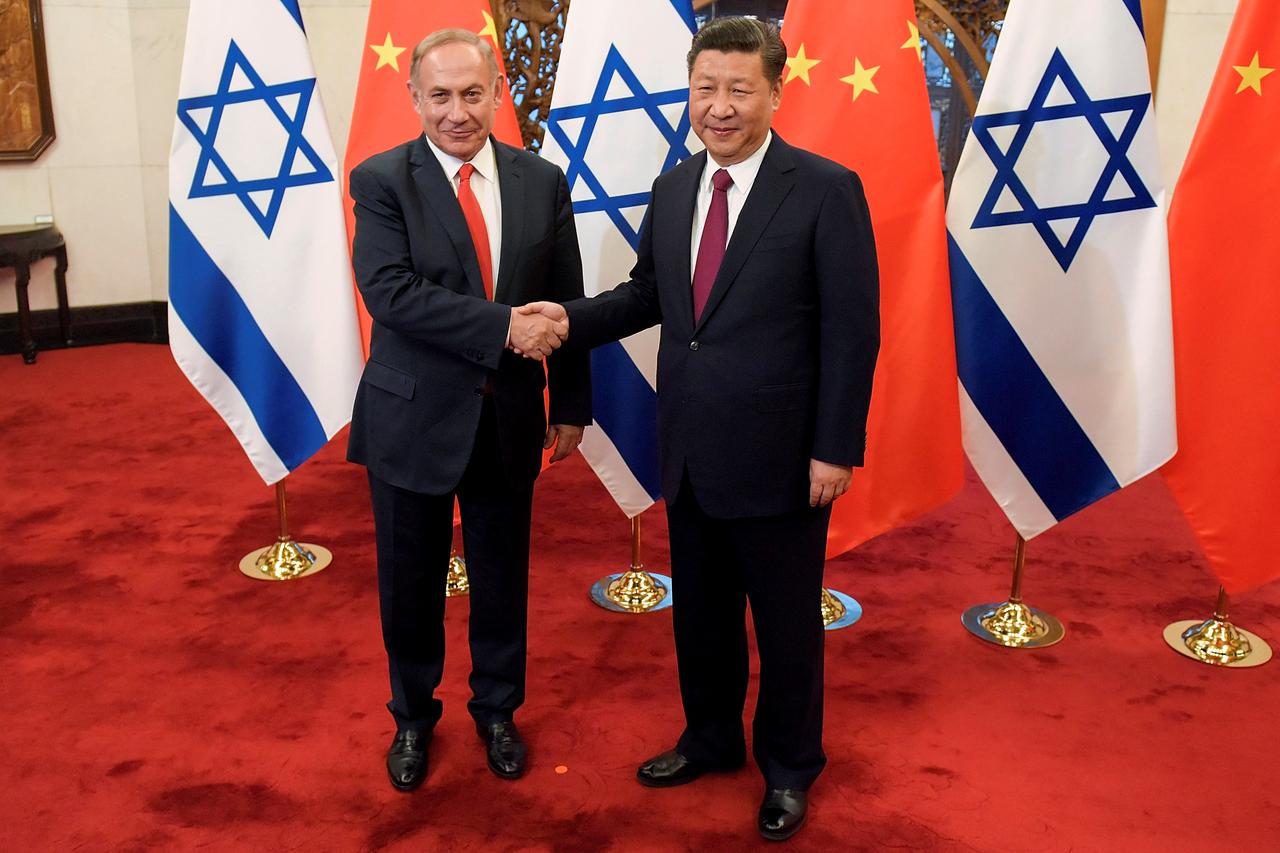
This comes at a time when China is, through programs such as the Belt and Road Initiative, playing an increased role in infrastructure projects and the economy in the Middle East, including Israel. Tel Aviv has been trying to balance the interests of both China and the US, but the latest tender for the Sorek 2 desalination plant prompted a bump in the road with the Trump administration, which supports Israeli security unconditionally. In short, the increased tensions between China and the US forced Israel to disregard a Chinese firm’s bid for the Sorek 2 contract. As Beijing and Washington start facing off more directly, especially in the aftermath of the coronavirus disease (COVID-19) pandemic and during a US election year, it seems Israel is unsure on how to act, as it wishes to maintain a balance for now.
These global relations have always directly impacted the Israeli-Palestinian peace process and the energy-rich Middle East. During the Cold War, the world resembled a chessboard, leaving little opportunity for a US-Soviet agreement in order to impose a peace deal. After the USSR’s collapse, the Oslo peace initiative was launched under a new world order. This was a fantastic window of opportunity, but the details prevented an agreement. The world we see today is much changed and these differences have been accentuated by the COVID-19 pandemic. There has been a return to the Middle East chessboard, involving stronger and more affirmative regional powers as well as the usual international powers — namely the US, Russia and China. Yet, for now, the regional powers are trying to avoid taking sides and are instead attempting to maintain balance with a case-by-case approach.
Although many analysts will say President Donald Trump’s policies are responsible for these changes, the Middle East felt a change of strategy from the US during Barack Obama’s presidency. His new “pivot to Asia” signaled a disengagement from the region to focus on and counter China. This was translated into a focus on the Iran nuclear deal, as well as a tougher approach toward Arab countries and greater questioning of Israel.
I believe it was at this moment that most countries in the region started taking more decisions independently of the US. Basically, they took the attitude of asking the US for forgiveness rather than permission for their actions. This was not only seen in Israel, where there was an expansion of illegal settlement building for electoral purposes, but also in the defense contracts of countries such as Egypt, which increased its purchases from France. This period also saw the return of Russian military interventionism in the region, mainly in Syria but also now in Libya, both of which have an important impact on the Mediterranean and European security.
Unlike Russia, China seems to be in a geopolitical observation mode for now, staying mostly neutral with a noninterventionist policy whenever its interests are not impacted, and instead focusing on infrastructure projects. Beijing often uses debt and financing as a development tool in this process. However, its interests will grow necessarily as most of the oil in the region is now flowing east toward its terminals, making it dependent on energy from the Middle East. At the same time, the US’ share of the region’s oil has continuously declined since President George W. Bush’s energy initiative, signaling a similar decline in its involvement and interests. Trump reassured of his commitment to the Middle East and has proved it, but this energy and trade trend is bound to create more links and potential for cooperation with China, both for Israel and the wider region.
I must admit my bias. I believe in the US and I believe its role — despite this unpredictability — has been largely positive for the region and the world. However, friendship with the US demands efforts. It is not an easy friendship, especially nowadays; some might even prefer being a “tolerated enemy.” From Congress to pressure groups or even social media uproar, these are points that one needs to consider and work with in order to keep a balanced relationship with the US. It is a challenging friendship that demands shows of strength and the ability to deliver on key files.
In this regard, it seems that Israel and its current leader Benjamin Netanyahu have lost much of their exceptionalism. The Israeli government has, in fact, become a true Middle Eastern regime involved in corruption and the disregard of societal institutions. Its inability to deliver on important files puts a strain on the relationship between the US and Israel. So could we get to a point where Israel is labeled an apartheid state by US policymakers? Although this seems highly improbable, it is now being suggested by a growing and mainstream movement. The shift toward socialist policies in the US is also an unpredictable point that Israel will surely have to consider.
The US’ is a challenging friendship that demands shows of strength and the ability to deliver on key files.
Khaled Abou Zahr
As China’s interests grow, it remains focused on business and economy, but one may ask when will it take on a more active geopolitical role in the region? Will we witness a Chinese peace process? Will China become more aggressive if it is systematically disregarded for infrastructure projects like the Israeli desalination plant? What policies would it implement for the security of the Middle East and to maintain energy supplies? Will it consider leveraging the debt it holds and its project for direct geopolitical gains? Will there be an alliance between China and Russia to counter US interests?
Despite all these unknowns, I still believe there is a need to rebalance relations with China and ultimately a consensus will be found that acknowledges Beijing’s new status, and that it will adapt and commit positively to the current international order. But, in this US election year and amid the COVID-19 pandemic, if relations between China and the US keep worsening and slide into indirect confrontation, then the Middle East, Israel included, will most probably align in the same way it did during the Cold War. International relations will once again look like a chessboard, but this time with stronger regional powers. It seems that unpredictability will not only be on the US side, but everywhere.
- Khaled Abou Zahr is the CEO of Eurabia, a media and tech company. He is also the editor of Al-Watan Al-Arabi.


