
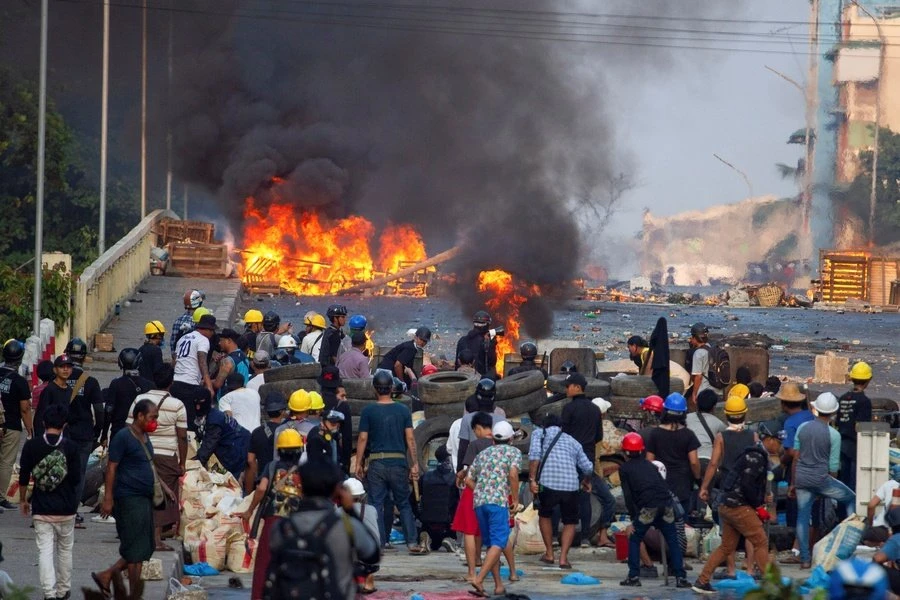

As the situation in Myanmar continues to deteriorate, the Biden administration is looking to shift gears in its approach to the country. And it is looking like sanctions are back on the cards.
The ongoing civil strife in the country is still simmering and we appear to be heading down the path toward a full-blown civil war, despite a number of ceasefires agreed between the junta and a number of civilian resistance groups. Most recently, diplomatic efforts to find a more permanent settlement to the conflict led by the international community, and the Association of Southeast Asian Nations in particular, have gone nowhere. This is because the leadership of the incumbent military government has blocked the mediators from meeting with Aung San Suu Kyi, the nominal leader of the pro-democracy faction in the conflict, who is being kept under house arrest.
In the face of this lack of cooperation — or really any sign of good-faith engagement — from the junta, the international community is being forced to rethink its approach. ASEAN remains the most important diplomatic forum through which the next steps will be taken, but even this studiously non-interventionist bloc now recognizes the need to bring out the big guns if the military government of Myanmar is to be forced toward any kind of compromise.
This is where the US comes in. Washington is a close military, economic and strategic ally to many of the ASEAN countries, which were also responsible for previously bringing Myanmar out of international isolation after it promised to start moving toward democracy following the adoption of a new constitution in 2008. Myanmar’s abortive road toward democracy originally appeared as one of the Obama administration’s greatest success stories, at least prior to the Rohingya genocide of 2016. As a consequence of American diplomatic engagement and foreign direct investment, Myanmar registered as one of the world’s fastest-growing economies during the 2010s.
The spoils of that economic growth have disproportionately gone to the owners of natural resource exploitation rights, who in Myanmar were almost entirely the leaders of the military government currently running the country. And those profits have largely been taken out of Myanmar, primarily through financial vehicles registered in Singapore. It is, therefore, no surprise that Washington appears to be working closely with the government of Singapore as it weighs up its options.
Sanctions — particularly targeted sanctions against individuals, including but not limited to freezing their assets in Singapore or wherever else they may be held, banning US companies from trading with any entities associated with these individuals, and so on — will be powerful tools in the diplomatic arsenal of the international community. At this point, they look very likely to be deployed. But they should not be the only move led by the US.
It is equally important, and even more time-sensitive, that humanitarian aid makes its way to the civilian populations currently suffering from the military crackdowns in the country, as food shortages and spiking COVID-19 infection rates continue to take their toll. Of course, means to distribute this aid through civil society channels that avoid empowering the junta must be devised and implemented as quickly as possible, though there appears to be some hope that this is viable as the government has so far stated that it would allow such distribution.
Sanctions will be powerful tools in the diplomatic arsenal of the international community.
Dr. Azeem Ibrahim
The US and the international community must also keep the pressure on the regime in other ways, for example by doubling down on the commitment to hold accountable before international tribunals any and all human rights abuses ongoing in the country. This may force the top leaders of the junta to double down on their position, but it may also serve to peel away from their cause lower-ranking officials who do not wish to partake in the ongoing abuses that the junta deem necessary to “pacify” the restive pro-democracy civilian population. Sowing division among the junta right now might be the fastest and most effective way to bring this conflict to a quick resolution, and the promise of individual accountability is going to be a powerful weapon to that end.
- Dr. Azeem Ibrahim is the Director of Special Initiatives at the Newlines Institute for Strategy and Policy in Washington D.C. and author of “The Rohingyas: Inside Myanmar’s Genocide” (Hurst, 2017). Twitter: @AzeemIbrahim


