

Does US President Joe Biden have a strategy to deal with the Gaza crisis? Do any of his European allies? This matters because, despite the US’ decline and disinterest in the Middle East for long periods, it is still the world’s leading power and, of course, Israel’s predominant ally. No other power can influence it. It was Biden who, in 2021, told Israeli Prime Minister Netanyahu that he had run out of runway and the bombardment of Gaza had to end. Will he do that now?
What is clear is that Biden does not wish to see the US dragged into any Middle East conflict. How could that end well? He has, like all his predecessors since 1948, been sucked into dealing with Israel-Palestine. His deployment of two aircraft carrier groups to the Eastern Mediterranean was doubtless to prevent such an eventuality as much as anything. Iran and Hezbollah would have picked that up. He has reportedly asked Netanyahu on numerous occasions how he will avoid widening the conflict.
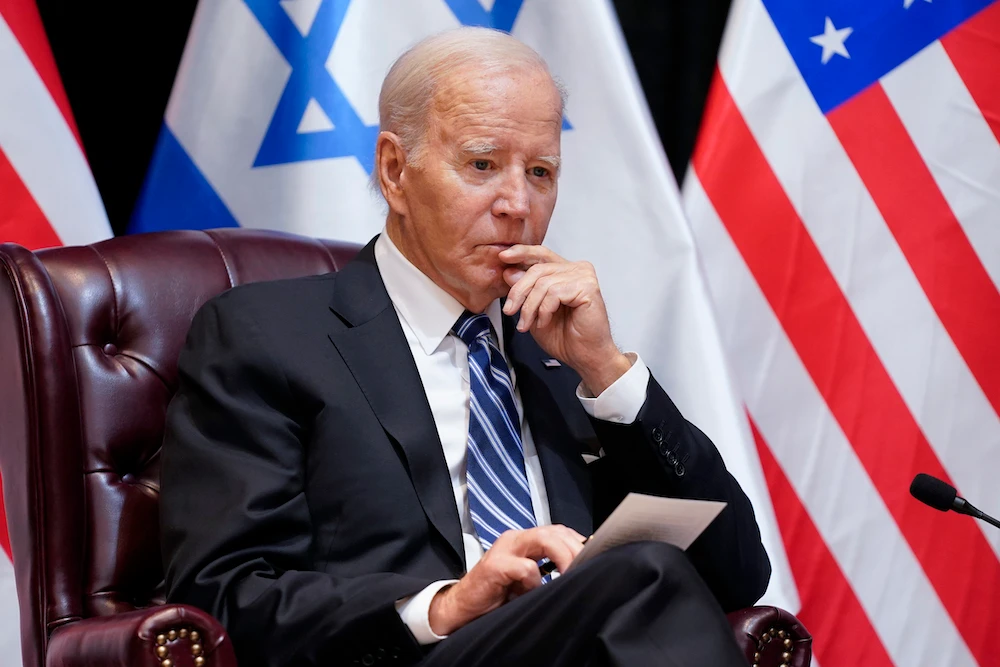
Typical of his approach is to hug Israel first, hence his visit last week. Biden felt he had to demonstrate his support for Israelis at their time of loss and pain. He met with victims’ families, which many Israelis contrasted with Netanyahu’s distant attitude. The Israeli PM is yet to apologize for the chronic military and security lapses on Oct. 7.
But Biden also undermined his regional standing by endorsing the Israeli narrative on the Al-Ahli hospital blast before any proper evidence could be examined. Even his words indicated that the US did not have definitive proof of what happened. Biden told Netanyahu: “Based on what I’ve seen, it appears as though it was done by the other team, not you.” He also echoed the Israeli line likening Hamas to Daesh, which is misleading propaganda and glosses over considerable ideological differences.
Demonstrating empathy with Israeli suffering is understandable given the situation. Yet the sin of omission was to fail to emphasize the suffering of Palestinian civilians under occupation, blockade and now total siege. Like other Western leaders, he failed to push Israel to abide by its international legal obligations despite knowing full well its past violations, not least in relation to Gaza. Only late in the day have references to international law emerged, seemingly half-heartedly, from US officials.
Biden’s diplomatic efforts were scotched following the Al-Ahli hospital blast. Jordan canceled a planned multilateral summit with him. Given the sentiment among Arab populations, this was maybe understandable, but energetic engagement with regional partners does matter.
What has also been consistently clear ever since Oct. 7 is the yawning chasm between the US and Europe on the one hand and the Global South on the other. The latter grouping of states nearly all see a massive double standard, particularly after Biden tried to link Ukraine and Israel.
This pivot to trying to link Israel to Ukraine lands the US in a totally contorted position. Biden stated: “Making sure Israel and Ukraine succeed is vital to our national security. History has taught us that, when terrorists and dictators don’t pay a price for their terror, they cause more death and destruction.” One can understand Kyiv’s success, getting Russia out of Ukraine. The equivalent position on Israel-Palestine would be to get Israel out of Palestine. You cannot oppose the Russian occupation of parts of Ukraine that started back in 2014 and not oppose the Israeli occupation of Gaza that started back in 1967.
International law is not there as some punitive mechanism to bash miscreant rogue states. It is for all our protection
Chris Doyle
This poses a major risk to the whole concept of the rules-based international order. Essentially, the next time the US starts demanding this be adhered to, many are going to shrug their diplomatic shoulders and say no. They will just mention Gaza and walk away.
That should be of no comfort to anyone. International law is not there as some punitive mechanism to bash miscreant rogue states. It is for all our protection. The prohibition on collective punishment is something everyone should wish to see preserved and upheld. The bombing of hospitals is a war crime, something the US was quick to point out in Syria, but less so when Israel bombed medical facilities in Gaza.
The US vetoed a UN Security Council resolution that called for a ceasefire and the establishment of humanitarian corridors, as well as condemning the “heinous terrorist crimes by Hamas.” The US objection was that the text did not acknowledge Israel’s “right to self-defense.” There was no indication it pushed for a less severe resolution at all. Once again, the US did Israel’s bidding by refusing to allow the UN to have a significant role.
The topsy-turvy US policy is just as notable with regard to humanitarian aid. Biden pressed Israel on this and got an agreement for just 20 trucks to pass through the Rafah crossing. Even that was delayed subject to Israeli protests. To put this into perspective, between 400 and 450 trucks used to enter the Strip daily. This convoy was just 4 percent of the usual daily average as a one-off. This reeked of weakness more than success.
An undersecretary at the US State Department, Uzra Zeya, released a video stating: “Our message to Palestinians in Gaza, the West Bank and all around the world is clear: we see you, we grieve with you and we mourn every loss of innocent life. Civilians are not to blame and should not suffer for Hamas’ horrific terrorism.” Well, Palestinians cannot hear this above the din of the American-made bombs dropping on their homes, schools and mosques.
How can the US leadership believe that Palestinians, and indeed the wider Arab world, will understand American protestations that it wants to get aid into Gaza when the only American products Palestinians see are the explosive variety dropped from the sky? What will happen if the siege is not lifted and Palestinian children, including babies, start dying in unimaginable ways? Will Biden speak up then and say enough is enough?
Aid for Palestinians is vital. The siege must be lifted. But what is the point of feeding a population just so they can survive to be bombed? The sad reality for the 2.3 million Palestinians in Gaza is that the US leadership has shown consistently more concern for Israeli civilians than it has for them.
The US has huge leverage should it wish to use it, but it refuses regardless of the dire emergency, the humanitarian catastrophe and the risk of regional conflagration. If the crisis does spread to the West Bank, Lebanon and elsewhere, that leverage may become pointless. At the moment, the US can contain the situation. It may be only a matter of days before that is no longer possible.
• Chris Doyle is director of the London-based Council for Arab-British Understanding. He has worked with the council since 1993 after graduating with a first-class honors degree in Arabic and Islamic Studies at Exeter University. He has organized and accompanied numerous British parliamentary delegations to Arab countries. X: @Doylech


