
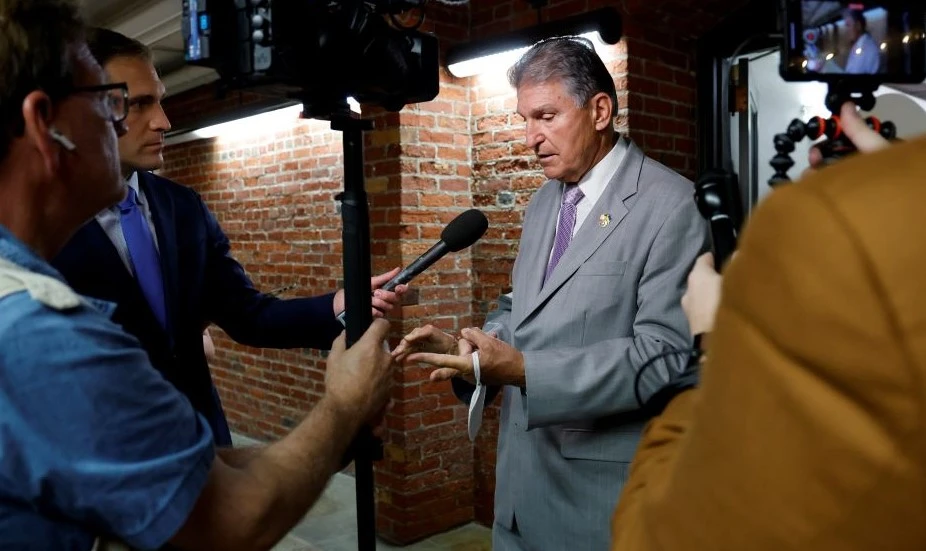

On a celebratory night in late 2016, the Arc de Triomphe and Eiffel Tower were lit up in green to remind the world to implement the Paris climate agreement. Yet, in recent years, climate legislation in the US has been stuck at a red light, most recently because Sen. Joe Manchin, a conservative-leaning Democrat from West Virginia, single-handedly made a hostage of America’s commitment to the Paris Agreement’s decarbonization targets.
But now, after previously striking a lethal blow to US President Joe Biden’s $2 trillion Build Back Better Act — the most ambitious climate legislation in US history — Manchin has come around in support of a modest substitute bill that will include hundreds of billions in federal funding to support the clean energy transition.
At a time when extreme weather events are ravaging many parts of the world, the compromise package comes as a big relief. But it is also somewhat disappointing for a beleaguered Democratic Party that is still reeling from the Supreme Court’s reversal of Roe v. Wade and for an American electorate that is increasingly anxious about climate change.
Efforts to establish a global climate policy governance regime have taken a long, zigzagging path, passing through 26 annual “conferences of parties.” The process got off to a promising start in 1988, with the creation of the Intergovernmental Panel on Climate Change, the world’s premier climate science entity. And that was soon followed by the 1992 Rio Earth Summit, where 178 countries adopted the UN Framework Convention on Climate Change.
But this framework imposed no binding requirements and, at the 1997 Kyoto Conference, the first attempt to mandate specific emissions reductions (for developed countries) in global climate talks hit a roadblock. After the US Senate refused to ratify the Kyoto Protocol, declaring it “dead on arrival,” there would be almost no progress for the best part of two decades.
By the time 196 parties to the framework approved the Paris accord, in late 2015, the world had already crossed the 1 degree Celsius warming threshold. Nonetheless, with its central goal of limiting global warming to well below 2 C, and preferably to 1.5 C, the Paris Agreement marked a decisive, epochal shift in climate regulation. Having been adopted (though not ratified) by every country on the planet, it was the first truly global pact on the issue.
All Paris signatories are expected to submit their own decarbonization pathways — known as Nationally Determined Contributions — and then to revisit and increase their targets every five years. In the spirit of setting a common destination while allowing each party to chart its own course, the agreement relies more on carrots (international approval) than on sticks (there are no fees, sanctions or formal system of arbitration for noncompliance).
As a uniquely dynamic, hybrid and flexible legal framework, the Paris Agreement embodies state-of-the-art contract making. It is light on enforcement, heavy on consensus and mediated by participation, interaction and regular monitoring. In addition to being a breakthrough for climate policy, the accord offers a masterclass in institution building, drawing its moral force from a broad-based global movement of activists, nongovernmental organizations, students, indigenous groups and many others.
Although the accord is technically a legally binding treaty (at least procedurally), it relies on the goodwill of individual actors (in this case nation states), which makes it a landmark in international law. True, there is no scientific litmus test to determine definitively whether something counts as a “legal system.” Rather, the best definition we have is the one given by the English legal theorist H.L.A. Hart, who argued in “The Concept of Law” that a legal system is the union of primary and secondary rules — meaning “rules” and “rules about rules.”
Hence, one way to determine if the Paris Agreement marks the start of an effective global climate policy governance system is to see if its “rules about rules” are percolating down to the “rules” set by nation states through domestic legislation. So far, the EU, Canada, South Korea, Japan, South Africa and the UK have all updated existing laws or enacted new ones to uphold their commitments under the Paris Agreement. And all have embraced the emerging gold standard of compliance — a 2050 net-zero emissions target.
Moreover, individual members of the European Economic Area, such as Iceland, have also chosen to incorporate Paris targets into national law, even though they are not legally bound by the EU’s commitments. And even China, the world’s biggest emitter in absolute terms, has committed to achieving carbon neutrality by 2060.
International law rests on the notion of “opinio juris,” which refers to the sense of something being binding. For many around the world, the Paris Agreement has indeed instilled this sense of obligation. But not so in the US, where the Republican Party and one Democrat with disproportionate power have been able to threaten the emerging global climate policy regime.
The US is one of the world leaders in per capita emissions, so its cooperation is necessary to achieve the Paris Agreement’s goals. Good-faith US participation is also important for global morale. When then-President Donald Trump withdrew the US from the agreement in 2017, the move was felt around the world. America’s climate credibility has been at a low ebb ever since. Although Biden has reversed Trump’s decision and committed to reducing the country’s emissions by 50 percent to 52 percent (from 2005 levels) by 2030, his climate ambitions have been hampered by both Congress and the Supreme Court.
The Republican Party and one Democrat with disproportionate power have been able to threaten the emerging global climate policy regime.
Antara Haldar
If the US cannot back up its climate rhetoric with substantive domestic achievements, its participation in global negotiations is likely to be met with allegations of hypocrisy and “green colonialism.” Why should developing countries forgo fossil fuels when advanced economies are still consuming them with abandon?
While the voluntary mobilization of corporations, cities, subnational governments, NGOs and others has been impressive, it cannot substitute for systematic regulation. By further undermining US credibility on this critical issue, Manchin has been setting back not only the Democrats’ climate agenda but also the broader project of international cooperation and law. Let us hope that his change of heart is enough to keep the Paris Agreement alive.
- Antara Haldar is associate professor of empirical legal studies at the University of Cambridge. ©Project Syndicate


