


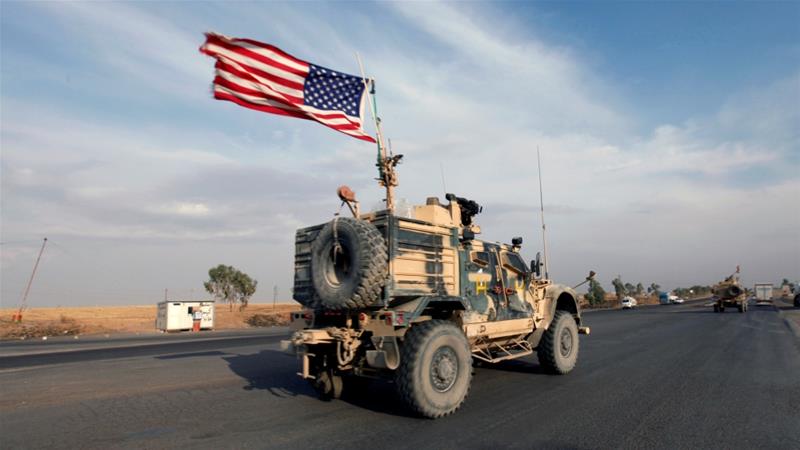
In remarks regarding northern Syria, US President Donald Trump last week said: “Turkey, Syria, and all forms of the Kurds, have been fighting for centuries… Let someone else fight over this long-bloodstained sand.” This was not the first time he has expressed the sentiment that there is something primordial and immutable about conflict in the Middle East.
Nor is he alone is holding that idea. For the more than 20 years that I have studied US policy toward the Middle East, I have heard foreign policy experts, academics and policymakers on both the right and left of the political spectrum express the attitude that the Middle East is a land of ancient conflict, where bloodshed is an inherent part of the region’s culture and conflict is inevitable.
This attitude has clearly shaped Trump’s policy toward the region, but it also played a subtle role in some previous US presidencies. This is unfortunate because there are multiple flaws with the assumption that the Middle East is somehow uniquely doomed to violence.
The idea that the Middle East is historically more prone to conflict than other regions does not hold up under close examination. While the region has experienced a relatively — though not uniquely — high level of war and instability in the post-Second World War era, the assumption often made about the region is that this trend goes back for centuries. A historical viewpoint that considers events prior to the 1950s quickly reveals that Europe, Asia and Africa suffered extremely high levels of warfare and violence. Meanwhile, the Americas endured mass violence through the institution of slavery, as well as wars in North and South America. Even after the 1950s, it is highly debatable whether the Middle East was more violent than many other parts of the world.
A broad historical lens demonstrates that people are very good at hurting and killing other people. There is nothing unique about Arabs, Kurds, Turks, Persians or Muslims in this regard. A look over centuries of human history makes it clear that other races, ethnicities and religions have their own bloody histories.
This reality raises the question about whether racism is at the heart of assumptions about Middle Eastern violence. Indeed, racism and Islamophobia are interwoven through many descriptions of the Middle East as uniquely and hopelessly bloody. At the same time, I have heard this sentiment expressed by people who do not otherwise typically express racist or Islamophobic views. Racism alone seems insufficient to explain these assumptions, though it is one driver of the attitude for many people.
The idea that there is something inherently violent about the Middle East often ignores the role that European powers and the US have played in fueling conflict in the region. The fundamental problem of a lack of sovereignty that underlies the Kurds’ current situation stems directly from the way that European powers drew new state boundaries with the Sykes-Picot Agreement and subsequent treaties after the First World War. The Israeli-Palestinian conflict, while complex, in part reflects the enduring impacts of the Holocaust — a genocide committed by Nazi Germany and its European partners during the Second World War. The US has actively helped to shape political outcomes in the region for years, from the 1953 coup against Mohammed Mossadegh in Iran to the 2003 invasion of Iraq and today’s approach in Syria, with many other examples throughout those decades.
Blaming some vague thing inherent in the culture and makeup of the Middle East is an easy way to pretend that Europe and the US bear no responsibility. It makes it much easier to absolve Western countries of a need to help make the region more peaceful and stable. While Europe and the US certainly do not bear all the blame for the region’s problems, they have played significant roles in contributing to them — something many in the West would like to ignore.
The idea that the Middle East is historically more prone to conflict than other regions does not hold up under close examination.
Kerry Boyd Anderson
A sense of no Western responsibility is related to another form of wishful thinking that drives inaccurate assumptions about the Middle East. Many in the US and Europe want to believe that they can simply disconnect from the Middle East; somehow wall it off (or parts of it) and never again have to face refugee flows, terrorism, war or other unpleasant things associated with the region. A belief that the region is inherently and uniquely violent bolsters a sense that other countries can just abandon it and never deal with the consequences.
The reality, however, is that the Middle East is deeply integrated into the world. It is not an island but a region geographically tied to Europe, Asia and Africa. In the age of globalization, it is an inextricable part of global flows of finance, trade and people. Wishful thinking will not change that.
Americans should debate US policy toward the Middle East, weigh the risks and benefits of engagement in the region, and carefully consider how and when the US should engage. These are complex policy decisions and there are valid questions about them. However, while Americans should debate US policy toward the region, they should not pretend that the US has no responsibilities or interests there.
- Kerry Boyd Anderson is a writer and political risk consultant with more than 14 years’ experience as a professional analyst of international security issues and Middle East political and business risk. Twitter: @KBAresearch


