
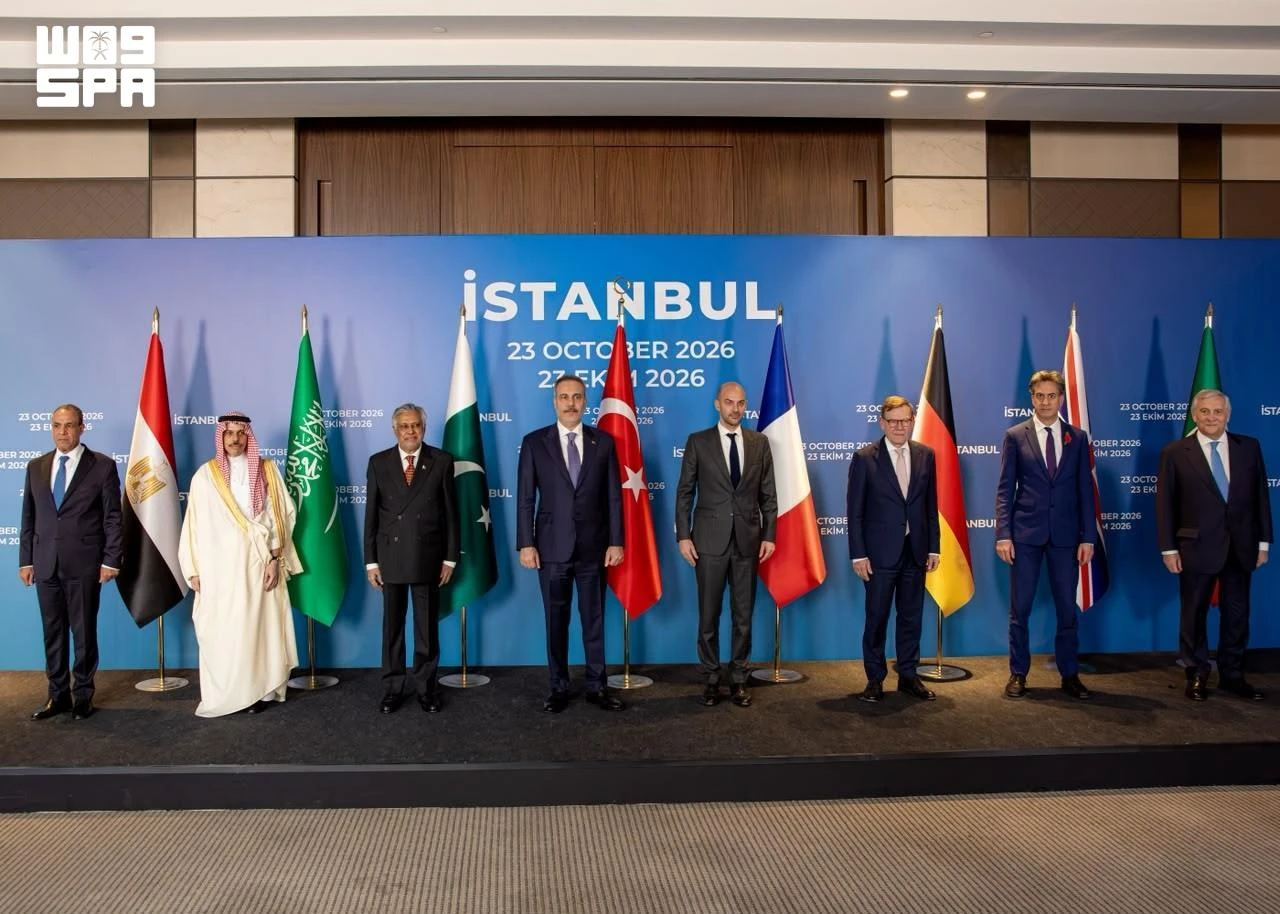

As the Middle East remains on tenterhooks, regional countries at the forefront of the US-Iran crisis are stepping up all possible diplomatic efforts to de-escalate tensions. On Oct. 23, the foreign ministers of the so-called R4 (Turkiye, Saudi Arabia, Pakistan and Egypt) and the E3+1 (the UK, France, Germany and Italy) met in Istanbul.
Initiated by Turkiye, the meeting was the first of its kind to bring together the R4 and E3 countries in this format. It represented an attempt to build a stronger bridge between regional and European powers, bringing them together to address crises that increasingly affect both regions’ security and economy.
Europe has long been criticized in political discussions for being relatively absent from regional affairs. So, the central idea of the meeting was to encourage it to take greater responsibility for resolving security challenges that concern not only regional countries but also Europe. Without European cooperation, particularly as the US becomes the main actor in the escalating tensions, regional coordination will not have a sustainable impact.
The R4 was established in 2026 to strengthen regional coordination amid the escalation of the US-Iran war, while the E3 originated in 2003 through diplomatic cooperation on Iran’s nuclear program. At the Istanbul meeting, Italy also participated, expanding European representation beyond the E3.
The key issues require more than unilateral or bilateral initiatives — they require multilateral cooperation
Dr. Sinem Cengiz
The Turkish deputy foreign minister said at last weekend’s Manama Dialogue that Italy had requested its inclusion from the Turkish side and Ankara had welcomed it. Italy’s inclusion was significant because, among European nations, it seems to be one of the more engaged with Gulf states. Italy also makes a major naval contribution and plays an operational command role in Red Sea maritime security through Operation Aspides and Operation Atalanta, alongside other EU member states.
Although Turkiye is not an EU member state and is therefore not part of these operations, it has a significant naval presence in the Red Sea, which makes coordination with European countries important, even if this does not necessarily translate into cooperation.
While the protection of international shipping routes and maritime security, particularly in the Strait of Hormuz and Bab Al-Mandab, were at the top of the Istanbul meeting’s agenda, other key issues included Palestine and Gaza, Iran and regional escalation, Yemen and Saudi security, Ukraine and the Black Sea, and Syria. These are all interconnected issues rather than isolated ones. Moreover, they require more than unilateral or bilateral initiatives — they require multilateral cooperation. Therefore, the scope of the Istanbul meeting was unsurprisingly broad.
So, why is it important to bring Europeans on board? There are several reasons European participation matters. First, the R4 needs greater international support for its efforts. Although these countries have geographical proximity to the crises and direct security concerns, bringing European countries to the table means that regional initiatives can gain wider international support.
Second, although the war in Ukraine is the foremost concern of European leaders, the continent is directly affected by instability in the Middle East. Its economic interests are closely connected to stability in the region. In particular, energy and maritime security have become genuine concerns that mean Europe cannot remain simply an external observer, especially when both regional and European states are both frustrated with the US approach.
The first meeting of this format surpassed expectations, with participants agreeing to hold regular talks
Dr. Sinem Cengiz
Third, the E3 already has historical experience in negotiations concerning Iran’s nuclear program and European countries have significant operational involvement in the Red Sea. This gives the R4 both European diplomatic and security support.
Fourth, the R4 may also help bridge differences between European states, which have pursued separate policies based on different political calculations. Bringing these within a common diplomatic framework creates an opportunity to coordinate their positions rather than leave room for initiatives that could undermine one another. Of course, this does not mean that everyone will agree but at least they could manage their disagreements while maintaining pressure on the actors driving the escalation, namely the US, Iran and Israel.
Officials announced that the first meeting of this format surpassed expectations, with participants agreeing to hold regular talks. Germany will host the next meeting. Each participant brings significant strengths to the table: Turkiye, with its regional security and Black Sea experience; Egypt, with its proximity to Gaza and the Eastern Mediterranean; Saudi Arabia, with its Gulf influence and economic weight; Pakistan, through its South Asian influence; and European countries, with their diplomatic influence and international security engagement.
For Turkiye, the meeting reinforces its role as a bridge between regional and European powers, connecting regional priorities with European ones. For Europeans, it provides an opportunity to coordinate with heavyweight actors in the Middle East that promote regional ownership, in contrast to US-led initiatives for the region.
From the regional perspective, there is no expectation that Europeans can solve regional issues immediately, while the European countries also know that they cannot effectively influence regional developments without engaging the countries that have direct stakes in them. Yet, despite these realities, there is a desire to move forward without overly ambitious expectations. The Istanbul meeting therefore represents an effort to move from fragmented diplomacy toward a more coordinated Middle Eastern-European diplomacy.
It might be too premature to argue that this will be a transformative format but the desire to continue it creates a foundation for a new partnership. Since this format was triggered by the current crises, it is important to see if this interregional diplomacy can be translated from political dialogue into practical cooperation, even after the war. The real test will be whether the participants can move beyond declarations and establish practical cooperation, particularly on Palestine, Iran, maritime security and regional de-escalation in the long-term.
Dr. Sinem Cengiz is a Turkish political analyst who specializes in Turkiye’s relations with the Middle East.
X: @SinemCngz


