

Healthcare throughout the world is under intolerable strain, mostly as a result of the hangover from the coronavirus pandemic. The worst of COVID-19 may be over, except in China, but the malady lingers on — regardless of what kind of political system its victims live under, or how their healthcare is funded.
In the US, where heaven help you if you do not have private health insurance, thousands of medical staff were laid off during the pandemic and many have not returned, placing unbearable stress on those who remain. Now, it is true that American healthcare has always been a dysfunctional shambles, shamelessly manipulated for profit by powerful vested interests. The US spent $4.3 trillion on healthcare in 2021, or $12,914 per person, more than twice the average of other major countries. But in an analysis of key healthcare outcomes in 11 high-income nations, from maternal deaths to life expectancy, the US came last.
It was bad before, but the pandemic has made it worse. The US will need more than 200,000 new registered nurses every year until 2026 to keep up with a retiring workforce, New York state alone expects a shortage of more than 500,000 nurses by 2025, and nearly a quarter of 5,000 hospitals surveyed by the US Department of Health have what they describe as a “critical staffing shortage.”
At the other end of the political spectrum, thanks to President Xi Jinping’s disastrous “zero COVID” policy, China is only now beginning to endure the nightmare from which the rest of us have just awoken. For three years, Chinese families were locked up in their own homes and the country was shut off from the rest of the world, all in a futile effort to prove that the virus could be beaten.
Having executed a screeching U-turn, China has now unleashed the full horrors of COVID on 1.5 billion people. Hospitals cannot cope with the sick, crematoriums cannot cope with the dead, and the annual migration for Chinese New Year is ensuring that the spread of the virus is going to get a whole lot worse before it gets better.
In the UK, where the taxpayer-funded National Health Service operates in tandem with private health insurance for those who can afford it or whose employer provides it, matters are no better. A combination of coronavirus lockdowns and COVID stresses on NHS hospitals created a healthcare logjam. When the pandemic was at its height, healthcare providers had neither the staff nor the time to offer preventive checks and screening to patients at risk of heart attacks, strokes, and other life-threatening events. That dam has now well and truly burst. New figures show that 50,000 more people than usual died in 2022, the largest non-pandemic excess death level since 1951.
So this tsunami of ill health knows no national boundaries, and in the vanguard of confronting it are — our nurses. Since the Victorian days of Florence Nightingale, these women (and nowadays often men) have provided everything we need as patients, from an encouraging word or a comforting arm around the shoulder, to bandaging our wounds and dispensing essential medication. They are usually the first people we see when we seek healthcare, and the last we see before we go home, well again.
The essential role played by these professionals, and the high esteem in which they are held worldwide, make it all the more inexplicable that British government ministers should choose now to pick a fight with the country’s nurses.
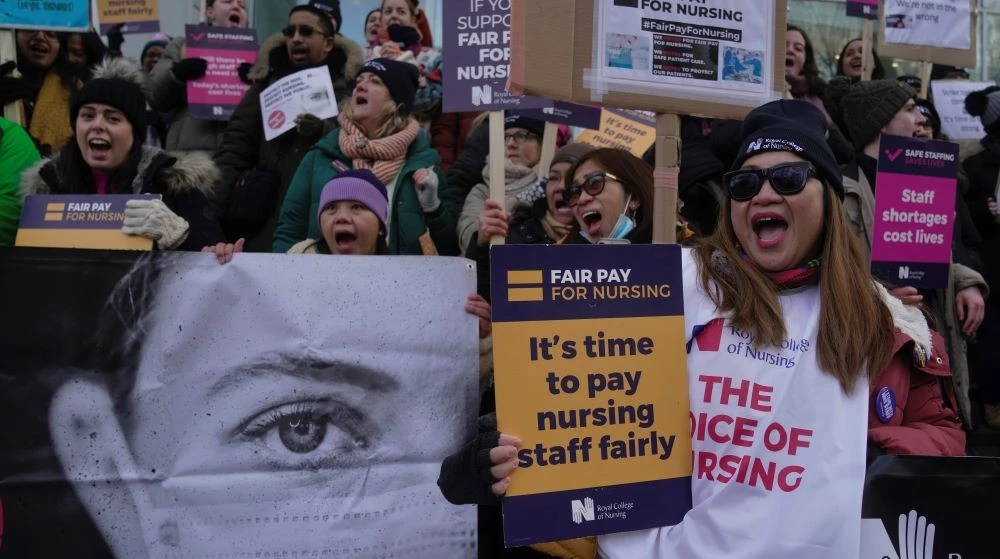
The NHS, with about 1.7 million staff including just over 320,000 nurses, is the largest nonmilitary public organization in the world, and its purse strings are held by the government. The nurses have asked for a pay increase of 5 percent above inflation, which comes to about 19 percent. The government has offered a rise of £1,400 ($1,700) a year, or about 4 percent. At the end of their tether, members of the Royal College of Nursing went on strike in December for the first time in their 106-year history, with further strikes taking place this week and more scheduled for next month.
In making its derisory offer, the government is hiding behind the recommendation of an independent pay review body — ignoring that when the calculation was made inflation was a fraction of what it is now, and that the review body itself has admitted its recommendation is now out of date.
Unlike most of the rash of industrial action currently afflicting the UK, from train drivers to postal workers, polls suggest that the nurses’ strike has the overwhelming support of at least two thirds of the British people. So how can a government be so out of touch? In this case, the answer appears to be longevity.
The current administration in Westminster has been in power, either shared or absolute, since 2010. The best of the ministerial talent has long since come and gone, and key departmental positions are now filled by scraping the bottom of the barrel — in which context, step forward the Right Honourable Steve Barclay, Member of Parliament for North East Cambridgeshire and His Majesty’s Secretary of State for Health and Social Care.
It is inexplicable that British government ministers should choose now to pick a fight with the country’s nurses.
Ross Anderson
Barclay is a product of the British military academy at Sandhurst, but the rigors of logical thought that they teach there appear not to have penetrated. In refusing even to discuss pay with the nurses, Barclay argues that a large increase “would turbocharge inflation when we are endeavoring to keep it under control,” a position devoid of reason. It is true that if, for example, workers in a widget factory were to obtain a 20 percent pay increase, the retail price of widgets would probably rise, thus fueling inflation. But how paying nurses more would increase retail prices, Barclay is unable to explain.
For a genuine example of cause and effect, the minister may wish to consider the following: 1. British nurses’ pay has fallen by 8 percent in real terms since 2010; 2. One in 10 nursing posts in England are unfilled, and there is a national shortage of 40,000 nurses. Er, doh! As our American friends say, do the math.
There are two things everyone knows. The first is that at some point Barclay is going to have to sit down with the nurses and negotiate a satisfactory pay deal. The second is that he and the rest of his government will be turfed out of office at the next general election. Neither of these events can come soon enough.
- Ross Anderson is associate editor of Arab News.


