


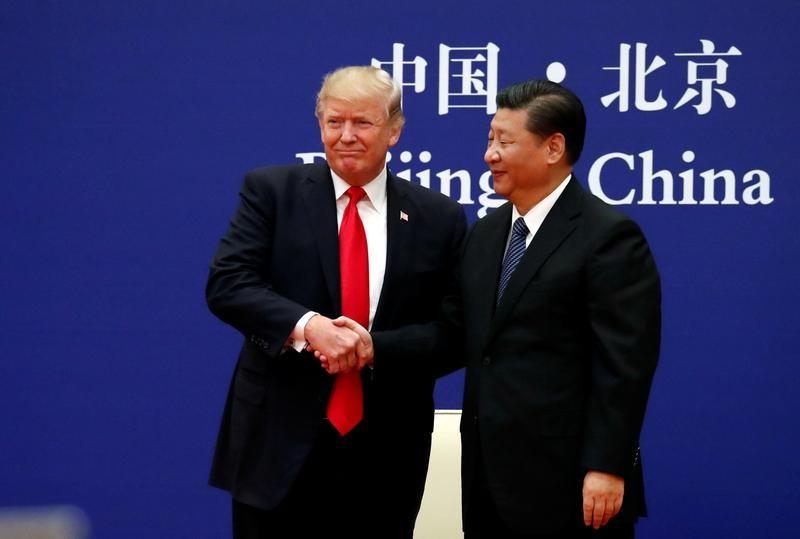
Donald Trump probably made a political calculation after being elected that taking on China would be, in basketball terms, a slam dunk. There has been a constant refrain from US chief executives that trade with the emerging market behemoth is a one-way street – China is exporter to the world and market access for US corporates remains a challenge.
The problem with these macro-economic debates is that there is a bit of truth in every statement. China is fabled for copying the best that western companies invent, not respecting intellectual property rights and for slowly opening its market to competition. The US has been patient because the prize is so grand, with 1.3 billion consumers and a rapidly growing middle class.
With the US representing China’s biggest single market, the President Trump made a campaign pledge to level the playing field with Beijing, by bullying his way toward a fairer deal. The bottom line in business, as we are witnessing today, is that there’s no “win-win” when two economic titans clash over trade.
The Trump fair trade effort with China has lasted for nearly has long as he has been in office. Both sides complain, via twitter in the case of the US president or via press briefings in Beijing, that neither is living up to the spirit of their closed-door negotiations.
Donald Trump said recently that he and his Chinese counterpart Xi Jinping would “meet up soon” to get trade talks back on track. China’s Foreign Affairs spokeswoman Hua Chunying countered by saying, “We hope the US can work in concert with China… to work out a mutually acceptable solution through equal footed dialogue.”
While China needs America, it has leverage by owning about a third of the US Treasury market and sitting on $3 trillion of foreign exchange reserves.
John Defterios
Therein lies the challenge. Trump does not envision giving up anything (at least publicly) to China during these talks. While China needs America, it has leverage by owning about a third of the US Treasury market and sitting on $3 trillion of foreign exchange reserves. The latter is one big cushion in which to play the waiting game and turn the tables to apply pressure on Trump ahead of an election year.
I may be wrong, but the tone that has been coming from Beijing has changed. There is no desperate rush to have a bi-lateral meeting as the US President suggested a few months ago. The two met in Osaka on the sidelines of the G20 Summit, thought they had a mutual understanding in which to proceed, and have not seen eye-to-eye on how to proceed ever since.
In fact, President Trump can be accused of blinking first by delaying some of the tariffs on Chinese goods originally scheduled for early September to mid-December. He claimed he did not want to be the Grinch who stole Christmas by penalizing US consumers with higher costs for electronic goods and toys. Perhaps Trump believed this would be the gesture that brought Xi back to the bargaining table. China, so far, talked only of responding with commensurate tariffs.
That does not sound like a country scarred by the trade war, but it is. In July, China produced the lowest expansion of industrial production in 17 years, at just 4.8 percent. The figure was both a huge leap down from the 6.3 percent figure in June and well below expectations. Retail sales were also sub-par, meaning the Chinese consumer is feeling the pinch of the trade war as well.
The performance was so poor that Mizuho Bank told CNN Business that it should provide “a great incentive to make larger compromises”. Xi has not blinked yet.
The challenge for Donald Trump is whether he and his team are calculating correctly, that US growth can withstand another year of disputes with China and not slip into recession. The US bond market is suggesting otherwise, with long term yields falling below short term yields for the first time since 2007. That reversal has been a harbinger for recession since World War II, but those inside his administration, such as his trade czar Peter Navarro insist it is not a problem. “It’s all good,” Navarro told CNN earlier this month.
Don’t tell that to the International Monetary Fund. It downgraded its forecast for global growth to just 3.2 percent. And don’t mention that to export giant Germany which notched up its worst GDP result in a decade, a contraction of -0.1 percent. Carsten Brzeski of Dutch Bank ING told CNN Business that the report “marks the end of a golden decade for the Germany economy.
Red lights of alarm are flashing and global investors are having sporadic anxiety attacks over a range of issues that has included: protests in Hong Kong, South Korea and Japan fighting over trade ties, a re-emergence of the Brexit dilemma, tensions in the Gulf linked to US sanctions on Iran and an overall concern the 10-year economic expansion is running out of fuel.
For the sake of the global economy, the two titans of commerce may need to park their pride, forego their public outbursts (especially via social media) and seek an agreement, even if it is merely a truce.
- John Defterios is CNN Business Emerging Markets Editor and host of The Global Energy Challenge on CNN International. Twitter: @JDefteriosCNN


