
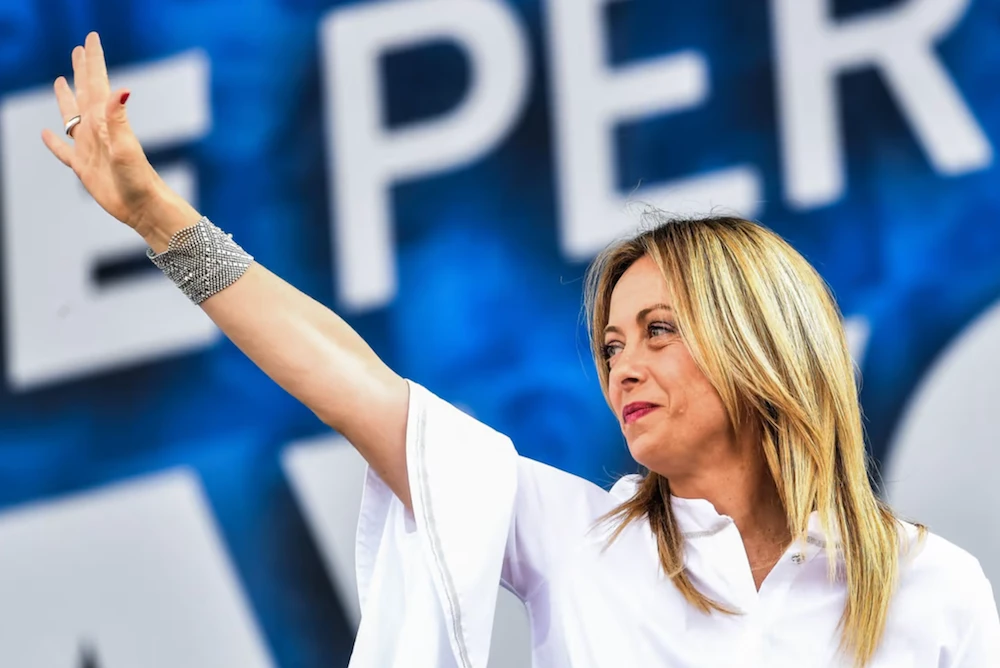

The eyes of much of the globe are already on November’s US midterm elections. Before then, however, there is another national ballot over 5,000 miles away that could also have huge international repercussions.
On Sunday, Sept. 25, Italy goes to the polls, and the result may trigger a political earthquake in Europe that could ripple across the rest of the world, for polls indicate that it is most likely the nation may elect its first far-right prime minister since the war, Giorgia Meloni.
Italy is a pivotal state in the West, not only because of its membership of the G7 and the fact that it has the third largest economy in the eurozone. It has wider systemic importance in Europe, having the biggest debt load in the single currency area with fears that if the nation gets into trouble, it could spark a wider sovereign debt crisis.
With such renewed angst in a country where there have been more than 65 national governments in the post-war era, concerns are growing again about its future. Part of the reason for the growth of populism and far-right politics in Italy is public concern over corruption and continuing fragility of the economy with higher-than-EU-average unemployment and low growth. Indeed, only Greece has fared worse in the eurozone in the last two and a half decades.
Italy has therefore long been a “weak link” in the eurozone, with the biggest debt load in the single currency area. Indeed, Italy’s approximately €2.5 trillion ($2.5 trillion) government debt pile is larger than those of the next four countries combined, and maybe too big for a bailout. Little wonder that investor bets against Italy’s government bond market are at their highest since 2008 in a sign of unease about the economic outlook.
If the far-right secures a super-majority in Italy, far-reaching reform could ensue in the nation that could have implications not just for Europe, but also for the wider West.
Andrew Hammond
There are fears too that if Italy gets into trouble, it could spark contagion and a wider sovereign debt crisis in Europe. Some investors are increasingly questioning whether other eurozone countries can continue to roll over public debts, which have grown significantly during the pandemic and are becoming more expensive to refinance as the European Central Bank raises interest rates.
This dramatic political and economic context for Italy’s big election could see a reshaping of the nation’s policy agenda in multiple areas, including the war in Ukraine and support for the EU. The right-wing government, which polls are predicting might prevail, could result in significantly reduced Italian resolve in the campaign against Russia, an array of new tensions with Brussels and new economic and social flashpoints domestically.
Meloni formed Brothers of Italy in 2012, four years after becoming Italy’s youngest-ever minister in then-Prime Minister Silvio Berlusconi’s final administration. In 2018, the Brothers of Italy won less than 5 percent of the vote in the last general election, though today it is polling around five times that number.
Part of the reason for this rise is that Meloni took the decision to become the only major party leader refusing to go into Mario Draghi’s broad-based coalition. This allowed her to carve out a distinctive political profile.
Meloni’s party has no significant experience in government. If she wins power, that may rely quite strongly on the parties she is planning to go into coalition with. These include Berlusconi’s Forza Italia and The League, which is led by Matteo Salvini.
However, there remains a significant margin for surprise in the result, not least given that about a fifth of eligible voters are still undecided. There is also a lot of uncertainty over the electoral impact of revelations that emerged on Sept. 14 over a US intelligence dossier that reportedly details a $300 million covert international influence campaign by the Kremlin, including potentially in Italy.
The issue is causing concern in Italy, potentially negatively impacting the chances of any of the right-wing and/or populist parties that are perceived to have close ties to Russia, but the exact electoral impact cannot be quantified yet because of the national polling “blackout,” which began on Sept. 10. Before the new Russia revelations emerged, the right-wing bloc appeared to have the wind in its sails, with the possibility it could secure a so-called “super-majority” of two-thirds in both chambers (the lower House or Chamber of Deputies and the Senate). Such a super-majority would be unprecedented in Italy’s modern history and would allow for the type of significant constitutional change that has not been seen before in its post-war history.
Taken together, this is why the political and economic stakes are so high in the upcoming election. If the far-right were to secure a super-majority, far-reaching reform could ensue in the nation that could have implications not just for Europe, but also for the wider West.
- Andrew Hammond is an associate at LSE IDEAS at the London School of Economics.


