


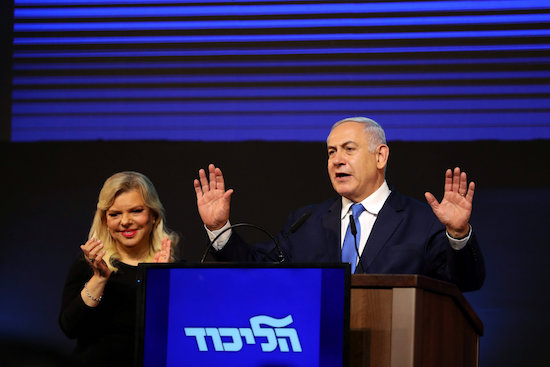
The morning after the night before, there was at least one great cause for relief —that one of the most obnoxious election campaigns in Israel’s history was over. The tone of the campaign was set by the prime minister’s office in its diatribes against those who threatened his chances of forming a government for an unprecedented fifth term. In the final analysis, not much has changed. The way is now clear for Netanyahu to form the most right-wing coalition since the Jewish state was established. However, there is much more to digest from the results.
One of the takeaways is that after many years during which even the big parties were relatively small, now Likud, up from 30, and the newly formed Blue and White alliance, are neck and neck with 35 seats each. For the first time since 1996 the two big players in Israeli politics could form a government without the help of smaller parties. Not that this is likely, or even desirable, but it indicates a shift in voting patterns, and also the impact of raising the threshold for entering the Knesset to 3.25 percent of votes cast.
For Netanyahu the result must have brought mixed feelings of celebration and relief. Once again he managed under the most difficult circumstances — i.e. the attorney general’s long and well-argued indictment against him on charges of bribery, fraud and breach of trust — to consolidate his base and even entice voters from other parties. With a genuine challenge breathing down his neck in the form of the Blue and White Party, led by former military chief of staff Benny Gantz, pulling him to the center, and a number of more nationalist and religious parties pushing him to take an even more hawkish and populist stand, he still managed to navigate skilfully toward another term as prime minister. Between his instinctive understanding of the electorate, his unscrupulous manner of playing on people’s worst fears, his shameless smearing of rivals, and promises that he has not the slightest intention of fulfilling, he gets the result he wants, election after election.
Once again Netanyahu managed under the most difficult circumstances — i.e. the attorney general’s long and well-argued indictment against him on charges of bribery, fraud and breach of trust — to consolidate his base and even entice voters from other parties.
Yossi Mekelberg
Another takeaway is that there are enough voters in Israel, especially among the Jewish population, who are content with the current situation. Not that many are unaware of the shortcomings of Netanyahu himself and his government’s policies. But there are many more who support a two-state solution than those who are prepared to vote for a party that might actually pursue it. Most Israeli voters favor a short-term approach that avoids taking risks associated with compromises required to reach a lasting peace agreement with the Palestinians. Netanyahu’s zone of operation lies between the deep-seated fears of many Jewish Israelis, which he encourages, and the religious-messianism of others for whom Greater Israel takes precedence over peace.
These elections also experienced unparalleled interference by foreign powers, President Trump in particular, though not far behind him came presidents Putin and Bolsonaro of Russia and Brazil, who were mobilised in support of Netanyahu. Washington, in its recognition of Israel’s annexation of the Golan Heights as Netanyahu was visiting the US just before the elections, and in its silence over Netanyahu’s declaration of intent to annex most of the West Bank, displayed acts of partisan and blunt intervention in another country’s democratic processes. Putin’s help with the return of the missing body of an Israeli soldier from Syria, and hosting Netanyahu days before the elections, along with the Brazilian president’s visit to Israel, were expressions of the nationalist-populist kindred spirit of two world leaders in support of a third who would love to be considered among their ranks. This certainly enhanced Netanyahu’s reputation, as he likes to portray himself as a statesman on a much bigger stage than his domestic one. And his base support loves it.
Self-evidently, those who expressed their will so clearly for the current prime minister to continue to govern have little interest in ridding Israel of corruption. Similarly, relations with the Palestinians; advancing social equalities and opportunities; protecting the independence of the judiciary; and making politicians accountable for compromising the interests of the country in order to enhance their standard of living or keep them in power, are secondary issues to many Israelis.
The voters delivered their verdict not only on the government, but also on the traditional opposition and the new contenders. Their conclusion was that they don’t see them as ready for government. The left has been decimated, with the Labor party reduced to six seats. Blue and White gained their support from within the left-leaning bloc, thus doing little to end Likud and Netanyahu’s decades in power. Unless those in opposition reflect how they might truly differentiate themselves from Netanyahu, it is hard to see them coming to power. Instead they should start to speak out in a clear and coherent voice in favour of a historic compromise with the Palestinians, of respect for the human rights of everyone between the Jordan River and the Mediterranean Sea, and of fortifying the struggling Israeli democracy. Otherwise they will always end up second best to Netanyahu or some similar successor. It is for those who have been elected to sit in opposition to hold the government accountable, while preparing themselves for government. After all, there may be another election just around the corner, especially if Netanyahu is finally brought to court to face those corruption charges.
- Yossi Mekelberg is professor of international relations at Regent’s University London, where he is head of the International Relations and Social Sciences Program. He is also an associate fellow of the MENA Program at Chatham House. He is a regular contributor to the international written and electronic media. Twitter: @YMekelberg


