


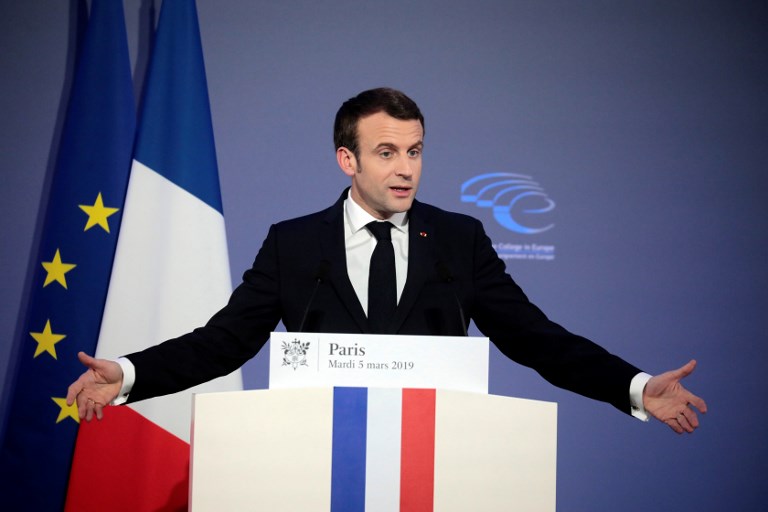
Just as Britain is getting ready to leave the EU at the end of March, Brussels is preparing for elections to its Parliament in May. French President Emmanuel Macron took this opportunity to write an op-ed delineating his vision on Europe in 28 newspapers across the EU — one paper per country. In the UK, he chose the Guardian.
He made an impassioned plea that these elections would be pivotal: “Never has Europe been as essential. Yet never has Europe been in so much danger.” He lists Brexit and populist movements as the key dangers. “The trap lies not in being part of the European Union; the trap is in the lie and the irresponsibility that can destroy it,” he wrote. He went on to question whether Britons understood the economic ramifications of Brexit.
Macron listed three core pillars that are, in his view, essential to the future of the EU. Defending freedom (advocating a pan-European cyber-agency to defend against foreign powers meddling in elections and against hatred and violence on the internet); protecting the continent (which involves revamping Schengen, stronger external border protection with a common border force and closer cooperation on defense in collaboration with NATO); and lastly the spirit of progress (including becoming zero carbon by 2050, halving the use of pesticides by 2025, and the protection of workers).
This vision reflects Macron’s speech in front of I.M. Pei’s Louvre Pyramid when he ascended to the presidency. It is also in line with European Commission President Jean-Claude Juncker’s vision of ever closer integration.
When the newly elected French president shared his vision in 2017, he was riding high. Since then, his popularity has declined and he has faced harsh criticism from the “gilets jaunes” for being out of touch with the economic needs of everyday French people. When Macron swept to power, his La Republique En Marche party had obliterated all the traditional parties, which probably reinforced the yellow vests because they no longer had a meaningful opposition in Parliament to turn to.
German Chancellor Angela Merkel, quite beleaguered at the time, paid lip service to Macron’s vision, but no more than that. Merkel’s days are numbered and it is unclear whether Macron can take the mantle of leadership in the EU from her.
Macron has a point in naming freedom, protection and progress as the three pillars of renewal. The problem is that, in many European countries, populist forces are going strong
Cornelia Meyer
Macron has a point in naming freedom, protection and progress as the three pillars of renewal. The problem is that, in many European countries, populist forces are going strong. That goes well beyond the hard-line Brexiteers in the UK. In his native France it is the Front National, in Holland it is the Freedom Party, in Italy it is Matteo Salvini’s Lega — not to speak of Denmark, Sweden, Poland, the Czech Republic or Austria. All of these movements and their protagonists fear immigration, don’t like Schengen, and generally do not want to see greater European integration.
While Macron is right that the European project has been very successful overall — especially when it comes to creating a unified common market and integrating many countries of the former Eastern Bloc without conflict — many don’t see it that way.
The populists in particular tend to be fiercely nationalistic and may not really appreciate the president of a foreign country giving them advice on how to run their affairs. Macron’s op-ed certainly made the blood of many members of the Conservative Party’s European Research Group (the UK’s “uber-Brexiteers”) run cold. Old enmities die hard: To this day, many British disrespectfully call the French “frogs,” and the French reciprocate by calling the British “perfidious Albions.”
In other words, Macron raised many excellent points. The message was great; alas, the messenger may have been wrong in the eyes of many. It is always tricky when the leader of one nation tries to address the citizens of another over the head of that country’s leaders. As Macron correctly pointed out, a lot is riding on the outcome of May’s European Parliament elections. Let us hope his penmanship did not awaken too many contrarian and populist protagonists and their voters.
• Cornelia Meyer is a business consultant, macro-economist and energy expert. Twitter: @MeyerResources


